A Day in the Life: Understanding Autism Through the Eyes of Autistic Children


A girl I have been thinking about as I begin this piece — which is, as honestly as I can manage it, an attempt to describe what autism feels like from somewhere closer to the inside — composite, the details changed enough that she is, effectively, not one child but several — is eight years old and autistic, and her name in this piece is Maya. She lives in a house with a yard and an older sibling and a dog who, on the whole, she likes more than she likes most people. She has a recurring interest in birds. She is, as she would tell you herself if she felt like it, autistic and not broken — a phrase she picked up from her mother's reading, and a phrase, as it happens, that the autistic adult community has been trying to make audible for thirty years.
About 1 in 31 children in the United States is now identified as autistic by age eight, according to the CDC's April 2025 ADDM Network surveillance. Maya is one of those children, and what I want to do in this article is what most parenting writing about autism does not do: walk through a single ordinary day from somewhere closer to her perspective, and let the formal vocabulary about autism — communication differences, sensory processing, meltdowns, stimming, special interests — emerge from the day rather than be imposed on it.
I want to be careful about a few things before we start. First, this is a composite. Maya is not a real child, and the specific details in any vignette are not lifted from a single family I have worked with. Second, no two autistic children have the same day. Third — and this is the most important one — the most authoritative voices on what autism feels like are autistic adults, not clinicians like me. Where I quote one in this piece, I cite them by name. Where the autism research literature has updated its understanding of something in the last few years, I cite the source. There are no anonymous experts. There were five in the previous version of this article. There are none in this one, on purpose.
A Note on Language and the Voices in This Piece
A short editorial note. I will say autistic child throughout rather than child with autism, because most autistic adults and the self-advocacy literature strongly prefer it; surveys by the Autistic Self Advocacy Network and Autism Women's Network have been clear on this for years. I will avoid high-functioning and low-functioning, which the current neurodiversity-affirming literature treats as misleading on both ends. The voices I cite in this article are real and linked. If you want to read further than this piece, the resource list at the bottom is where I would start.
6:30 a.m. — Waking, and the First Five Minutes
Maya wakes before her alarm, as she usually does. Her room is dim, the curtains are heavy, and the door is open at exactly the angle she likes. The first five minutes of her morning are, by long-standing family agreement, quiet. Her mother has learned — over years, not months — that conversation in this window is felt as input the way light is felt as input, and the same brain that will hold a forty-minute conversation about birds at lunchtime cannot, at 6:33 a.m., process good morning, did you sleep well.
Most autism parenting writing describes routines as something autistic children need. It is more honest to describe them as something autistic children deploy — small structural decisions, made by them and for them in collaboration with the adults around them, that lower the cost of every later moment in the day. Maya's quiet first five minutes are not a concession. They are infrastructure. The day works better because they exist.
7:45 a.m. — Communication, in More Than One Channel
Maya is verbal — most autistic children are. About 30 per cent of autistic individuals are nonverbal or minimally verbal at any given point, per the AAC research literature, and many more move in and out of speech depending on stress, fatigue, or sensory load. Maya's morning includes an old script from a favourite cartoon, repeated three times, while she is putting on her shoes. Her father has learned, over time, that this is not a sign that she is not listening. It is, in the formal language of the field, gestalt language processing (GLP) — language acquired in chunks rather than word by word, and the Natural Language Acquisition (NLA) protocol formalised by ASHA in 2024 maps it through stages: full echolalic chunks, then mitigated phrases ("we're going to the birds place"), then single self-generated words, then original sentences. Maya is somewhere between the second and third stage. The cartoon script is doing real communicative work — it is, roughly, I am ready and also a little nervous about the day, and saying this thing makes me feel grounded.
Two important reframes the recent literature has put on autistic communication that I want to name in plain language.
The double empathy problem. Coined by the autistic researcher Damian Milton in 2012 and validated by Crompton and colleagues in 2020, this is the proposal that social difficulty between autistic and non-autistic people is bidirectional. Both groups struggle to read each other. Autistic-to-autistic information transfer is, on the data, statistically as effective as neurotypical-to-neurotypical; mixed-neurotype communication is where the breakdown happens. The implication is uncomfortable for people who have spent decades being told their child needs social-skills training in isolation. The honest version is that both sides need to do some learning, and the responsibility to bridge belongs to both.
AAC is not a last resort. Augmentative and alternative communication — picture exchange, sign, AAC apps like Proloquo2Go, TouchChat, LAMP — is appropriate for any child who cannot reliably communicate in speech, including those who have some words. The 2024 Frontiers in Psychiatry literature is clear: AAC use does not delay or replace speech development; in many cases it supports it. Despite this, a 2024 multi-stakeholder study found that 88 per cent of parent-carers, 80 per cent of educators, and 100 per cent of clinicians report negative attitudes toward AAC as a barrier to its use. If you have been told to wait, the evidence does not support the wait.
A small caution from the consulting room. The most common parental anxiety I hear about autistic communication is what if speech doesn't come. The honest answer is that for some children it will not, fully, and that this is genuinely fine — autistic adults who communicate primarily by AAC live full, expressive, relationship-rich lives. Communication is the goal. Speech is one of several roads to it.
10:00 a.m. — The Cafeteria, and What Sensory Overload Actually Looks Like
Maya's school cafeteria at midmorning — that is, snack time, before the louder lunch crowd — is loud, brightly lit, and smells of cleaning fluid and yesterday's chicken. For Maya, the cafeteria is a place where four senses are simultaneously turned up too loud and one (interoception, the awareness of internal body signals like hunger or needing the toilet) is turned almost entirely down.
Most parent-facing autism writing treats sensory processing as a single thing called hypersensitivity. The reality is more layered. Autistic individuals can be hypersensitive and hyposensitive across the eight sensory systems — visual, auditory, tactile, olfactory, gustatory, proprioceptive (body-in-space), vestibular (balance), and interoceptive (internal body). Maya's interoception is hyposensitive: she does not reliably notice she is hungry until she is light-headed, and she does not notice she needs the bathroom until it is suddenly urgent. Her tactile sense is the opposite — the seam in a sock, the tag in a shirt, are events.
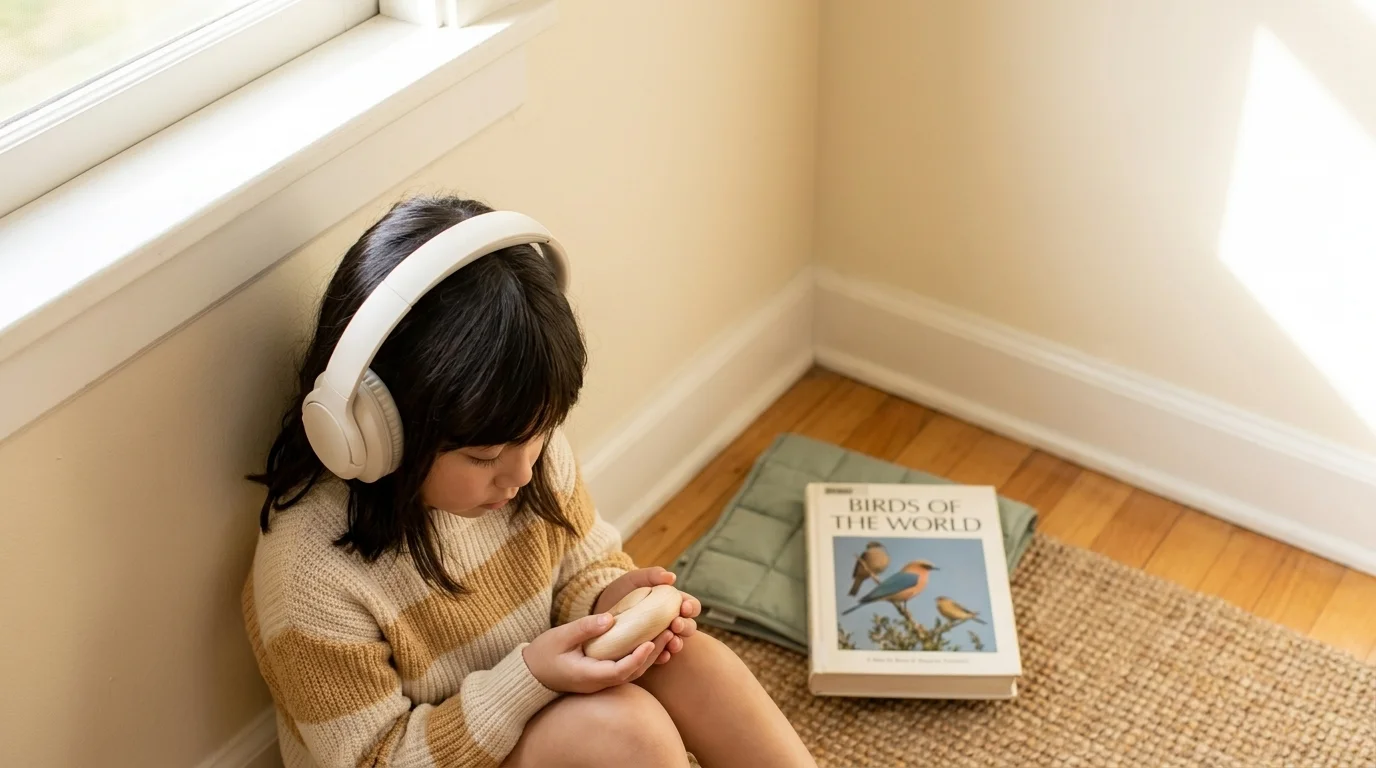
What does sensory overload actually look like, in the moments before a meltdown? Less dramatic than the writing tends to suggest. Maya goes quieter, not louder. Her movements get smaller. Her language reverts to scripts. She might rub the side of her thumb against her index finger over and over, or hum on a single repeated note. Her teacher has learned to read these signs. The teacher's response is the right one — less input, not more. Quieter voice, dimmer corner of the room, fewer questions, the option of headphones, the option of leaving. The cost of refusing this de-escalation is almost always higher than the cost of granting it.
12:00 p.m. — Hyperfocus, and Special Interests as Strengths, Not Symptoms
At lunchtime, alone with her sandwich and a library book about the migration patterns of European starlings, Maya is, for the first time since waking, fully easy in her body. She reads for forty minutes without looking up. She knows, by name, the specific town in Scotland where the largest known starling murmurations have been recorded. She would, if asked, give you a detailed and accurate explanation of the four leading theories about why starlings move in such tight, coordinated formations, and she would do so in a way that is structurally indistinguishable from how a graduate student talks about their PhD topic. She is eight.
The clinical literature used to call this perseverative behaviour and frame it as something to be redirected. The current neurodiversity-affirming literature — and, more importantly, the autistic adults who lived this experience — calls it something nearer to engagement infrastructure. Special interests are not a distraction from learning. They are, very often, the fastest available route into it. Temple Grandin, the most widely cited autistic self-advocate of the last forty years, built her entire career as an animal-science professor and welfare designer out of a special interest in animal behaviour she had as a child.
The practical implication for parents and teachers is simple and, in my clinical experience, often resisted. Wherever possible, let the special interest do the work. Maths problems involving the topic. Writing prompts involving the topic. Reading material chosen for genuine resonance. The autistic child whose narrow interest is honoured tends to broaden — not narrow — over time, because the broad world has been allowed to enter via a door the child actually walked through.
2:00 p.m. — Transition, and Why It Matters More Than You'd Think
The bell rings, and the class is told to put away the books and line up for music. Maya freezes. Music is not a thing she dislikes; it is a thing she was not prepared for. The visual schedule on her desk says reading, and her brain had already organised the next forty minutes around reading.
Unexpected transitions are, on the autism literature's consensus, the costliest moments of the autistic day. They are not interesting on their own; they are interesting because of what they reveal about how an autistic child holds a day together. Maya is not being inflexible. She is being asked to dismantle and rebuild, in three seconds, the cognitive scaffolding she had spent the last hour constructing. The remedy is not, on the whole, to ask her to be more flexible. It is for the room to provide more runway — a five-minute warning, a visual countdown, a change card slipped onto the visual schedule, a brief object-of-reference (the music folder appearing before the music conversation).
A small caution. The autistic child who transitions badly is not a behavioural problem; they are a system that has been asked to do something the literature explicitly identifies as expensive. The expense is real, and it has to be paid somewhere. Predictable transitions pay it cheaply, in advance. Unpredictable transitions pay it later, in regulation collapse.
3:30 p.m. — A Meltdown, and the Difference Between a Meltdown and a Tantrum
After a difficult afternoon — the unexpected music switch, a confusing instruction, a fluorescent light flickering visibly above her desk — Maya gets in the car at school pickup and, within four minutes, is in a full meltdown. She is crying. She is hitting the back of the seat. She cannot, in the moment, tell her mother what is wrong. Her mother has learned to do less, not more.
Let me say what I mean by meltdown, because this is one of the more consequential vocabulary items for parents and the formal distinction is rarely made well in lay writing. The 2024 scoping review by Emerald makes the distinction the autism literature has been converging on:
- A tantrum is goal-directed. The child wants something; the behaviour escalates to get it; it usually stops when the goal is met or the audience leaves. Some control is retained. Discipline-style responses sometimes help.
- An autistic meltdown is involuntary. It is a neurological response to overwhelming sensory, emotional, or cognitive input. The child has lost the capacity to modulate their own response and continues even when alone. Discipline does not help — the child is not making a strategic choice. The work in the moment is to lower input, not to manage behaviour.
- A shutdown is the internalised parallel. Same overload mechanism, different presentation. The child goes still and unresponsive, sometimes appearing to have "frozen". Easier to miss; just as serious.
What helps Maya in the back of the car is what helps most autistic children mid-meltdown: quieter voice, dimmer car interior, one hand on her foot in steady pressure, no questions, no instructions, no eye contact unless invited. Her mother says, every time, the same five words: I am here. Take time. The reflective conversation comes later, sometimes the next day, when Maya is back inside her window of tolerance. Trying to discipline a meltdown is, in a phrase a colleague of mine uses, like trying to reason with a sneeze.
5:00 p.m. — Recovery, and Stimming as Communication
By five, Maya is calmer. She is in her room, lying on the floor with her dog. She is humming a song from her favourite show on a single repeated note, and she is rocking gently from side to side. Her father, who used to ask her to stop both, no longer does either.
Stimming — self-stimulatory behaviour, including hand-flapping, rocking, vocalising, finger-tapping, spinning — has been, until very recently, framed almost exclusively as self-regulation. The 2025 SAGE study by Morris and colleagues reframes it more broadly: most of the autistic participants in their research described stimming as having a social communication function within the autistic community as well — a way of being recognisable to other autistic people, a way of marking emotional state, a way of building shared rapport. The 2025 University of Rochester neuroscience research suggests stimming may stem from differences in action-prediction circuitry; it is, in other words, physiological in origin, not behavioural in origin.
A small caution from the consulting room. The reflexive parental impulse to suppress stimming — quiet hands, no rocking, look at me when I'm talking to you — has been linked in adolescent and adult autistic accounts to higher anxiety, masking exhaustion, and burnout. Suppress a stim only when it is actively self-injurious (head-banging, biting), and even then redirect to a safer alternative that meets the same need (a chew necklace, a heavy-pressure activity, a fidget tool), rather than removing the underlying regulatory function. Stimming is not pathology. It is, in the strongest sense, a child speaking the language they actually have.
7:00 p.m. — Evening, and the Quieter Architecture of a Family
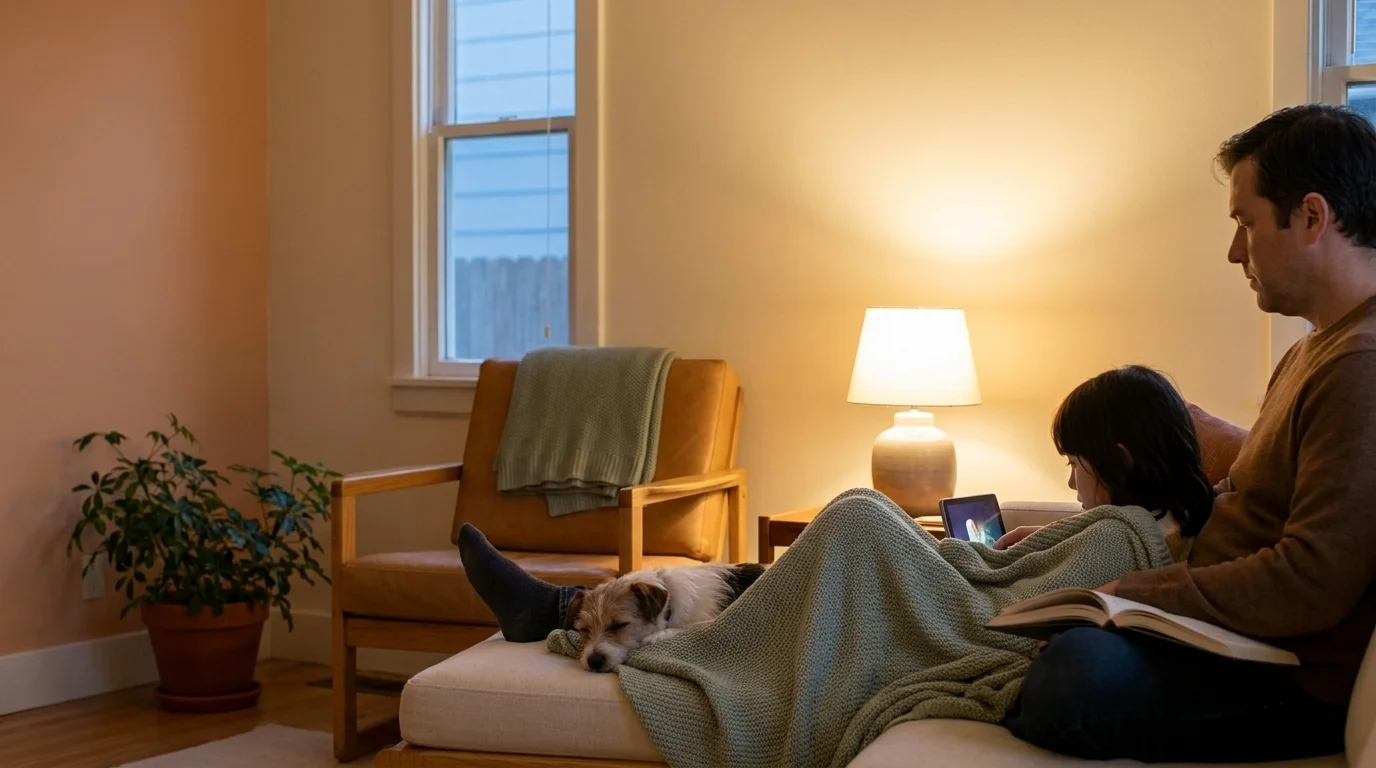
By seven, the house is quiet. Maya is in pyjamas, on the sofa, watching an old episode of a show she has watched perhaps eighty times before. Her father is reading next to her. Her mother is in the kitchen. The dog is on Maya's feet. Nobody, in this fifteen-minute window, is doing anything in particular. The day has not been miraculous. The day has, on balance, gone well.
Most parenting articles about autism end on a triumphant note about thriving and unlocking potential. I want to end this one closer to where the day actually ends. The work of being an autistic eight-year-old in a non-autistic-majority world is expensive. The work of being her parent is also expensive. The point is not that any single day is glorious; the point is that the family has, collectively, learned to build a day that costs Maya less than yesterday's day cost her, and that this is the work that, over years, accrues into a life she can recognisably live.
Listening to Autistic Adults
The single most consequential decision a parent of an autistic child can make, in my clinical experience, is to start reading what autistic adults have written about their own childhoods. Not as the only source — the clinical and developmental literature is real and useful — but as the primary source on what the inside of an autistic life actually feels like. The clinicians describe; the autistic adults know.
A few starting places worth your time:
- Autistic Self Advocacy Network (ASAN) — the autistic-led civil rights organisation in the United States. Their Start Here guide for newly diagnosed families is unusually honest.
- Reframing Autism — an Australian neurodiversity-affirming resource, autistic-led, written for parents and professionals in plain, warm prose.
- Temple Grandin — the most widely-known autistic self-advocate of the last several decades. Her writing on visual thinking and animal behaviour is foundational and accessible.
- Eric Garcia, We're Not Broken (2021) — a journalist's first-person and reportage account of contemporary autistic adult life.
- Sara Luterman — disability journalist whose work in The 19th and elsewhere on autism, policy, and care is unusually sharp.
You do not have to agree with every position of every autistic-led source. You do, I think, have to listen.
A Closing Note
What autism feels like, for Maya, is not a single thing. It is the quiet first five minutes of the morning that lets the rest of the day work. It is the cartoon script that is doing real communication. It is the cafeteria that costs more than people realise, the lunch hour that is the only fully easy hour of the day, the unexpected transition that breaks the afternoon, the meltdown that is not a behaviour to discipline, the gentle rocking that is regulation and also conversation, the ordinary quiet evening that the family has slowly, deliberately, built.
It is also, importantly, Maya being Maya — autistic and not broken, recognisable to the people who love her, and entitled to grow up understood by the world she will eventually have to make her way in. The work of this article, and the work of every honest article about autism in children, is to make a little more of that world than there was before. The room has two chairs in it. Pull one up. Listen.
Frequently Asked Questions
Autism is a different way of experiencing the world, not a deficit. Many autistic children describe their senses as 'turned up louder' on some channels and 'turned down' on others — fluorescent lights flicker visibly, fabric tags feel painful, conversations in a busy room blur into one wall of sound, while interoception (awareness of hunger, thirst, fatigue) can be unusually quiet. Communication can feel like translating in real time. Special interests bring intense joy and focus that's harder to find in non-preferred topics. Temple Grandin and other autistic self-advocates describe autism as 'a different operating system, not a broken one.'
A tantrum is goal-directed — the child wants something, the behaviour escalates to get it, and it usually stops when the goal is met or the audience leaves. An autistic meltdown is involuntary — a neurological response to overwhelming sensory, emotional, or cognitive input. The child has lost the capacity to modulate their own response and continues even when alone. Discipline does not help mid-meltdown; the child is not making a strategic choice. The work in the moment is to lower input, not manage behaviour. A shutdown is the internalised parallel — same overload, but the child goes still and unresponsive instead of crying or thrashing.
Stimming (self-stimulatory behaviour — flapping, rocking, spinning, vocalising, tapping) serves three documented functions: emotional regulation, sensory input management, and — per a 2025 SAGE study by Morris and colleagues — social communication within the autistic community. Don't stop stimming unless it is actively self-injurious; suppressing stims has been linked to higher anxiety, masking exhaustion, and burnout in autistic adolescents and adults. If a stim is unsafe (head-banging, biting), redirect to a safer alternative that meets the same need (a chew necklace, a fidget, a heavy-pressure activity).
Gestalt Language Processing (GLP) is how many autistic children acquire language — in chunks ('gestalts' or scripts) rather than word by word. A child who quotes movie lines, repeats phrases, or uses echolalia is often doing meaningful communication, not 'just repeating'. The Natural Language Acquisition (NLA) protocol, formalised by ASHA in 2024, maps GLP through stages: full echolalia → mitigated phrases → single self-generated words → original sentences. Treat scripts as communication, not behaviour to extinguish — they are the foundation that original language is built from.
No. About 30% of autistic individuals are nonverbal or minimally verbal at any given point; the majority are verbal, though many have differences in pragmatic language (turn-taking, sarcasm, idioms). 'Nonspeaking' does not mean 'without language' — many nonspeaking autistic people communicate fluently via AAC apps, typing, sign, picture exchange, or written language. Verbal status can also fluctuate during stress or after meltdowns ('intermittent speech loss' is common and is not regression).
AAC (Augmentative and Alternative Communication — apps like Proloquo2Go, TouchChat, and LAMP, plus low-tech tools like PECS and picture boards) is appropriate for any child who cannot reliably communicate in speech, even if they have some words. Research consistently shows AAC does NOT delay speech development and may actually increase it — yet a 2024 multi-stakeholder study found 88% of parent-carers and 80% of educators report negative attitudes toward AAC as a barrier. If your child is minimally verbal, intermittently verbal, or shows communication frustration, talk to a speech-language pathologist about early AAC introduction. The 2024-2025 research consensus is 'earlier is better; AAC is not a last resort.'
The double empathy problem (proposed by autistic researcher Damian Milton in 2012, validated by Crompton and colleagues in 2020) reframes autistic social difficulty: it is not that autistic people lack social skills, it is that communication is bidirectional, and autistic-to-autistic communication is statistically as effective as neurotypical-to-neurotypical. Mixed-neurotype communication is where breakdown happens — and the responsibility to bridge belongs to both parties, not just to the autistic one. This is the 2025-era replacement for 'autistic kids need social skills training' framing.