Autism and Education: Enhancing Learning for Autistic Children


A teacher I correspond with in Edinburgh wrote to me last spring, near the end of a long term, about autism in the classroom — or, more precisely, about two autistic students in her class of twenty-eight, both with very different profiles and very different supports, and the point she had reached in the year where the question she was asking was no longer "how do I help them?" but the older, harder one underneath it: what do I actually owe them, and on what basis do I owe it?
That is the question I want to begin with, because almost every honest conversation about autism in the classroom eventually arrives there. The strategies and frameworks and accommodation lists are real and useful. They are not, however, the foundation. The foundation is a moral claim — that an autistic child has the same standing in the room as any other child, that the room itself can be wrong about what counts as participation, and that adapting the environment is, on the whole, a more defensible response than asking the child to mask their way into a setting that was not built for them. Most of what follows in this article is a working out of what that claim actually requires.
Some readers will already accept the claim. Some will want to push back. Both responses are reasonable, and I will try, in this piece, not to mistake confidence for argument.
What's Current in 2026
- Prevalence: roughly 1 in 31 children at age eight in the United States has been identified as autistic, per the CDC's April 2025 ADDM Network surveillance. Up from 1 in 36 in 2020 and 1 in 150 when CDC first tracked the figure. Boys are identified at roughly 3.4 times the rate of girls (49.2 versus 14.3 per 1,000), and for the first time in the surveillance series, prevalence among Asian/Pacific Islander, American Indian/Alaska Native, Black, and Hispanic children exceeds prevalence among White children — a finding consistent with improved identification rather than rising incidence.
- Federal mandate: under IDEA '04 and ESSA, schools are required to use evidence-based practices for autistic learners. The U.S. National Professional Development Center on ASD currently lists 27 such practices as the reference standard.
- Practice frame shift: the 2025 SAGE scoping review operationalised neurodiversity-affirming practice into specific educator actions — integrate the child's interests, value autistic communication, eliminate goals tied to "masking" — marking a clear move away from compliance-focused intervention.
A Note on Language
Let me say what I mean by a few terms before they start doing work in the rest of the article.
I will say autistic student rather than student with autism, because most autistic adults and most self-advocacy organisations prefer it, and because the field's clinical language has been moving in that direction. I will avoid high-functioning and low-functioning, which current neurodiversity-affirming guidance treats as misleading on both ends; I will refer instead to support needs. None of this is decorative. Language shapes what teachers and parents are looking at, and looking at the wrong thing is a much commoner pedagogical failure than not looking hard enough.
What "Inclusion" Actually Obligates
The phrase inclusive education is doing a great deal of work in current policy, and a good deal of that work is sloppy. The strongest version of the argument for inclusion runs like this: an autistic child placed in a general-education classroom, with appropriate supports, has access not just to academic content but to the full social texture of childhood — friendships formed in passing, the daily negotiation of belonging, the experience of being known. That is a serious good and not a small one.
The strongest version of the objection runs like this: a classroom that cannot meet a child's needs is not an inclusive setting; it is a thinly disguised place of failure, and the right response to a child who is drowning in a class of thirty is not to insist on the principle of inclusion but to find them somewhere they can swim. I take this seriously. I have taken it seriously for years.
What I think the honest answer requires is that we hold both at once. Inclusion is a moral default, not a moral certainty. The default places the burden of proof on those who would remove a child from the general setting; it does not pretend that every general setting is, as currently constituted, fit for purpose. The work of the next dozen sections is the work that makes the default actually defensible.
Twelve Strategies That Earn Their Place
What follows is not an exhaustive list. It is a working set of evidence-based practices drawn from the 27 EBPs identified by the National Professional Development Center on ASD and the broader autism-in-the-classroom strategies literature, chosen because they recur across studies and because most teachers can begin using them on a Monday morning without specialist credentials.
I have written these for both audiences. Teachers will recognise the language of practice. Parents will recognise what to listen for in an IEP meeting and what to ask for at a parent-teacher conference.
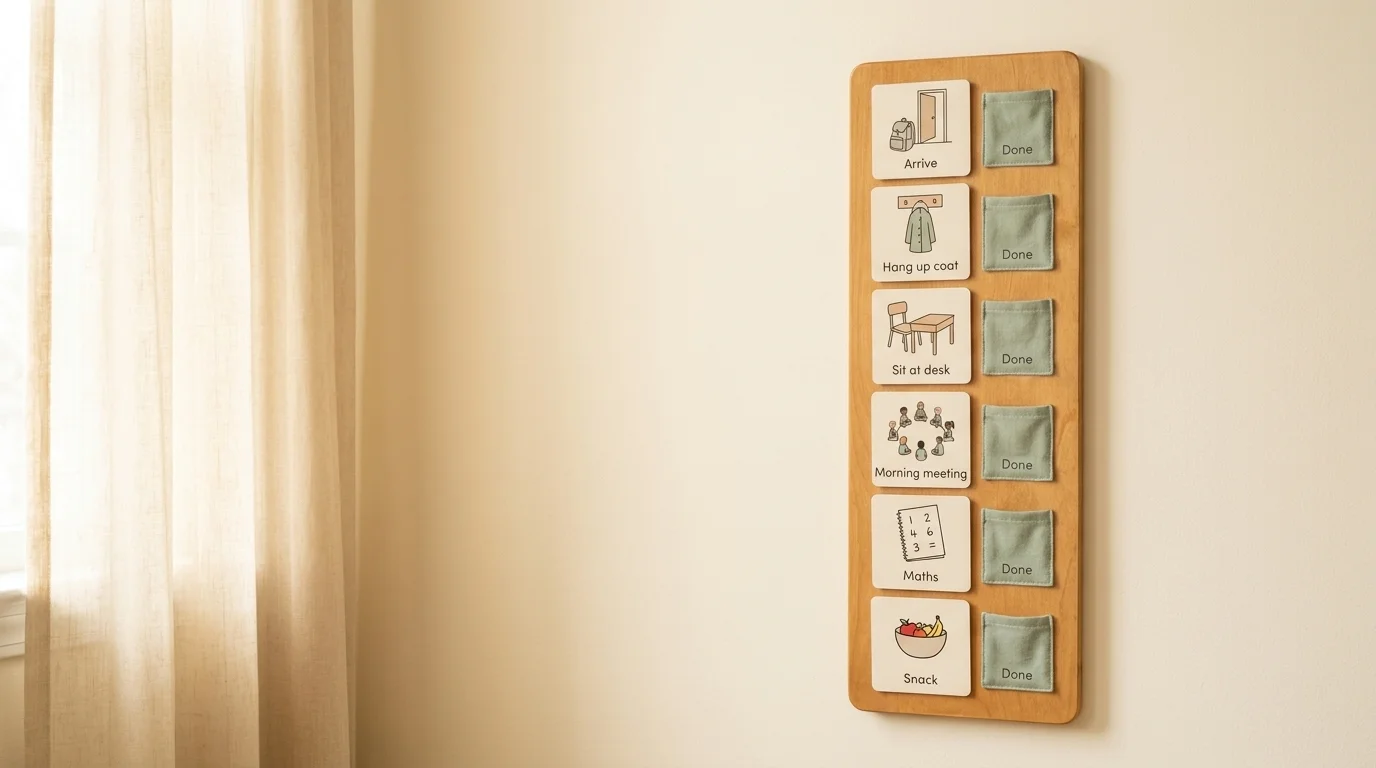
1. Visual structure first. A visual schedule (see the dedicated section below) is the single most-evidence-supported intervention a general-education teacher can introduce. It does the work that sustained verbal prompting otherwise demands, and it gives the child legible agency over the day. For parents: if your child has no visual schedule at school, this is the first thing to ask for.
2. Predictable transitions. Five-minute warnings, visual countdowns, and a brief object-of-reference (the gym shoe appears before the gym conversation) reduce the costliest moments of the day. The autism literature is fairly consistent that unexpected transitions are where the day breaks.
3. Concrete, single-clause language. "Open your book to page forty-two." Not "Could you do me a favour and find page forty-two for me?" Idioms, sarcasm, and conditional politeness add cognitive load without adding meaning, and many autistic children process them literally and slowly.
4. Pre-teaching of new content and routines. Twenty minutes the day before a fire drill, a substitute teacher, or a unit on a new topic produces a measurably calmer child than twenty minutes of de-escalation after the fact. This is cheaper, kinder, and almost always available.
5. Sensory accommodations as routine, not exception. Noise-cancelling headphones, fidget objects, weighted lap pads, sunglasses indoors when fluorescent lighting is bad. Available without permission, treated as ordinary classroom equipment, never moralised. (More in the sensory-friendly classroom section below.)
6. Structured teaching (TEACCH). The TEACCH framework, developed at the University of North Carolina, organises the physical environment, daily schedule, and individual work systems so that what is expected at any given moment is visually clear. A TEACCH-aware general classroom is not a TEACCH classroom; it is a classroom that has borrowed the model's clarity about what counts as a finished task.
7. Social stories. Short, personalised narratives, originally formalised by Carol Gray, that walk through a social situation step by step from the child's perspective. They are most useful for new or unpredictable contexts (a school assembly, a dentist visit, the first day of a substitute teacher), less useful as a daily compliance tool.
8. Augmentative and alternative communication (AAC). AAC includes picture-exchange systems (PECS), speech-generating devices, and apps such as Proloquo2Go, TouchChat, and LAMP. AAC is not a last resort and not a sign of failure; it is, for many minimally-speaking and non-speaking autistic students, the channel through which they actually communicate. The AAC literature is consistent that introducing AAC does not delay or replace speech development; in many cases it supports it.
9. Peer-mediated instruction. Structured peer-buddy systems, when introduced thoughtfully and without making the autistic student a project, produce stronger social outcomes than adult-led social-skills lessons in isolation. The autistic student should not be permanently the recipient of help; reciprocity is the point.
10. Sensory breaks built into the schedule. Not as rewards, not as consequences. Built in — five to ten minutes at predictable points in the day, accessible without negotiation. The cost of refusing them is almost always higher than the cost of granting them.
11. Token economies, used cautiously. Some autistic students enjoy a gamified token system and benefit from it. Many do not. A token economy that asks the child to suppress how they actually are — to mask, to hide stimming, to perform an indistinguishable-from-neurotypical version of themselves — is doing harm even when it appears to be working. The 2025 SAGE review is unusually direct on this point.
12. Strengths and interests as the curriculum, not its decoration. An autistic student with a deep interest in trains will, given the chance, write a stronger paragraph about a train than about anything else. The interest is not a distraction from the curriculum; it is the fastest available route into it.
Visual Supports for Autistic Students
If I had to name the single intervention that returns the most for the least effort across general-education classrooms, it would be visual support. The evidence is unusually clean. Visual schedules are listed by the National Clearinghouse on Autism Evidence and Practice as one of 28 evidence-based practices, and the 2025 SAGE review of visual schedules confirms their use across age groups, support needs, and settings.
The category is broader than most teachers realise. A short working catalogue of visual supports for autistic students:
- Visual schedules — a sequence of pictures, icons, or words showing the order of activities for a class period, a day, or a week. Pinned at child eye-level. The child marks each step done.
- First-then boards — a two-cell visual showing what comes now and what comes next ("first maths, then snack"). Best for younger children and for moments when a less-preferred task precedes a preferred one.
- Choice boards — a small set of options the child can select between (which book, which activity centre, which sensory tool). Choice boards build agency and reduce conflict over decisions that the adult does not actually need to make.
- Social stories — short personalised narratives, as above, used as a visual support for social or unfamiliar situations.
- Video modelling — short videos of the desired behaviour or routine performed correctly. Useful for self-care routines, classroom expectations, and social scripts.
- Picture exchange systems (PECS) — a structured method by which a non-speaking child requests something by handing over a picture card. Often the bridge into AAC.
- Priming cards and transition cues — a brief image or object shown a few minutes before a change ("PE in five minutes" with a picture of the gym).
- Token boards — a visual version of a reward system; used carefully (see strategy 11 above).
- AAC apps — Proloquo2Go, TouchChat, LAMP, and others that turn an iPad into a communication device. These are visual supports in the deepest sense: they make communication itself visible.
A small caution: the temptation, once a teacher discovers visual supports, is to plaster the room with them. The schedule the child cannot read or change is not a support; it is wallpaper. Fewer, well-chosen, frequently-updated visuals do more than a wall of pristine ones.
A Sensory-Friendly Classroom
Between 69 and 93 per cent of autistic individuals report sensory hypersensitivity in classroom and daily settings, according to the clinical research literature aggregated by Autism Speaks' classroom toolkit. That is not a footnote. In a typical class of twenty-five with one autistic student, it means the most likely reason a behaviour plan has stopped working is not that the plan is wrong but that the room is loud, bright, or unpredictable in a way no one has thought to measure.
A few load-bearing design choices, almost all of them inexpensive:
- Lighting. Where you can, replace overhead fluorescent panels with diffused, warm light or supplement with floor lamps. Where you cannot, allow sunglasses or visors indoors without comment.
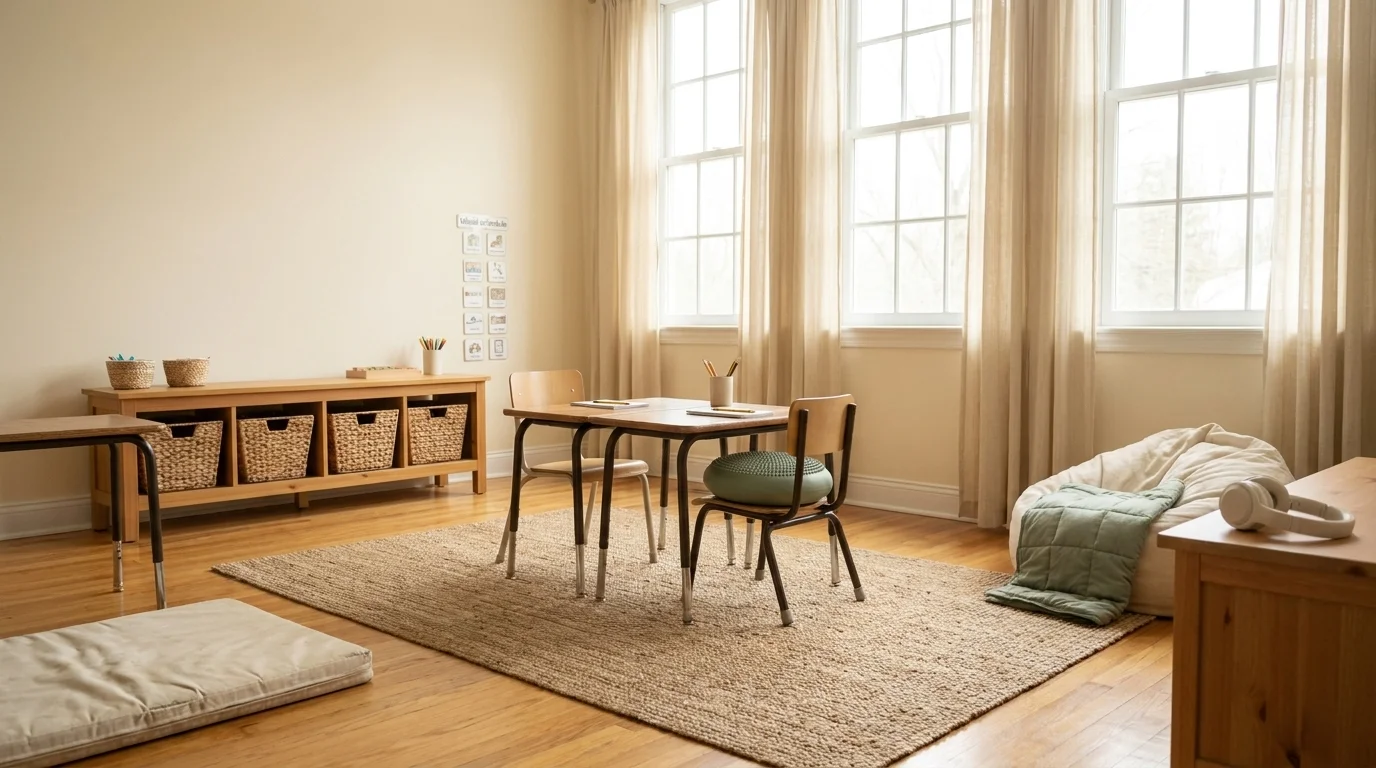
- Sound. Soft furnishings absorb sound; rugs, fabric panels on walls, and felt under chair legs all reduce ambient noise dramatically. Have noise-cancelling headphones available without negotiation.
- Seating zones. A class can quietly accommodate a standing desk, a wobble cushion, a fidget chair, and a low beanbag without making any single child the spectacle. The point is choice, not assignment.
- A calm-down corner. Soft floor, low light, a few sensory tools, no academic demands. Not a punishment space; not a reward space; a regulation space.
- Visual layout. Predictable visual layout — a known place for backpacks, coats, finished work, the schedule — reduces the cognitive cost of every transition.
- A daily walkthrough of the schedule. Two minutes at the start of each day, in front of the visual schedule, naming what is coming. This is the cheapest single intervention available.
The framework I find most useful here, and which the broader 2025 inclusive-education literature is converging on, is the Autistic SPACE framework — five domains to design around: Sensory, Predictability, Acceptance, Communication, Empathy. It is not a checklist; it is a way of asking, before any lesson is planned, whether the room itself is one a child can show up to.
IEP vs. 504 for Autistic Students
The acronyms here matter, and the distinction is often muddled in parent forums in ways that cost families real services.
An IEP (Individualised Education Programme) is a federal special-education service plan under the Individuals with Disabilities Education Act (IDEA). It provides specially designed instruction, measurable annual goals, and related services such as speech therapy, occupational therapy, and behavioural support. It is the heavier instrument and the appropriate one for most autistic students who require direct service hours, modified curriculum, or the support of a paraprofessional.
A 504 plan (named for Section 504 of the Rehabilitation Act of 1973) provides accommodations only — environmental, behavioural, or instructional — without specialised instruction or service hours. It is the lighter instrument and the appropriate one for autistic students whose academic profile is on or above grade level and who principally need the room changed rather than the curriculum changed.
The honest summary: most autistic students who qualify for either will benefit more from an IEP. A 504 should not be treated as a less paperwork-heavy substitute when an IEP is what the child actually needs.
A few sample IEP goal patterns that hold up well in practice:
- "Given a visual schedule and a five-minute warning, Student will independently transition between activities in 4 of 5 trials across two consecutive weeks."
- "Given a choice board with three options, Student will independently select a preferred activity in 5 of 5 daily opportunities for four consecutive weeks."
- "Using AAC, Student will initiate a request to a peer or adult in 3 of 5 daily opportunities for four consecutive weeks."
- "Given access to sensory tools and a calm-down space, Student will independently identify when a sensory break is needed in 4 of 5 trials across two consecutive weeks."
Goals like these have two properties worth noting. They specify the support that makes the behaviour possible, rather than asking the child to perform it without scaffolding. And they measure what the child does with the environment adjusted, not what the child does once the environment has been engineered to be hostile.
ABA in the Classroom: A Civil Disagreement
I want to spend a paragraph on Applied Behaviour Analysis, because no honest article about autism in the classroom can avoid it and because most of what is written about it is too partisan to be useful.
The strongest version of the case for ABA runs like this: it is the most studied behavioural intervention in the autism literature, it has fifty years of methodological refinement behind it, and in particular settings — early intensive intervention for very young children, support for daily-living skills, and reduction of self-injurious behaviour — it produces measurable outcomes that few other interventions match.
The strongest version of the case against ABA runs like this: a great deal of what historically counted as a "successful" ABA outcome was indistinguishability from neurotypical peers, achieved by suppressing autistic traits, often at the cost of autistic identity and adult mental health. Many autistic adults who underwent intensive ABA in childhood describe lasting harm. Any practice that asks a child to mask is, on the present evidence, doing damage even when the immediate behaviour appears to improve.
I think the honest position in 2026 is closer to the second view than the first, but I want to be careful about how I say so. ABA as currently practised in some clinics is appropriate when the goals are autistic-led, focused on quality of life, and explicitly exclude masking or compliance for compliance's sake. ABA as historically practised in many settings is not appropriate, and the burden of proof is on the programme to demonstrate which version it is. The 2025 SAGE neurodiversity-affirming framework is unusually direct in calling for the elimination of masking-tied goals; that is the standard parents and IEP teams should now be asking programmes to meet.
Co-Occurring Conditions
Most autistic students do not present with autism alone. Roughly 30 to 40 per cent also have ADHD; an estimated 40 per cent have a co-occurring intellectual disability; anxiety disorders are common across the spectrum. These figures, aggregated from the 2025 disability statistics literature, are not trivia. They mean that an accommodation plan written for autism alone will, for most students, be addressing roughly half of the picture.
A short working list of overlay considerations:
- Autism + ADHD — the executive-function load of an ADHD profile compounds the transition difficulties of an autistic profile; visual schedules and external structure do double work here.
- Autism + anxiety — predictability and pre-teaching are even more load-bearing; a "change card" in the visual schedule is often the difference between a manageable surprise and a refusal.
- Autism + intellectual disability — pacing, alternative assessment formats, and AAC support tend to be central; the inclusive-classroom default still applies, but the intensity of supports is higher.
- Autism + sensory processing differences — these are usually treated together rather than separately, but the sensory-friendly classroom design above bears more weight than it would otherwise.
Specialised Settings, Honestly Considered
Self-contained classrooms and specialised programmes have a place. The honest test is not whether they exist but whether a particular child genuinely needs the higher intensity, and whether the placement is being used as a thoughtful clinical decision or as an administrative escape from the harder work of accommodation in a general setting. The right question to ask is what will this child not have access to here that they would have in the general classroom, and is that loss worth what they will gain?
Most placements that begin as a temporary support drift toward permanence; permanence in the more restrictive setting should be a deliberate decision, revisited annually, not the path of least administrative resistance.
Inclusion, Belonging, and the Long View
Roughly three in four autistic high-school students in the United States now graduate with a regular diploma, up from earlier estimates of about half. That is, on the whole, a good number, and it is the result of better evidence-based practice, more systematic accommodations, and a slow cultural shift in how schools think about what counts as an autistic student succeeding.
It is also a number that obscures as much as it reveals. Graduation is a low bar to clear and a poor proxy for the things parents and teachers actually want for these children — a sense of belonging, friendships of the durable kind, a sense of being known and not merely tolerated, a foothold in adult life that the school years prepared them for. Those goods are slower to build, harder to measure, and more dependent on the daily work of a classroom that has decided the child belongs in it.
So I want to end where I began, with the teacher in Edinburgh and her sharper version of the question. What do we actually owe an autistic child in the room? Not, I think, a perfect classroom. Not even a guaranteed outcome. We owe them the same standing as every other child, an environment willing to be wrong about what counts as participation, and the slow daily work of finding out — together, over years — what it actually means to include them. The strategies above are the apparatus. The standing is the point.
Frequently Asked Questions
Build the lesson around predictability and visual structure: pair every routine with a visual schedule, break instructions into concrete single-clause language, give advance notice of transitions, and pre-teach upcoming changes. The 2025 neurodiversity-affirming consensus is to adapt the environment first rather than ask the child to adapt to a setting that was not built for them. One autistic child's needs rarely match another's, so match the strategy to the student in front of you.
Common accommodations include preferential seating away from sensory triggers, visual schedules and first-then boards, sensory tools available without negotiation (noise-cancelling headphones, fidgets, weighted lap pads), extended time and chunked assignments, written backup of verbal directions, scheduled sensory breaks, and access to a calm-down space. The IEP or 504 plan should list these explicitly so every staff member follows them consistently.
An IEP (Individualised Education Programme) is a federal special-education service plan under IDEA — it provides specially designed instruction, measurable goals, and related services such as speech, occupational therapy, and behavioural support. A 504 plan provides accommodations only — no specialised instruction or service hours. Most autistic students who need direct instruction or therapy services qualify for an IEP; those who need only environmental accommodations may use a 504. A 504 should not be used as a lighter substitute when an IEP is what the child actually needs.
It depends on how the programme is run. ABA can be appropriate when goals are autistic-led, focus on the student's quality of life, and explicitly exclude masking or suppression of autistic traits. ABA is not appropriate when it prioritises compliance, eye contact, or 'indistinguishability' from neurotypical peers. The 2025 neurodiversity-affirming research consensus, formalised in the SAGE scoping review, favours approaches that adapt the environment to the child rather than demand the reverse — and treats the elimination of masking-tied goals as a baseline standard.
Plan around five domains — the Autistic SPACE framework: Sensory (low-stimulation lighting, noise control, predictable visual layout), Predictability (visual schedules, clear routines, advance notice), Acceptance (identity-first language, autistic strengths visible), Communication (multiple modalities — visual, written, AAC), Empathy (read behaviour as communication, not defiance). Add a calm-down corner with sensory tools, a visible daily schedule at child eye-level, and flexible seating options that no one child has to ask permission to use.
The most evidence-supported strategies are visual supports (schedules, first-then boards, social stories), structured teaching (TEACCH), sensory accommodations, predictable routines with advance notice of transitions, concrete single-clause language, peer-mediated instruction, and AAC support for non-speaking or minimally-speaking students. The U.S. National Professional Development Center on ASD currently lists 27 evidence-based practices as the federal-mandate reference standard under IDEA '04 and ESSA. Token economies and reward systems should be used cautiously — never to suppress autistic traits.
According to the CDC's April 2025 ADDM Network surveillance, about 1 in 31 children at age eight (3.2%) has been identified as autistic — up from 1 in 36 in 2020 and 1 in 150 when CDC first tracked the figure. Boys are identified at roughly 3.4 times the rate of girls. In a typical class of 25 students, that means about one autistic student per classroom — and given diagnostic gaps, often more. Roughly three in four autistic high-school students now graduate with a regular diploma.
Check Out These Related Articles
Visual Schedule For Students With Autism

Learning Adventure: Creative Educational Approaches to Cater to Autistic Childrens Diverse Learning Styles

Inclusive Playtime: Creating Supportive Environments for Autistic Children