Embracing Neurodiversity: Celebrating Differences and Promoting Acceptance


A friend of mine — a careful reader who writes about neurodiversity, and the parent of an autistic child — sent me a sentence she had overheard at a school gates the previous week. The sentence was: we accept all kinds of children here. The woman who said it meant well. My friend, who had been at this school for two years, knew that the school's actual record on accommodation was much patchier than the sentence implied. The gap between the two — between what was being said and what was being done — is, in some form, the subject of this essay.
The vocabulary we now use for this conversation — neurodiversity, neurodivergent, neurotypical, neuro-inclusion, acceptance, celebration — is recent and not yet stable. Most of the disagreements I see in print, and a fair number in person, turn out on inspection to be disagreements about what these words mean. Before we can sensibly argue about whether to embrace neurodiversity, what to celebrate, and what acceptance owes neurodivergent children that mere awareness does not, it is worth taking the words seriously.
Where the term came from
The word neurodiversity was coined in 1998 by the Australian sociologist Judy Singer, in a graduate thesis. The term was meant, originally, to describe a fact: that human nervous systems vary, in ways the medical model of disability had tended to flatten. It was not, at first, a slogan. It became one — partly because the fact was already politically alive, and partly because the early autistic adult community, organising in the late 1990s and early 2000s, found in it a way of describing themselves that did not require them to first concede that they were broken.
The current consensus account, found in Cleveland Clinic's neurodivergent explainer and in Harvard Health, is that neurodiversity describes the range of variation in human cognition, and that neurodivergent and neurotypical are the corresponding adjectives describing where on that range any one nervous system sits. None of these are clinical diagnoses; they are categories of description. Knowing the history matters because the term still carries the shape of the moment it came from — a community claiming the right to describe itself.
A glossary, before going further
Let me say what I mean by these terms, because most of the published arguments turn on them, and most of the public confusion does too.
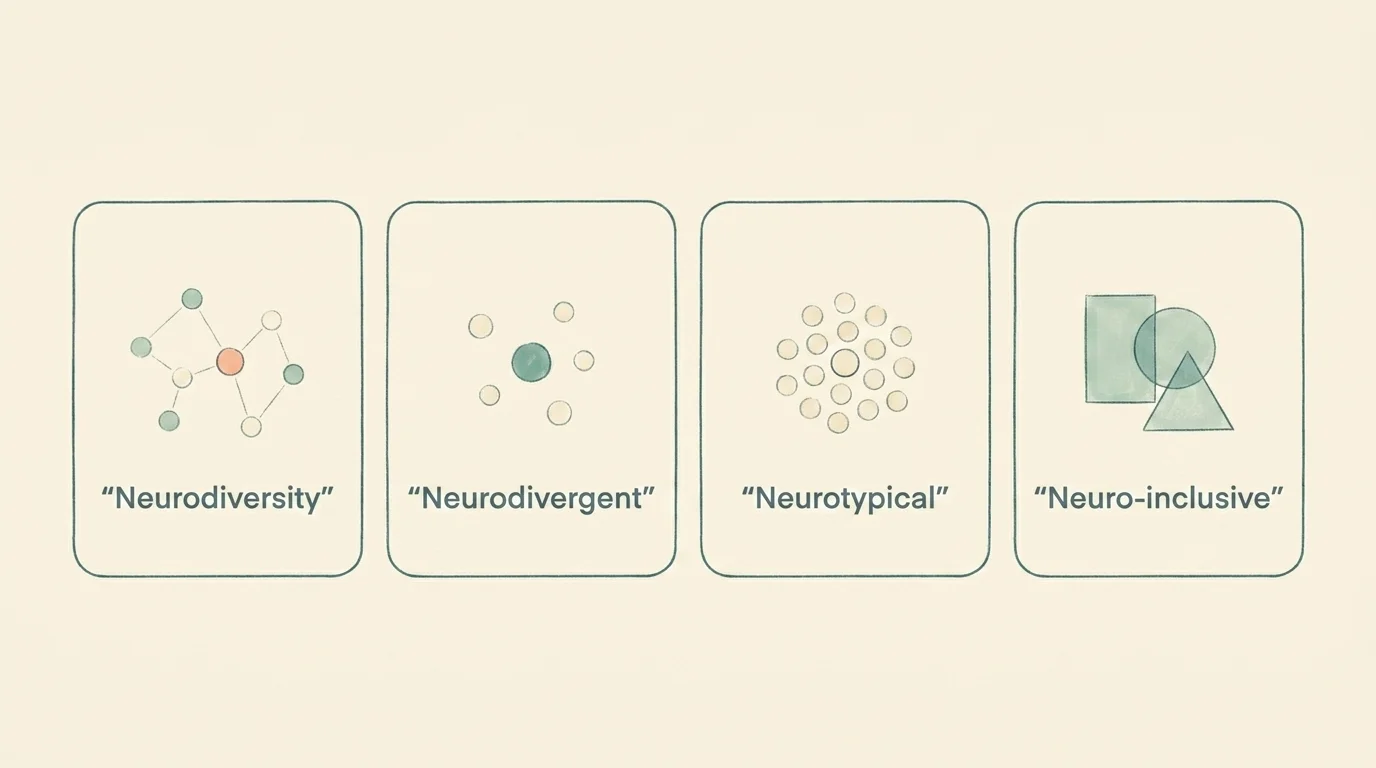
- Neurodiversity. The fact of variation in human cognition. Neurodiversity is not a property of an individual. It is a property of populations. To say of a single child that she "is neurodiverse" is, strictly, a category mistake; she is neurodivergent, in a population that is neurodiverse.
- Neurodivergent. A description of a person whose cognition differs from what a given society treats as standard. The term is broader than autism — it is conventionally used to include autism, ADHD, dyslexia, dyscalculia, dyspraxia, Tourette syndrome, and several conditions that frequently co-occur. Estimates of how many people this describes vary; Nancy Doyle's 2020 figure of 15 to 20 per cent of the global population is the most widely cited.
- Neurotypical. A description of a person whose cognition falls within the range a given society treats as standard. The word does not name a virtue. It names a statistical position.
- Neuro-inclusive. A more recent term, used in policy and workplace writing — for example by Deloitte's 2025 guidance on neuro-inclusive workplaces and The Chicago School's writing on a neuro-inclusive society — to describe institutions that have actually changed their structures, not only their language. The distinction between neuro-inclusive and neurodiversity-aware is, as we will see, doing real work.
A few numbers, since the discourse is short of them
Most of the popular writing on neurodiversity is conducted in a near-total absence of numbers. This is curious, because the available statistics tell a more interesting story than the slogans do.
Roughly 1 in 100 children worldwide are diagnosed with autism spectrum disorder (Zeidan and colleagues, Autism Research, 2022). Approximately 11.4 per cent of US children aged 3 to 17 — about 7 million — were diagnosed with ADHD in the 2022 CDC release. The 2025 City & Guilds Foundation Neurodiversity Index reported that 26 per cent of UK parents say a child of theirs may be neurodivergent and is currently awaiting assessment, which is a striking number on its own and a striking number in light of how slow many assessment pathways now are. Only 21.7 per cent of autistic adults in the UK are in employment (Office for National Statistics, 2020) — a figure roughly four times worse than the general working-age employment rate, which is itself a fact most awareness campaigns do not mention. And 52 per cent of neurodivergent US professionals report that they do not feel safe disclosing their neurodivergence at work (CIPD, 2024) — a number that bears directly on the next section.
Awareness, acceptance, inclusion: the three are not the same
I want to draw a distinction that current advocacy writing almost always gestures at and almost never makes precisely.
Awareness is a state of knowing. To be aware of neurodiversity is to know that human cognition varies and that one's neighbour's child or one's colleague is, perhaps, neurodivergent.
Acceptance is a stance taken in light of that awareness. To accept a neurodivergent person is to extend to them the same regard one would extend to any other person — without the implicit footnote that they are a problem to be patient with.
Inclusion is a structural fact about institutions. An institution is inclusive when its rooms, schedules, conversational norms, and procedures actually accommodate the people awareness has named.
The strongest current evidence that these three are not interchangeable is the 2026 City & Guilds Foundation Neurodiversity Index Report, which finds that public awareness of neurodiversity continues to grow while delivery and consistency lag behind — neurodivergent employees report uneven support, longer adjustment delays, lower psychological safety, and more frequent microaggressions in 2026 than in 2025. The two curves are diverging. Awareness without acceptance, and acceptance without inclusion, is what the discourse currently calls a delivery gap. The 52 per cent disclosure figure is what the gap looks like at one workplace at one moment.
The strongest version of the objection runs like this: but surely awareness is the precondition for everything else; we should not begrudge it. I take this seriously. The honest reply, I think, is that awareness is necessary and not sufficient, and that current advocacy spends a great deal of its energy on the necessary part and very little on the sufficient. There is no contradiction in being grateful for one and impatient about the other.
The strongest objections, taken seriously
It would be intellectually dishonest to write about this terrain without naming the serious objections. There are, I think, three.
The first is that neurodiversity as a frame can flatten genuinely high-support needs into a politics of recognition. A child who is non-speaking and requires significant lifelong care is being described, by the same vocabulary that describes a high-functioning adult coder. Some autistic adults and their families argue that this elision does the high-support population a disservice. I find this objection serious. It does not, as far as I can see, require us to abandon the neurodiversity frame. It requires us to be careful that recognition does not become a substitute for the structural support some neurodivergent people need.
The second objection concerns the relationship between the neurodiversity movement and Applied Behavior Analysis (ABA). Some autistic adults and clinicians regard ABA — particularly its older, compliance-based variants — as in tension with neurodiversity-affirming framing. Others, including many ABA practitioners, argue that contemporary ABA has reformed and is consistent with affirming framing. I do not think this debate is settled. I think it is an honest debate, and that any responsible parent will end up reading more than one camp.
The third objection is that the neurodiversity frame, as currently practised, has been disproportionately written by and for white, Western, middle-class adults — a critique made carefully in a 2025 paper in Frontiers in Human Neuroscience. This is not a reason to abandon the frame. It is a reason to extend the table to the people who have not been at it.
Diversity within neurodiversity
The 2025 Frontiers critique points at a fact that recent US research has made specific: Black autistic children are diagnosed approximately 1.5 years later than their white peers. The statistic does not name itself; it is the consequence of a long chain of small failures — clinician training, parental access, school referral, insurance, language. None of those failures need to be present for the statistic to land, in a particular family, as a year and a half of unspecified struggle.
The conceptual point is small and important. Celebrating differences is not a single moral act. It is a longer obligation to ask which differences are being celebrated, by whom, in what venues, and which differences continue not to be. Bernard Williams, on whom I once spent a great deal of time, would have called this the part of the moral picture that mere consistency cannot capture — the part where you have to look at which lives the principle is reaching, and not only at the principle. We have, I think, much more of that work to do than the current discourse acknowledges.
What acceptance looks like in practice
It is worth ending this section in the venues where the difference between awareness and acceptance is felt. I will keep these brief and concrete.
At an IEP meeting. The sentence that signals acceptance, in my friend's experience, is not "we want to support your child." It is the much smaller sentence: "what does she need that we are not currently doing?" The first describes a sentiment. The second invites a list.
At the kitchen table. Sibling explanations of autism are easier when they are factual rather than moral — your brother's brain works differently in these particular ways, and these are the things we change to make our days easier — than when they are framed as patience the sibling is being asked to extend.
At a workplace. A 21.7 per cent autistic-adult employment figure is not a recruitment problem. It is a retention problem and an interview-design problem. The interventions that work — written interview questions sent in advance, sensory accommodations in the office, clear structure rather than implicit social rules — are mostly small.
At a clinic. The 26 per cent assessment-waiting figure is the right number to ask one's local pediatrician about, by name, when seeking a referral. Knowing the wait is long is itself a piece of evidence that should change one's planning.

The calendar: NCW and ND Pride Day
Two civic markers are worth knowing about, partly because they are useful in school and workplace planning and partly because they have become, for many neurodivergent communities, the closest thing to a shared annual ritual.
Neurodiversity Celebration Week 2026 ran 16 to 22 March under the theme Working together to create a world that understands it takes all kinds of different minds. It is observed in schools and workplaces in dozens of countries and is a defensible occasion to ask one's child's school what its concrete plans are. Neurodiversity Pride Day, 16 June, is observed in a smaller but more autistic-led set of communities and has a different temperament — less institutional, more first-person.
Neither of these is a substitute for the structural work of inclusion. Both are, in their best instances, a public reminder that the work is owed.
A sharper version of the original question
I want to leave this essay where I think the conversation actually is, which is not at should we embrace neurodiversity? but at the smaller, more demanding question: what would it take for the institutions we share with neurodivergent children to actually deliver, in any given month, the kind of accommodation our public language already promises?
That question, asked of a particular school, a particular workplace, a particular pediatrician's office, is harder to answer than the slogan, and is, I think, the version worth asking.
Frequently Asked Questions
Neurodiversity describes the range of variation in human cognition — the fact that human nervous systems differ from one another. The term was coined in 1998 by the Australian sociologist Judy Singer to argue that this variation is a fact about human populations, not a deficit in particular individuals. Neurodiversity is a property of populations; an individual whose cognition differs from a society's standard is described as neurodivergent.
Neurodivergent describes a person whose cognition differs from what a given society treats as standard — typically including autism, ADHD, dyslexia, dyscalculia, dyspraxia, and Tourette syndrome among others. Neurotypical describes a person whose cognition falls within the range a society treats as standard. Neither term is a clinical diagnosis. Neither names a virtue; both name statistical positions in a population.
No. Neurodiversity is a broader term that includes autism, ADHD, dyslexia, dyscalculia, dyspraxia, Tourette syndrome, and several conditions that frequently co-occur. Estimates of how many people are neurodivergent vary, but Nancy Doyle's 2020 figure of 15 to 20 per cent of the global population is the most widely cited.
Awareness is a state of knowing — knowing that human cognition varies and that one's neighbour's child or one's colleague is, perhaps, neurodivergent. Acceptance is a stance taken in light of that awareness — extending the same regard one would extend to any other person, without the implicit footnote that they are a problem to be patient with. The 2026 City & Guilds Foundation Neurodiversity Index found that public awareness continues to grow while actual delivery — the structural changes that constitute acceptance and inclusion — lags behind. Awareness is necessary; it is not sufficient.
At home, sibling explanations of autism land more easily when they are factual ("your brother's brain works differently in these particular ways, and these are the things we change") than when framed as patience the sibling is being asked to extend. At school, the most useful sentence at an IEP meeting is the small one: "what does she need that we are not currently doing?" Neurodiversity Celebration Week (16–22 March in 2026) is a defensible occasion to ask a school what its concrete plans are. Neurodiversity Pride Day (16 June) is a smaller, more autistic-led civic marker.
Recent US research finds that Black autistic children are diagnosed approximately 1.5 years later than their white peers, and 2025 research in Frontiers in Human Neuroscience documents that the neurodiversity scholarship has been written disproportionately by and for white, Western, middle-class adults. Celebrating differences is not a single moral act; it is a longer obligation to ask which differences are being celebrated, by whom, in what venues, and which differences continue not to be.