
Crafting Futures: The Therapeutic Touch of Clay in Autistic Development


A potter's studio I sometimes visit in the Liberties, just south of the Coombe in Dublin, has the texture of a place that has been a working studio for so long that it has stopped trying to look like one. The wheels are old. The wedging table is grey from a thousand pressings. On a Saturday morning when I last sat in it, a boy of perhaps nine was hand-building a small bowl, very slowly, with his mother and a quiet-spoken woman who I later learned was an art therapist, practiced in what the field calls creative arts therapy. The boy was not, on that particular morning, saying anything at all. His hands were saying a great deal. The bowl was small and a little crooked and you could see, in the pressure of his thumb where the wall folded inward, exactly how much weight he had been willing to risk. The bowl was, I would argue, a kind of sentence.
Clay therapy for autism — a phrase often shelved inside the broader field of creative arts therapy — sits in a tonal register most therapy writing avoids. It is hands-on, material, slow. It produces an object. It is also supported by a small but growing peer-reviewed evidence base that the existing consumer literature does not, on the whole, do a good job of citing. I want to spend this essay doing two things at once: describing what working with clay actually feels like for an autistic child, and naming the studies that tell us what the field knows and does not yet know.
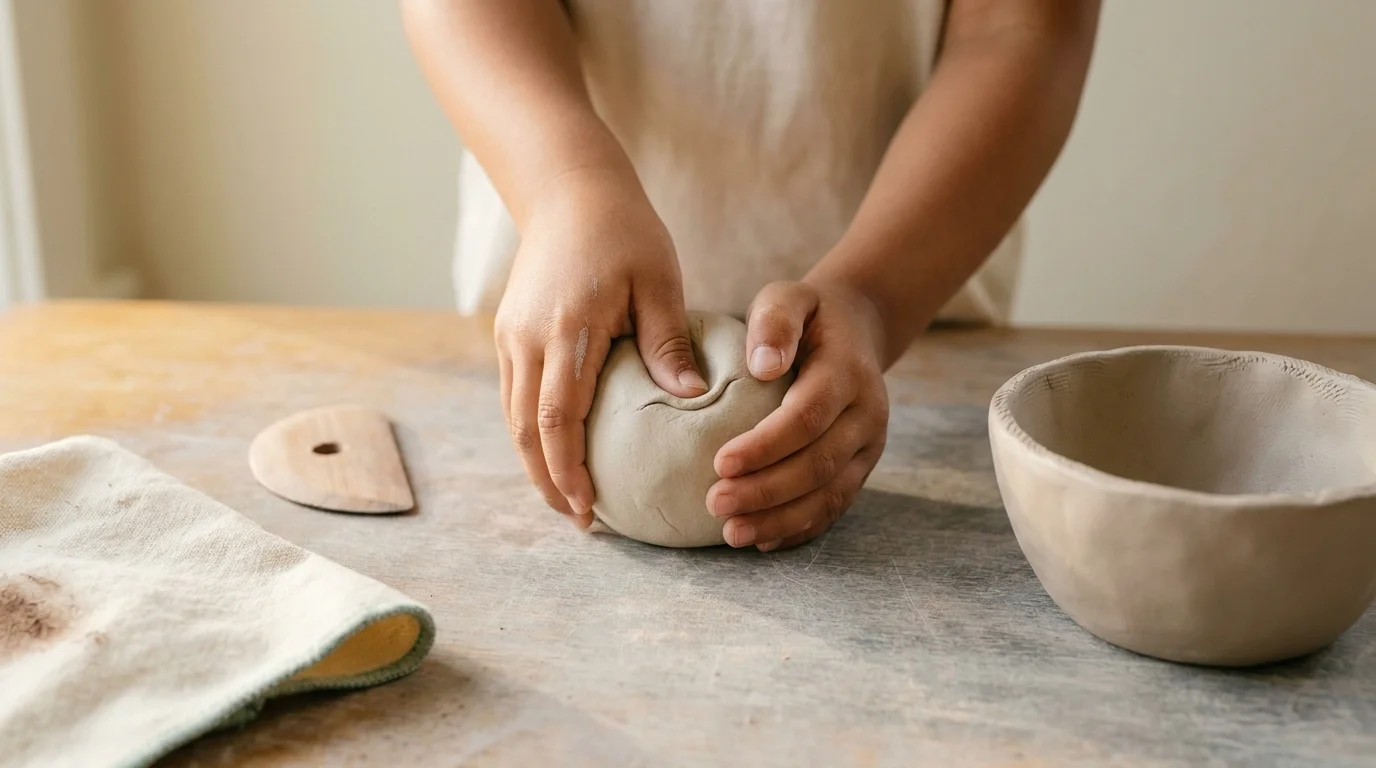
What is creative arts therapy, and how does clay fit in?
The American Art Therapy Association defines art therapy as the integrative use of psychotherapeutic theory and visual art-making to support emotional, cognitive, and social development. Creative arts therapy is the broader umbrella — visual art, music, drama, dance, writing — administered by a clinician trained in both an art form and a therapeutic framework. Clay therapy, in the strict sense, is one tactile branch within visual creative arts therapy, focused on three-dimensional modelling work as the medium through which clinical goals are addressed.
The way this distinction matters for an autistic child is that clay carries certain physical affordances that other visual media do not. It accepts pressure. It records pressure. It tolerates being undone and re-done. It engages the proprioceptive system — the body's sense of itself in space — in a way that drawing or painting do not. The textbook framework for understanding why this matters for sensory-over-responsive autistic children is Ayres Sensory Integration, which I will come to in a moment.
Sensory play with clay: the Ayres integration framework
There is a specific reason that working a lump of clay calms a child whose nervous system is, at that moment, running too fast. It is not magic. It is the way the vestibular-proprioceptive-tactile triad of sensory inputs — body in space, pressure into the body, texture against the body — converges on a single repetitive activity that the child is in control of. The framework that names this is Ayres Sensory Integration (ASI), developed in the 1970s by occupational therapist Dr. A. Jean Ayres and refined for autism populations over the four decades since.
The reason this framework matters now, rather than a decade ago, is that it now sits inside the evidence-based-practice tier rather than outside it. A 2025 comparative trial published in Autism Research by Roseann Schaaf and colleagues — the first head-to-head randomised trial of its kind — compared occupational therapy using Ayres Sensory Integration against Applied Behaviour Analysis for autistic children. ASI met the Council for Exceptional Children's criteria for an evidence-based practice. That is a non-trivial reclassification: the framework has moved, in a regulatory and scholarly sense, from "interesting clinical model" to "intervention with the kind of evidence base that funders and education systems will increasingly recognise."
For the parent or therapist who has watched an autistic child move from agitation to focus over the course of fifteen minutes pressing clay, the framework offers a name for what they have been observing. The body is doing the work the mind cannot, just then, do directly.
Clay and fine motor skills in autism
The motor question is the one most blog-level coverage hand-waves. The honest answer, anchored on the literature, is that creative-arts media — clay among them — map cleanly onto the fine motor performance skills that occupational therapists assess and target.
The 2022 American Journal of Occupational Therapy scoping review by Bernier and colleagues mapped fifteen Level 1b and 2b studies of art interventions for autistic children, ages 3.5 to 16, to the Occupational Therapy Practice Framework (OTPF-4). The interventions showed benefits in the process and social interaction performance skill categories — the framework's labels for the cluster of abilities that includes finger isolation, bilateral coordination, grip strength, and the sustained attention that connects an intended movement to its result.
Working with clay engages these in a particular sequence. Wedging — the kneading motion that prepares a lump for shaping — builds proximal arm strength and bilateral coordination. Pinching and pressing isolate the thumb and forefinger, the same muscles that will later carry the weight of a pencil. Rolling coils organises a continuous, smooth motion across the palm and into the fingertips. Hand-building a vessel requires the child to track their own work in three dimensions and adjust pressure incrementally — a coordination demand much closer to handwriting readiness than the casual observer might guess.
One caveat the literature is clear about. The Bernier scoping review notes that of fifteen studies it surveyed, only three used general creative arts that included drawing, painting, clay, or craft; the rest were music (eight) or theatre (four). Clay specifically is underrepresented in the peer-reviewed evidence base. The mechanism above is well-supported within sensory integration and OT theory; the trial-level evidence that clay outperforms other modalities for a given child is not yet there.
Clay, anxiety, and sensory regulation
There is a tonal claim about pottery — that it slows the body down, that it produces a small steady focus — that the literature tentatively supports rather than firmly establishes. The most rigorous synthesis to date is the 2025 systematic review by Wei, Lai, and Ho in Healthcare, which examined twelve randomised controlled trials of art therapy for autistic children and adolescents, covering 899 participants aged 5 to 11, published between 2017 and 2024. The review reported promise across reductions in ASD symptoms and stress-related symptoms, and improvements in social communication, motor skills, language, and neurodevelopment.
The review's careful framing is what I want to underline. Most of the included trials had small samples, short durations, and what the authors describe as high risk of bias. The field is, in their phrase, promising, not yet conclusive. That is the honest version. A consumer article that promises clay-as-cure for autism-related anxiety is overstating what the trials so far have actually shown. A consumer article that ignores the evidence base altogether — most do — is underestimating what is real. The truthful place to stand is between these.
For the parent watching a child move from over-stimulation to a kind of working calm at the wedging table, the experience is genuine and the mechanism is plausible. The current literature supports the practice; it does not yet, at the population level, prove the magnitude of the effect.
Communication: the closest thing to a clay-specific RCT
The single most clay-specific peer-reviewed finding in this literature is a 2022 paper out of Frontiers in Psychology. Zhang, Sun, Liu, and Yang ran two studies — small samples, N = 3 and N = 8 — of autistic children and adolescents aged roughly 7.7 to 16.25, using an ultra-light clay intervention, 25-30 minutes per session, two to three times weekly, over three to six months.
The reported effect on responsive communication was significant — F(4,44) = 112.66, p < 0.001 — and improvements in initiating communication generalised to peer settings outside the sessions themselves. That is a specific finding from a specific study with a specific design, and I name it precisely because the rest of the consumer literature tends to assert clay's communication benefits without ever telling you what study, what age range, what dose, or what statistical test produced the claim. The Zhang sample is small. The effect, on responsive communication, is large. Both facts deserve to travel together.
What the research actually says about clay therapy for autism
If you want the single section a sceptical reader will want to find first, this is it. The current peer-reviewed picture, condensed:
- Twelve RCTs, 899 children, ages 5-11, art therapy for autism: promise on social communication, motor skills, stress symptoms, and language; most trials small, short, with high risk of bias. (Wei et al., 2025)
- Twenty studies, 781 participants, ages 0-11, creative arts therapies: eighteen of twenty reported positive effects on self-expression and peer cooperation, with no adverse effects. (Schweizer-style review, The Arts in Psychotherapy, 2024)
- Two clay-specific studies, N=3 and N=8, ages 7.7-16.25: significant gains in responsive communication, generalisation of initiating communication to peer contexts. (Zhang et al., 2022)
- Fifteen studies, AOTA scoping review: benefits in process and social-interaction performance skills under OTPF-4; clay specifically underrepresented in the included studies. (Bernier et al., 2022)
- First head-to-head RCT, ASI vs ABA: Ayres Sensory Integration meets Council for Exceptional Children evidence-based practice criteria. (Schaaf et al., 2025)
What this adds up to, in a sentence: the broader creative arts therapy literature for autism is small, promising, and improving; the sensory-integration framework that explains why clay specifically works has reached evidence-based status; the trial-level evidence that clay outperforms other arts modalities for a given child has not yet been produced at scale. A careful parent or clinician can act on that picture without overclaiming what is in it.
Five clay activities for autistic children, by age and sensory profile
These are not therapeutic prescriptions. They are activities a parent or carer can offer at home, modelled on the dose, duration, and developmental staging used in the studies cited above. Pair them with — never replace them with — guidance from an occupational therapist or art therapist who knows the child.
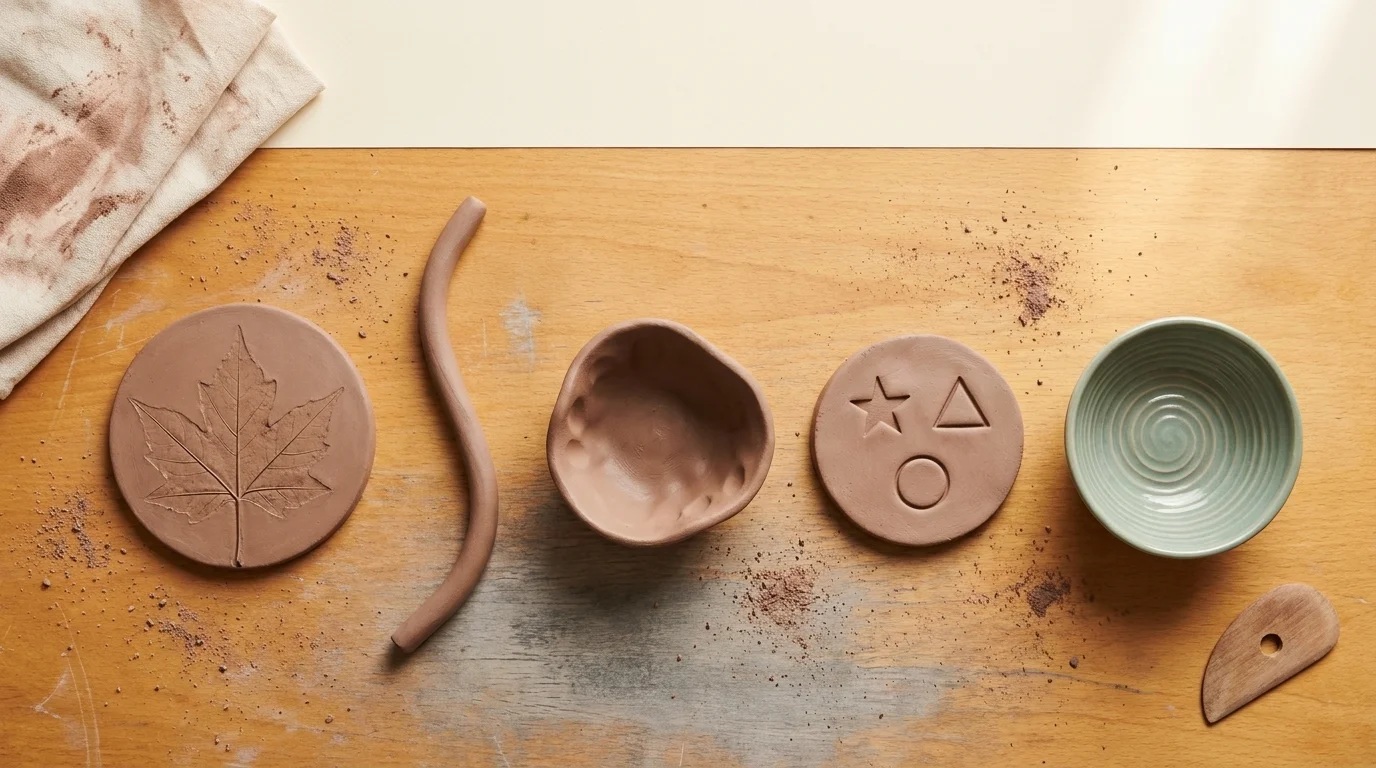
Pressing and imprinting (ages 3-6, higher sensory or motor support needs). A flattened pad of clay; objects of different texture pressed in — a comb, a leaf, the cap of a marker. Tactile registration without expectation of an outcome. Five to ten minutes is plenty. The work is the pressing.
Coil rolling (ages 5-9, moderate support needs). A small lump rolled between the palms and then on the table into a coil; coils stacked into a low cup or wall. Targets bilateral coordination and proximal arm regulation. The vessel does not need to hold water. The point is the rolling.
Pinch-pot bowls (ages 6-12, mild-to-moderate support needs). A ball pinched out from the centre, walls thinned with the thumb and forefinger. Targets finger isolation, sustained attention, and pressure modulation. Twenty to thirty minutes per session, modelled on the Zhang et al. 2022 dose.
Hand-built tile or letter forms (ages 7-12, milder support needs). Cutting a slab; pressing in letters or simple shapes; smoothing edges. Targets the perceptual-motor coordination that supports handwriting. A clear outcome — a finished tile — is built into the activity.
Wheel-throwing or kiln-fired pieces (ages 10+, milder support needs, supervised). Centring on the wheel; trimming a foot; glazing. This is the upper end of the range and probably requires a studio or a community programme. The work supports career-oriented engagement for older autistic children who have moved past basic tactile exposure.
The order is roughly developmental, not absolute. Plenty of older children begin at activity one, and there is no developmental ladder being missed if a child stays there happily for a year.
What parents can do at home — and when to call an OT
The structural shift in the literature over the last several years has been toward family-centred delivery. A 2025 Family Relations review by Moo and colleagues mapped how parents and caregivers participate in creative arts therapies for autistic children and noted that caregiver-delivered activity at home is increasingly understood as a meaningful complement to clinical sessions, not a poor substitute for them. The boundary between the kitchen-table version of clay work and the therapy-room version is, in the current evidence base, more permeable than it used to be.
What this means in practice. Play dough, modelling clay, and air-dry clay on a Saturday morning are good for an autistic child. They are good for tactile-proprioceptive regulation, for the small attention that comes from a manageable physical task, and — at the older end — for the satisfaction of a finished object. You do not need a clinical qualification to offer them.
The places to involve an occupational therapist or an art therapist are these. When clay is being used in service of a specific clinical goal (handwriting readiness, sensory regulation under a behaviour plan, communication initiation as in the Zhang 2022 design), the activity benefits from being placed inside a clinician's plan. When a child shows strong sensory aversion to tactile media — refusal, distress, a sustained inability to tolerate the texture — the right next step is not to push through but to ask an OT about graded exposure and alternative media. When the goal is participation in a community studio or a school programme, the introductions are easier and the accommodations more sympathetic when a clinician has framed the request.
The relationship between home practice and clinical practice, in this field today, is the long middle. It is where most of the actual work happens.
What clay says
I want to come back to the boy in the studio in the Liberties. I do not know, and never asked, what the clinical goals of his session were. I do know that his small crooked bowl ended up on the wedging table at the end of the morning while his mother packed her bag and the art therapist wiped down the wheels. He looked at it, the bowl, for a long moment before they left. He did not say anything about it. He did not need to.
A bowl is a small civic object. It implies a hand, a pressure, a decision about where the wall would hold and where it would not. The literature on clay therapy for autism is, today, exactly the kind of literature it should be: small, careful, improving, honest about what it does not yet know. The relationship between the small bowl and the small literature is, I think, the same relationship in both directions. A child works what is in front of them. A field works what is in front of it. Neither needs to be more dramatic than it actually is to do real work.
Slowly.
That, in a single word that I will allow myself, is what clay therapy is for. The thing it gives an autistic child is a piece of the day that proceeds at the pace of the hand. The thing it asks of the rest of us — parents, therapists, writers — is to take that pace seriously enough to describe it accurately.
Frequently Asked Questions
The broader creative arts therapy literature is supported by a 2025 systematic review of 12 RCTs covering 899 children (Wei et al., Healthcare), showing improvements in social communication, motor skills, and stress symptoms. For clay specifically, a 2022 RCT in Frontiers in Psychology (Zhang et al.) found ultra-light clay intervention significantly improved both responsive and initiated communication in autistic children. The evidence is promising but the field still needs larger, more rigorous trials.
Therapeutic clay work is structured around clinical goals — sensory regulation, fine motor development, or emotional expression — and is often guided by an occupational therapist or art therapist using frameworks like Ayres Sensory Integration. Casual play with play dough at home offers many of the same sensory benefits and is a valuable parent-led complement, but it is not a substitute for clinically guided sessions when formal therapy goals are in play.
The peer-reviewed evidence covers children from roughly 3.5 to 16 years (AOTA scoping review, Bernier et al. 2022). Younger children and those with more sensory or motor support needs typically start with simple tactile activities — pressing, rolling, pinching. Older children or those with milder support needs can progress to wheel-throwing, glazing, and finished pieces.
Yes — the AOTA-aligned evidence maps clay and modeling work to the Occupational Therapy Practice Framework's fine motor performance skills (finger isolation, grip strength, bilateral coordination), all of which support handwriting readiness and self-care tasks. A 2025 comparative trial of Ayres Sensory Integration therapy (Schaaf et al., Autism Research) reinforces the underlying sensory-motor mechanism.
A 2025 family-centered review (Moo et al., Family Relations) supports caregiver-delivered creative arts activities as a meaningful complement to clinical therapy. Parents can safely offer clay or play dough at home for sensory and motor benefit; consult an occupational therapist or art therapist when you want activities targeted to specific clinical goals or if your child shows strong sensory aversion to tactile media.