
Adult Executive Functioning


There is a particular shame that belongs to the capable. You know exactly what needs doing. And still the email goes unanswered for a fifth day, the dishes acquire a geology, and the tax form migrates from list to list like a debt you keep refinancing. The distance between knowing and starting is short, but strangely unbridgeable, and the private verdict is unkind: I am lazy. I have no discipline. What is wrong with me?
I want to offer a different account, and to defend it. The thing standing in that gap has a name — adult executive functioning — and it is not a character flaw. It is the mind's management system, behaving more or less exactly as its wiring disposes it to. Let me say what I mean by that, and then let me show you why the recent science has quietly made the kinder account the more accurate one as well. What follows is a definition, the core skills the term rests on, why adult life makes them harder, strategies that work with the brain rather than against it, and a reflective self-check that is a mirror, not a diagnosis.
What is adult executive functioning?
Executive functioning is the brain's management system — the mental skills that let you plan, focus attention, regulate emotions, and start and finish tasks.
That is the definition every serious source opens with, and it is worth dwelling on the word management. Executive functioning is not a single ability, like memory or vision. It is the coordinating layer that decides which ability to deploy, in what order, toward which goal, while ignoring the four more interesting things happening in the room. Think of it as the part of you that plays, roughly, the role of a manager: not doing every job itself, but keeping the others pointed in the same direction.
The psychologist Adele Diamond, whose 2013 review is the canonical account of these skills, puts the range of it well. Executive functions, she writes, "make possible mentally playing with ideas; taking the time to think before acting; meeting novel, unanticipated challenges; resisting temptations; and staying focused." Read that list slowly and you may notice it describes not a clinical deficit but the entire texture of a competent adult day.
Here is the frame I want to set before going further, because it decides how the rest reads. I am going to treat executive functioning as a lens for self-understanding, not as a diagnosis to be ashamed of. The difference matters. A diagnosis sorts you into a category; a lens shows you how something works so that you can work with it. For the wider version of that reflective stance — neurodiversity as self-understanding rather than deficit — the rest of horizonsmind's philosophy writing is the natural place to wander next.
You're wired this way — not lazy: what the 2026 genetics reveal
This is the one thing this page can tell you that the rest of the field, at the time of writing, is not. So let me put the evidence down carefully.
In May 2026, a genome-wide study of roughly 94,000 adults — 84,238 from the UK Biobank and 9,932 from the NIHR BioResource's Genes and Cognition cohort — went looking for the genetics underneath executive function, testing three separate measures of it. The most heritable of the three was a trail-making task, the sort of timed pencil-and-paper test a clinician might set you; that measure traced to 18 independent genetic loci, and following those loci up implicated 178 candidate genes. The work was published in Nature Communications by Rahman, Frkatović-Hodžić, van den Ameele and colleagues. That alone would be notable. But the finding that carries the argument is subtler. When the researchers followed the brain-enriched genes across the life course, twenty-one of them showed what they call a biphasic profile: switched up before the prenatal period, while the brain is being built, and switched down again after late infancy. In plain terms, the wiring behind adult self-control and planning is substantially laid down before you had any say in the matter.
Sit with what that does and does not mean. It does not mean your executive functioning is fixed or hopeless — the later sections are entirely about how much of it is movable. It means the difficulty is real, structural, and not a referendum on your willpower. The strongest version of the self-blaming objection runs like this: other people manage; if I cannot, the difference must be effort. I took that objection seriously for years. What the genetics do is dissolve its hidden premise — that everyone is running the same hardware and you simply decline to try. You are not.
The clinical literature gets close to this without quite arriving. Cleveland Clinic notes that a person with executive dysfunction "might seem careless or indifferent, but many people who experience this are uncomfortably — even painfully — aware of their struggle." That single sentence is the most humane line in the reference literature, and I want to go one step past it: the awareness is not a symptom to be managed. It is evidence that you are not indifferent at all — that the caring was never the thing in short supply.
What are the 7 executive functioning skills?
The skills are commonly listed as seven. The psychologist Russell Barkley lists them as self-awareness, inhibition, non-verbal working memory, verbal working memory, emotional self-regulation, self-motivation, and planning and problem-solving.
Seven is the number you will see most often, and it is a useful checklist. It is worth knowing, though, that the science underneath rests on fewer than seven, which is the sort of tidy discrepancy that rewards a second look.
The three core functions
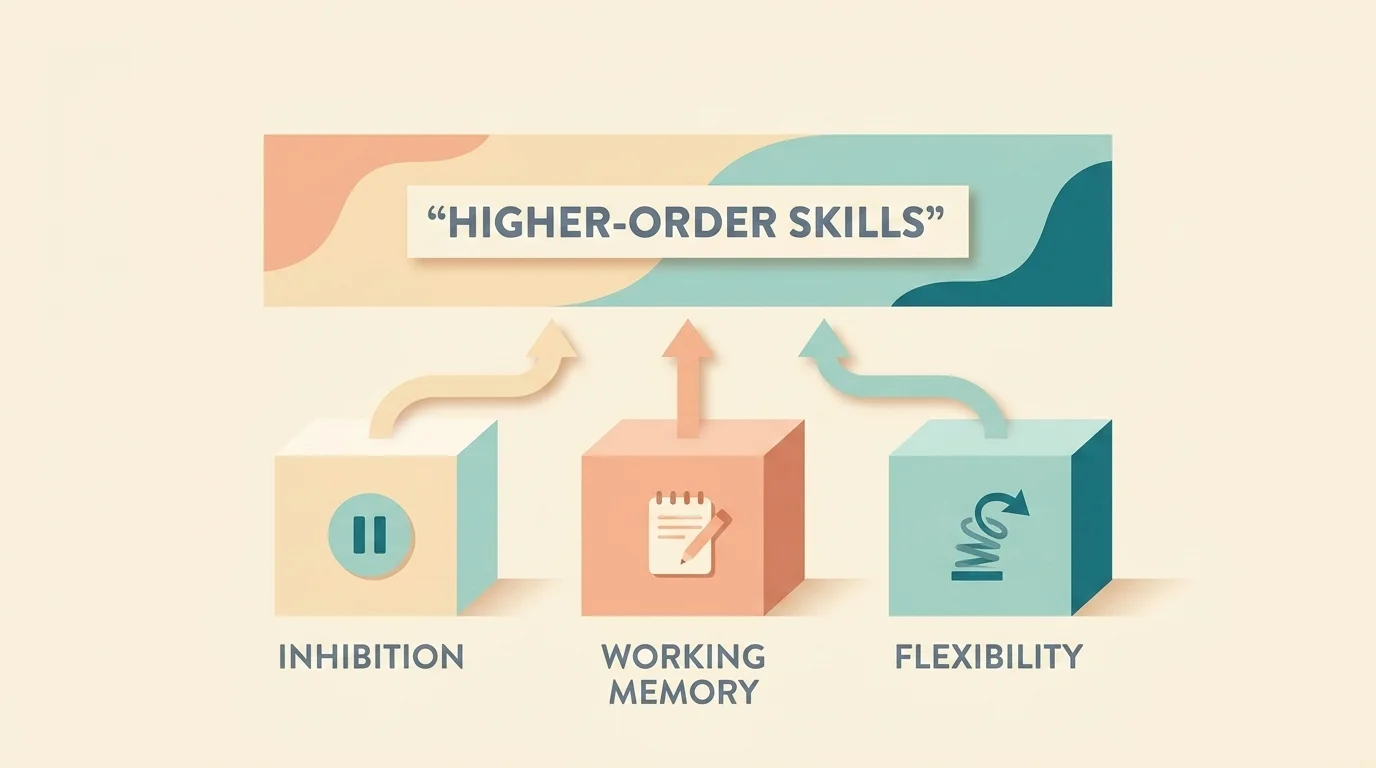
Diamond's model holds that there are three core executive functions. The first is inhibition — self-control over your behavior and attention, the capacity to not do the easy wrong thing and not chase every passing distraction. The second is working memory: holding information live in mind and working with it, the mental desk you lay a problem out on. The third is cognitive flexibility: the ability to shift, to see a situation from another angle, to change plan when the plan meets reality. Everything grander — reasoning, planning, problem-solving — is, on Diamond's account, built on top of these three rather than sitting beside them. Which is why I read the "seven skills" and the "three functions" less as rival lists than as two altitudes on the same terrain: the seven are, to my eye, what the three look like once they are doing real work in a life.
The seven skills in everyday adult terms
Here is each, in the register of an ordinary week — what it looks like when it works, and when it does not.
- Self-awareness: noticing what you are doing while you do it. Absent, you finish the evening with no memory of where it went.
- Inhibition: the pause before the reply, the reach not made for the phone. Absent, the impulse and the action are the same event.
- Non-verbal working memory: holding the picture in mind — the goal, the route, the shape of the thing you are walking toward. Absent, you arrive in the kitchen with a clear purpose and stand there, robbed of it.
- Verbal working memory: the inner voice that talks you through it, keeping the thread on rails. Absent, the commentary goes quiet halfway and the thought you were building dissolves.
- Emotional self-regulation: feeling the feeling without being run by it. Absent, a small setback colors the whole afternoon.
- Self-motivation: supplying your own reason to begin when no one is watching. Absent, only a deadline's adrenaline can start you.
- Planning and problem-solving: seeing the route from here to done. Absent, a three-step errand reads as a fog.
How executive dysfunction shows up in adult life
Definitions are cool to the touch. The experience is not, so let me describe it as it is actually lived — which is also, not coincidentally, how you win back some self-respect about it.
At work, at home, in relationships
At work: the deadline you meant to beat and missed by an afternoon; the inbox where every message is simultaneously urgent and un-openable; time blindness, the honest inability to feel that forty minutes have passed. At home: the doom-pile on the chair that has become furniture; the laundry that is always either in the machine or on the floor, never in the drawer. In relationships: the text you fully intend to answer and do not, until the not-answering has itself become the awkward thing. Underneath all of it sits one signature: the intention–action gap. The wanting is intact. The starting is not.
What sits underneath it
Executive difficulty has contexts it rides on, and they are worth naming plainly — as contexts, not verdicts. ADHD is the most familiar; executive function sits close to the center of how ADHD is usually described. Autism is the one the mainstream guides most often leave out, though executive load is part of adult autistic life too. Depression, chronic stress, and sleep debt each degrade the same machinery. The same struggle looks different from one person to the next partly because the context around it differs — which is why it is worth reading as a feature of something larger, not as a standalone thing you have failed at in isolation. The point of naming them is not to hand you a label. It is to move the question from what is wrong with me to what am I working with — a better question, and a kinder one.
Strategies that actually work — externalize the load
You don't so much fix executive functioning as build systems around it: make the mental load visible, protect sleep and movement, and choose environment over willpower.
That sentence is the whole strategy, and everything below is an elaboration of it. Two things to hold first: the tactics are dull, and the dullness is the point — reliability beats cleverness here — and no single one of them is a cure. What works is a stack of small externalizations — plus, I would argue, a meaningful drop in self-blame.
Externalize the load
The governing idea is to move the work out of your head, where it costs you constantly, and onto something outside you that holds it for free.
- Make tasks visible. A written list, a whiteboard, sticky notes at eye level. A task you can see is a task your working memory no longer has to carry.
- Time-block and chunk. Give work a place on the calendar, and break anything vague into a first concrete step small enough to be embarrassing. "Do taxes" does not start; "open the folder" does.
- Try body-doubling. Working alongside another person, in the room or on a call, borrows their momentum to start yours. It is not a trick; it is scaffolding.
- Choose environment over willpower. Put the phone in another room rather than resolving to ignore it. Willpower is expensive and unreliable; a closed door is cheap and works while you sleep.
A visual, external aid is often the most concrete version of this, and to my mind the same logic that runs a student's school day can run an adult's Tuesday — the visual-schedule approach to externalizing tools is not only for children.

The evidence it's not fixed
This is where "yes, you can improve" stops being a motivational slogan and becomes a finding. Executive function is state-dependent — it moves with the condition of the body carrying it. A 2025 meta-analysis pooling 79 studies in Sleep Medicine Reviews found that sleep loss measurably impairs all three core executive functions — working memory, inhibition, and cognitive flexibility. And a 2026 meta-analysis of 50 randomized controlled trials covering 4,826 older adults, in BMC Public Health, found that exercise improves executive function. Read together, they point somewhere practical: sleep moves executive functioning, and, in the older adults those trials studied, so does exercise. Neither of those is an app. Neither of them is willpower.
A closing honesty, because you have been sold cures before. No tactic here transfers perfectly, and there is a point past which self-help stops being the right tool. If these patterns are genuinely costing you your work, your relationships, or your health, the strategies complement — they do not replace — a proper assessment and, where it helps, coaching or clinical support. Knowing when to reach for that is itself an executive skill worth practicing.
A reflective self-check — not a clinical test
I want to offer you something to sit with, and I want to be clear about what it is not. What follows is a mirror, not a score. Read each line and simply notice whether it lands.
- Do you routinely know the next step but stall at starting it?
- Do you lose the thread of a task the moment you are interrupted?
- Does time slip — do forty minutes regularly vanish without your noticing?
- Do small emotional setbacks reshape a whole afternoon?
- Do you keep making the same plans and hitting the same wall in carrying them out?
- Do you rely on a last-minute deadline to do what calm intention could not?
If several of these landed, the honest interpretation is this is worth understanding better — not therefore I have a disorder. The distinction is not pedantry. A 2026 review in Frontiers in Psychology examined the four main ways executive functioning is assessed — performance tests, computerized tools, rating scales, and neuroimaging — and concluded that no single method adequately captures its complexity. If no single trained instrument captures it, a checklist you scored on your phone certainly cannot diagnose you.

So what is a self-check for? To turn a vague, shaming feeling into a specific, workable observation — and, if the observation is heavy enough, to be the reason you book a real assessment rather than the substitute for one. A genuine evaluation looks at several kinds of evidence at once, with someone trained to weigh them. Seeking it is not an admission of failure. It is the same move as protecting your sleep or writing the list down: choosing to work with the brain you have.
Conclusion
Return, for a moment, to the unstarted task at the top of this page. Nothing about it was a verdict on your character. Adult executive functioning is the mind's management system — biologically wired, laid down long before you could have been held to account for it, and more movable by sleep, movement, and visible systems than by shame. Working with it beats white-knuckling against it, every time.
The point was never to become a different brain. It is to stop grading yourself against one you do not have. So try one externalization this week — a single visible list, nothing more — and if you want the wider, gentler lens on all of this, horizonsmind's philosophy writing is here for the reflection, not the prescription.
Frequently Asked Questions
Poor executive functioning in adults usually stems from how the brain's management system is wired and functioning — not from laziness or weak character. It is commonly linked to ADHD, autism, depression, chronic stress, or sleep loss. A 2026 genome-wide study of roughly 94,000 adults tied its most heritable measure to 18 genetic loci, wiring largely laid down before birth.
Yes — you can improve executive function in adults, because it is state-dependent, not fixed. A 2025 meta-analysis found sleep loss measurably impairs all three core executive functions; another, of 50 trials in older adults, found exercise improves it. Externalizing systems — checklists, time-blocking, task-chunking — carry the load day to day. The realistic goal is not a cure but a reliable stack of supports.
No — executive dysfunction is not the same as being lazy. As Cleveland Clinic puts it, many people who experience it are 'uncomfortably — even painfully — aware' of their struggle, which is the opposite of not caring. The difficulty sits in the brain's task-initiation and self-regulation systems, not in willingness or character; the wanting is usually fully intact.
Executive function does change across the lifespan, but 'worse with age' oversimplifies it. It does not fully mature until the early twenties, and several components — flexibility, planning, working memory — begin a gradual decline from the mid-twenties onward. It is a trajectory, not a fixed trait. And it is state-dependent: sleep and stress move executive function day to day, whatever your age.
Executive dysfunction is usually a feature that shows up across conditions rather than a standalone diagnosis. It appears with ADHD, autism, depression, and chronic stress, among others — part of why the same struggle looks so different from one person to the next. Understanding what it rides on matters more than the label, because the underlying context is what any real support has to address.