The Intersection of AI and Autism: Crafting the Future of Care



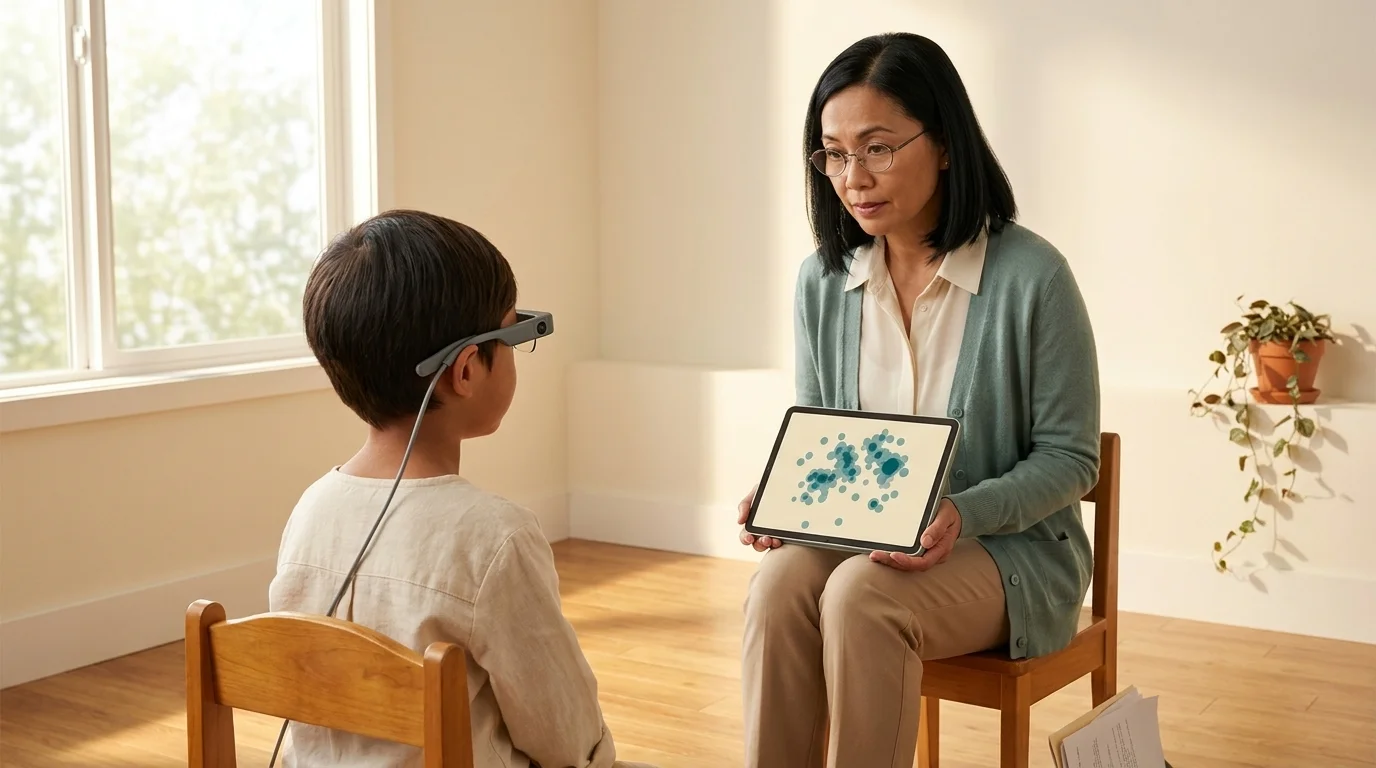
AI for autism is, in 2026, mostly a story about a slowly accreting set of small, specific studies — so let me start with one. In 2018, a team led by Dennis P. Wall at Stanford published the results of a small randomized trial of an unusual intervention. Children with autism wore Google Glass for about twenty minutes, four times a week, for six weeks; the headset ran software developed in the Wall Lab that recognized facial expressions in the people around them and surfaced labels — happy, sad, surprised, angry — in the wearer's peripheral vision. The control group received treatment-as-usual (Wall, Voss, Haber et al., Stanford Medicine, 2018; Wall Lab project page). The intervention group showed a statistically significant improvement on the socialisation subscale of the Vineland Adaptive Behaviors Scale, a standard developmental measure. The control group did not.
I want to use that study as the anchor for this piece, because it is roughly the right scale for what AI for autism actually is in 2026: a real, specific, peer-reviewed intervention with a measurable effect size, sitting in a much larger field of mostly-prototype tools, mostly-cross-sectional studies, and a great deal of press-release language. The honest map of artificial intelligence in autism is more interesting, and a great deal less dramatic, than the headlines about it.
The four places AI for autism is actually being used
If you assemble the work coming out of computational neuroscience labs, FDA submissions, clinical research, and human-computer interaction journals, the picture sorts cleanly into four areas. Diagnosis and screening — using behavioural video, eye-tracking, parent questionnaires, and biological assays to surface autism earlier and more reliably. Communication and AAC — predictive and conversational tools that help non-speaking or unreliably-speaking autistic people make themselves understood. Education and therapy — adaptive learning systems and therapist-assistive tools that respond to a child's specific profile. Adult use — autistic adults using large language models for workplace communication, social-script rehearsal, and code-switching, an area that did not exist as a distinct line of research before late 2022.
Each of these is a real, somewhat-mature subfield. Each has named tools, named labs, peer-reviewed evidence, and known limitations. The article you are reading is structured around all four. Most consumer-facing coverage of AI for autism picks one and writes about that one as if it were the whole thing.
Diagnosis and screening: the FDA-cleared toolkit
Of the four areas, diagnosis is where the regulatory infrastructure is now genuinely visible. As of early 2026, a small group of AI-based tools have either received FDA clearance or are deployed at clinical scale.
Cognoa Canvas Dx received FDA De Novo authorization in June 2021 as a diagnostic aid for autism in children aged 18 months to 5 years (Fierce Biotech, 2021). The tool combines parent-uploaded video of the child, structured questionnaires for caregivers, and inputs from a primary-care clinician, and returns a result intended to support — not replace — a clinician's diagnosis. The most-cited real-world performance numbers, summarised in a December 2025 review in Children (MDPI), are a positive predictive value of about 94.4% and a negative predictive value of about 95.2%. Here is the part the press release left out: Canvas Dx returns a determinate result — positive or negative — in roughly 60.5% of the children it sees. The other ~40% are referred on for full clinical evaluation, which is the correct conservative behaviour and is also why describing the tool as a 95%-accurate autism diagnostic is, on careful reading, misleading.
EarliPoint (EarliTec Diagnostics) is FDA-cleared as an eye-tracking diagnostic aid for ages 16 months through 95 months — that is, through age 7 (EarliPoint Health). The child watches short video segments while the system tracks gaze patterns, and returns indices for social engagement, language, and cognition. In its clinical-trial cohort, EarliPoint reported approximately 78% sensitivity and 85.4% specificity against expert clinical diagnosis, for an accuracy of about 82.1% (Children, MDPI, 2025). These are working clinical-decision-aid numbers, not the 99%-plus you sometimes see in ML papers on curated datasets.
SenseToKnow, developed at Duke with NIH support, uses a tablet-based digital phenotyping protocol — short interactive tasks combined with on-device behavioural data capture. Reported sensitivity is around 87.8% and specificity around 80.8%; its positive predictive value improves from roughly 40.6% to 63.4% when combined with the M-CHAT screening questionnaire (Children, MDPI, 2025). The combination point is the interesting one: the tool gets meaningfully better when it is used alongside the standard screening instrument rather than instead of it.
ClearStrand-ASD (LinusBio) sits at the unusual end of the field — it is a hair-based metabolomic assay rather than a behavioural classifier. The published figures are roughly 81% sensitivity and 92% negative predictive value (Children, MDPI, 2025). The high NPV is the load-bearing number: the tool is more useful for ruling autism out than for confirming it.
Across the broader research literature, pooled accuracies for video-based behavioural classifiers sit at around 88.9% accuracy, 94.5% sensitivity, and 77.4% specificity, with specificity peaking near 90% in the four-to-six age band (Children, MDPI, 2025). Pooled eye-tracking ML studies run from 80.5% to 98.33% diagnostic accuracy (Frontiers in Psychiatry, 2025). The wide range is the headline; the narrow operating points of the FDA-cleared tools sit inside it, in the part where the field actually trusts the numbers.
The boring version of all of this: AI is currently a screening and triage aid in autism diagnosis. It surfaces children for earlier specialist evaluation; it does not replace the specialist evaluation. The FDA-authorized tools are explicit about this, and the careful real-world studies confirm it.
Communication and AAC
Augmentative and alternative communication for autistic people predates the AI hype cycle by decades. Picture-exchange systems, symbol boards, and speech-generating devices have existed in some form since the 1970s. The post-2018 contribution of machine learning has been in two directions. The first is predictive: AAC apps now suggest the next word or phrase from a user's idiolect and context, which materially reduces the keystroke load for high-frequency utterances. The second, which is much more recent and much more contested, is generative: using large language models to produce longer phrases or full sentences on behalf of the user.
The mechanism question matters here. A predictive AAC system is doing pattern completion on the user's own communication history. A generative AAC system is doing pattern completion on the entire training corpus of the underlying model. The first is closer to a smart keyboard; the second is closer to a ghostwriter. Whether this is a feature or a bug depends, in practice, on whether the user wants the system to extend their voice or to speak for them — and that question is, in my reading of the field, the one most consumer coverage of AAC + LLMs is not yet asking.
LLMs for autistic adults: the workplace use case
The newest and probably the most under-covered area is the use of large language models — GPT-4, Claude, and their successors — by autistic adults for workplace social communication. A 2024 paper presented at CHI by Jang, Moharana, Carrington, and Begel (Jang et al., arXiv 2403.03297) studied eleven autistic workers using an LLM to help draft and revise workplace messages. The participants, the paper reports, "strongly preferred LLM over confederate interactions" — they would rather get help from a model than from a human helper, including a specialist job coach.
Here is the part the press release left out. The same paper records that a specialist job coach reviewing the LLM's output flagged that the model "was dispensing questionable advice" — that the suggestions, while fluent and confident, sometimes recommended workplace strategies that an experienced coach would not have. This is, in compressed form, the entire honest assessment of LLM-assisted social communication in 2026: it is preferred, by the people using it, over the alternatives; and it is also confidently wrong in a non-trivial fraction of cases, in ways that the user is not always positioned to detect. Both facts are load-bearing.
A 2025 LLM social-coaching pilot reported by Koegel and colleagues with thirty autistic adolescents and adults found that approximately 71% of participants showed improvement on the social-communication metrics targeted by the intervention. A commentary from the Vanderbilt Frist Center for Autism and Innovation by Aras Sheikhi, published in October 2025, offers the most balanced version of the case I have read — naming the genuine accessibility win (an always-available, non-judgemental rehearsal partner) alongside the genuine risks (over-reliance, model error, the slow erosion of independent social calibration).
For an autistic adult considering using an LLM for workplace email tone, rehearsal of a difficult conversation, or post-hoc decoding of a colleague's message, the careful summary is this: the tool is good enough to be useful and not good enough to be trusted unsupervised on consequential interpersonal decisions. Verify before you send. That is not a hedge; it is what the evidence supports.
Education and therapy
Adaptive-learning systems for autistic children — software that adjusts content difficulty, pacing, and modality based on response patterns — have moved from research labs into clinical adjunct use over the last several years. A 2025 longitudinal study published in JMIR Neurotechnology, summarised in the same Children review, tracked forty-three autistic children over twelve months using a Cognitivebotics adaptive-learning platform as an adjunct to human-led therapy and reported improvements across cognitive, social, and developmental domains. The repeated word in the design is adjunct — the platform supplemented therapist-led work rather than replacing it.
On the emotion-recognition therapy side, Kurian et al. (2024) reported approximately 88.25% accuracy in a GenAI-driven facial and vocal expression training tool tested with seventy-five children. The relevant caveat is the same one that applied to Stanford's Superpower Glass: an effect size on a specific outcome measure under controlled conditions tells you something genuine and tells you less than the headline implies. Improvement in recognising emotion labels in a training environment is not the same thing as improvement in social functioning in a classroom or a family, and the second is what most parents are actually trying to support.

What AI for autism cannot do — and what the literature is honest about
This is the section most consumer coverage skips. It is also where the most important reading happens.
Dataset bias. The December 2025 Children review is direct about it: "many training datasets underrepresent bilingual children, racial and ethnic minorities, and rural families." Autism presents differently across genders, cultures, and language environments, and tools trained on narrow populations — disproportionately white, English-speaking, male, urban — will underperform for everyone else. A diagnostic-aid sensitivity of 78% on the development cohort does not mean 78% on the population the cohort underrepresents.
Validation gaps. The same review notes that "most validation studies to date have been cross-sectional" — single-point-in-time measurements, not longitudinal follow-up. That means we have reasonable evidence that AI-assisted screening surfaces signals that correlate with later diagnosis, and very limited evidence about what happens to the children flagged by these tools over the subsequent five or ten years. The distance between "associated with" and "causes" is not pedantry in this field; it is what we do not yet know.
Equity rollout. A August 2025 BMC Health Services Research scoping review of generative AI for autism catalogued ten studies, most from 2024–2025, and concluded that most applications remain "at early proof-of-concept or prototype stages" with small samples. The families most likely to benefit from earlier identification and more responsive support are often the same families with the worst access to the devices, internet bandwidth, and clinician time these tools assume.
False positives and the YMYL question. A January 2026 STAT News investigation warned about a rising market for unproven autism treatments, several of which trade on the language of "AI-powered" without the regulatory scaffolding of the FDA-cleared tools described above. The careful posture for a family encountering an AI-based autism product in 2026 is the same posture appropriate to any health intervention: ask which body has cleared or evaluated it, ask for the operating-point numbers on a population that resembles the child in front of you, and use it inside the relationship with a clinician you trust rather than as a replacement for one.
The "cure" frame is the wrong frame. The autistic community, clinicians, and most serious researchers in this space converge on the position that AI applications in autism are about support and accommodation — diagnostic earliness, communication access, educational responsiveness, workplace inclusion — not cure. Autism is not a disease to be cured; it is a developmental difference with associated supports. Coverage that frames AI as racing toward a cure is, in addition to being scientifically wrong, missing what most of the people in this conversation actually want.
What's still genuinely open
The interesting research questions in this space, in my reading, are these. First, multimodal biomarker fusion — combining eye-tracking, behavioural video, acoustic analysis, and electronic health record context — appears to outperform any single signal on the existing benchmarks, and the FDA-cleared tools are converging in that direction. The open question is whether the combined-signal advantage holds up under longitudinal validation on populations the development cohorts underrepresented. Second, federated learning offers a plausible route to training these models without centralising sensitive behavioural data on children, but it is not yet operational at clinical scale. Third, the adult LLM use case, which is currently a small literature mostly driven by HCI rather than clinical research, will determine more than any other line whether AI in autism over the next five years is mostly a story about children being identified earlier or also a story about autistic adults having more agency in workplaces designed against them.
There is a version of this article I could have written that treats AI for autism as a coming revolution. The literature does not support that version. The literature supports something quieter and more useful: a slowly accreting toolkit, anchored in the FDA-cleared diagnostic aids and the small but real clinical-trial evidence for specific interventions, deployed cautiously, by people who have read the same evidence I just walked you through and who are honest about what it does and does not say.
That is, I think, the careful reader's takeaway. It is less dramatic than the headline version and considerably more interesting, once you start looking at the actual studies.
Frequently Asked Questions
No — and the framing itself is the wrong one. Autism is not a disease to be cured; the autistic community, clinicians, and researchers consistently frame AI applications as support and accommodation. AI is being used to help with early identification, communication, learning, therapy responsiveness, and workplace inclusion. It does not eliminate autism, and the leading research and FDA-cleared tools are explicit about this — they are diagnostic and assistive aids, not cures.
As of 2026, two stand out. Canvas Dx by Cognoa (FDA De Novo authorized 2021) analyzes parent-uploaded video, structured questionnaires, and clinician input to aid autism diagnosis in children aged 18 months to 5 years. EarliPoint by EarliTec Diagnostics uses eye-tracking to measure social attention patterns in children 16 months through 7 years, with reported sensitivity around 78% and specificity around 85%. Both are clinical decision aids — they support a qualified clinician's diagnosis, they don't replace it.
A 2024 CHI study by Jang and colleagues found that autistic workers strongly preferred LLM assistance over human help when drafting workplace social communication. The caveat documented in the same paper: a specialist job coach reviewing the LLM's output flagged that the model occasionally dispensed questionable advice. The honest answer is yes for script drafting, tone normalization, and rehearsal — with the same caution any LLM use demands: verify advice before acting on consequential interpersonal decisions.
Published lab accuracies range very widely — from around 78% sensitivity (EarliPoint clinical trial) to 99%+ in narrow ML studies on curated datasets. The high numbers do not generalize. Real-world deployments report more modest figures: Canvas Dx achieves around 94% positive predictive value but only delivers a determinate result in about 60% of cases. AI is currently an aid to clinical diagnosis — useful for triage and earlier identification, especially in primary care — not a replacement for a comprehensive specialist evaluation.
Three matter most. First, dataset bias: training data underrepresents bilingual children, racial and ethnic minorities, rural families, and girls and women; tools developed on narrow populations may underperform for everyone else. Second, equity gaps: the families who could benefit most often lack reliable internet, compatible devices, or tools available in their language. Third, validation gaps: most studies to date are cross-sectional snapshots rather than longitudinal follow-ups, so long-term outcomes for AI-augmented care are still largely unknown.