Theory of Mind And Autism


Theory of mind is the ability to grasp that other people hold beliefs, intentions, and feelings different from your own — and for roughly forty years, theory of mind and autism were welded together by a single, sticky claim: that autistic people are, in Simon Baron-Cohen's word, "mindblind." It is the version most articles still tell. It is also the version the field itself is now openly reappraising. Baron-Cohen, who helped build the deficit model in 1985, is himself named among the researchers who have positively recognized the alternative. This piece does three things: it explains the classic science plainly — the Sally-Anne test, mindblindness, where the deficit idea came from — gives an honest answer to whether that idea has been "debunked," and centers the double empathy reframe that turns a one-sided deficit into a two-way mismatch. The question running underneath is easy to state and harder to answer than the headlines suggest: deficit, or difference?
Theory of Mind and Autism: What It Is, and the "Deficit" It Was Built to Explain
Theory of mind is the ability to attribute mental states — beliefs, desires, intentions — to other people, and to recognize that theirs can differ from your own. The classic model claimed autistic people lack it. That view is now heavily contested.
The definition is the easy part, and nearly every explainer uses the same line: theory of mind is understanding that others have minds whose contents differ from what is in your own head. Knowing your colleague still believes the meeting is at three when you know it moved to four is a theory-of-mind act. So is realizing a friend does not yet know the news you just heard.
The harder part is the history. In 1985, Simon Baron-Cohen, Alan Leslie, and Uta Frith published a paper asking whether the autistic child "has a theory of mind," and concluded that the children they tested largely did not. Baron-Cohen later gave the idea its enduring name: "mindblindness." For decades this was the dominant cognitive theory of autism — the claim that the social differences associated with autism trace to a specific difficulty representing other minds.
Here is where this article parts company with most of them. That deficit framing is precisely what the field is now reappraising — moving from "deficit" toward "difference," and from a one-sided lack toward a two-way mismatch called the double empathy problem. I am putting that turn up front, in the innovation lane where it belongs, rather than tacking it on at the end. A note on language, too: this piece uses identity-first phrasing — "autistic people" — matching the neurodiversity-affirming and autistic-advocacy sources it cites.
The Sally-Anne Test and "Mindblindness"
The Sally-Anne test is a false-belief task: it checks whether a child understands that another person can hold a belief that differs from reality.
The setup is deliberately simple. A child watches two dolls, Sally and Anne. Sally puts a marble in her basket and leaves the room. While she is gone, Anne moves the marble to her own box. Sally comes back, and the child is asked one question: where will Sally look for her marble? The answer that shows theory of mind is "in the basket" — where Sally believes it is, not where it actually is. To get there, the child has to model Sally's mind as separate from reality, and separate from their own knowledge.
The 1985 study put three groups of children through exactly this. A high proportion of the typically developing children and of the children with Down's syndrome passed — 85% and 86% — while only 20% of the autistic children did. Baron-Cohen and colleagues read that gap as evidence of a specific difficulty representing others' beliefs, and "mindblindness" became the label.
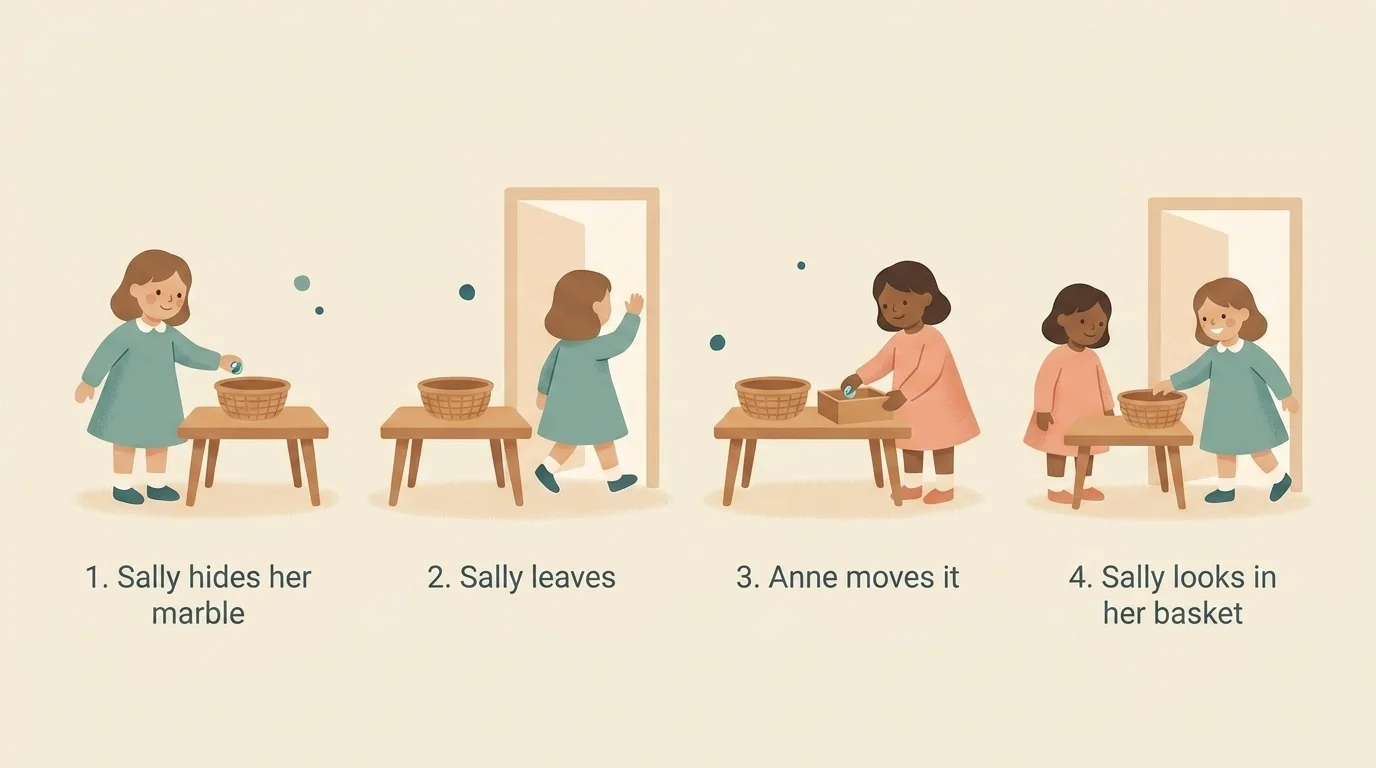
It is a clean, memorable result, which is part of why it traveled so far. But keep one thread in mind, because it becomes the whole story later: passing the Sally-Anne test requires parsing a fair amount of language and holding several clauses in mind at once. A later line of research — notably Schidelko and colleagues in 2021 — argues the task's questioning is inherently ambiguous, and a 2025 reappraisal notes these tasks may make significant demands on abilities other than theory of mind itself. Hold that thought.
Everyday Examples of Theory-of-Mind Differences
Abstract definitions land better with concrete cases, so here are a few — framed, deliberately, as communication mismatches rather than deficits.
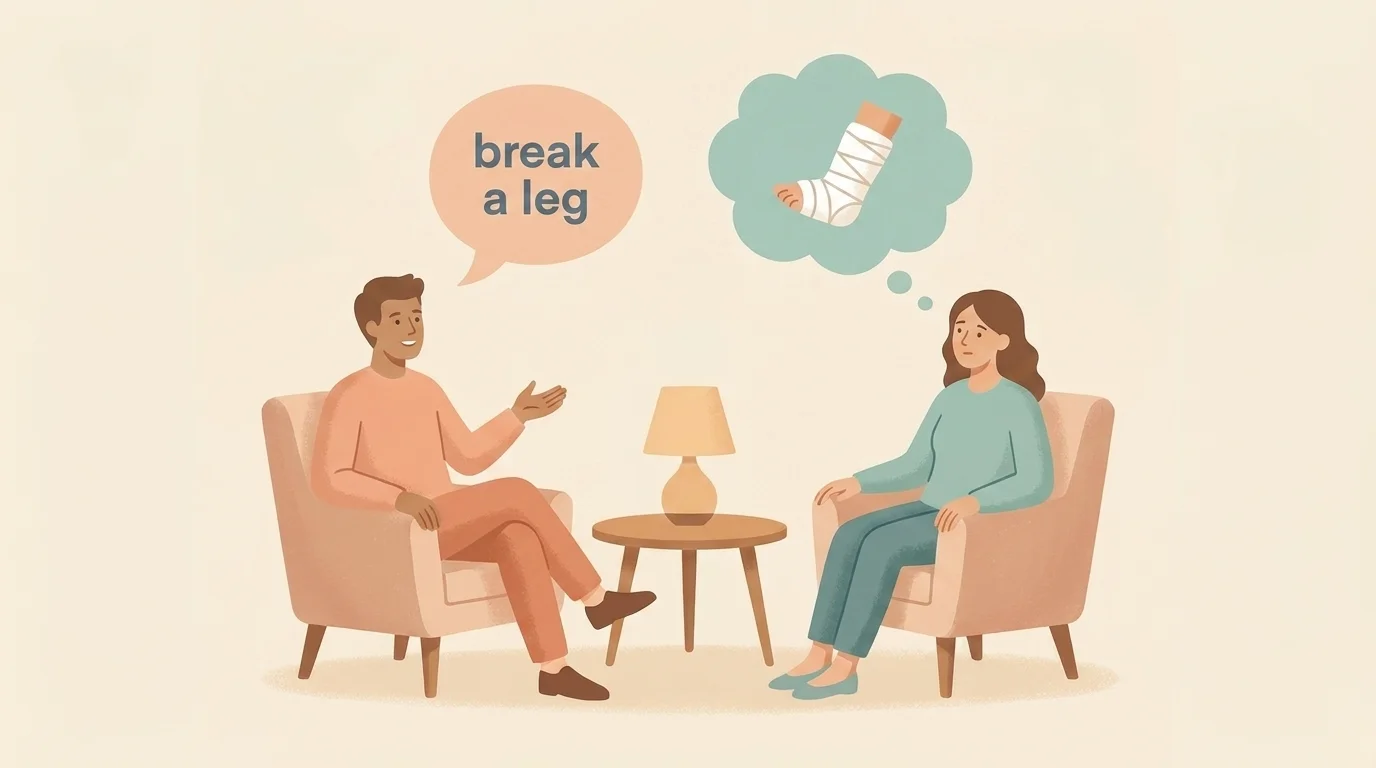
An autistic person takes a phrase like "break a leg" literally and is briefly baffled by it. Someone launches into the middle of a story, forgetting the listener was not there for the beginning and lacks the context they have. A deadpan joke is read as a sincere statement, or a sincere statement is read as sarcasm. Someone gives a technically complete but socially unexpected answer — precise, accurate, and not what the asker was fishing for.
The reflex is to file these under "autistic person fails to read the room." But look again at each one, because the mismatch runs in both directions. The non-autistic speaker who said "break a leg" could have said "good luck." The person expecting sarcasm misread a literal speaker exactly as easily as the literal speaker misread them. Neurotypical people, it turns out, are not natural experts at reading autistic cues — they are simply the majority, which lets their interpretation pass as the default.
That symmetry is the hinge the rest of this piece turns on. (For how these dynamics play out in a group often overlooked, see how autism presents in adult women.) The examples are here to illustrate, not to diagnose — every one describes a two-person moment, not a one-person flaw.
Is Theory of Mind in Autism Debunked?
Not exactly. The strict "autistic people lack theory of mind" claim is heavily contested, and a bidirectional explanation — the double empathy problem — is now supported or positively recognized by a range of autism researchers, Baron-Cohen among them.
"Debunked" is a stronger word than the evidence supports, but the direction of travel is unmistakable. In 2019, Morton Ann Gernsbacher and Melanie Yergeau published a paper whose title does the arguing for it: Empirical Failures of the Claim That Autistic People Lack a Theory of Mind.
Here is the part the press release left out. The best-known piece of evidence for the deficit — autistic children struggling with the Sally-Anne test — may not be measuring what its name suggests. Schidelko and colleagues found the false-belief task's line of questioning inherently ambiguous, and the 2025 reappraisal notes these tasks may make significant demands on cognitive abilities other than theory of mind — particularly executive function and language. Verbal ability does a striking amount of the work: a 1995 analysis pooling 174 participants from earlier studies found autistic children needed a far higher verbal mental age than other children to pass false-belief tasks — reaching a 50% chance of passing at a verbal mental age of about nine, against four in typically developing children. Note what that does and does not show. A gap remains; the autistic children needed more language to get there. But a test that leans this hard on verbal skill, then gets read as a measure of "understanding other minds," is exactly the kind of confound that turns a real result into a wrong conclusion.
This is not fringe pushback. The reappraisal now sits in the field's flagship journals: a 2025 APA critical evaluation of the theory-of-mind hypothesis of autism argues the deficit hypothesis is empirically shaky and should be reframed. The problem it puts to the classic account is simple: most autistic adults, and many autistic children, pass tasks requiring theory of mind — which is hard to square with a model built on an inability to represent other minds at all. "Lacking theory of mind" was never a universal description.
So: deficit, or difference? The honest verdict is that the strict deficit model is losing its grip, not that the classic findings never happened. What replaces it is not "autistic people are fine, nothing to see here" — it is a better account of what those early tests were actually capturing.
The Double Empathy Problem: A Two-Way Street
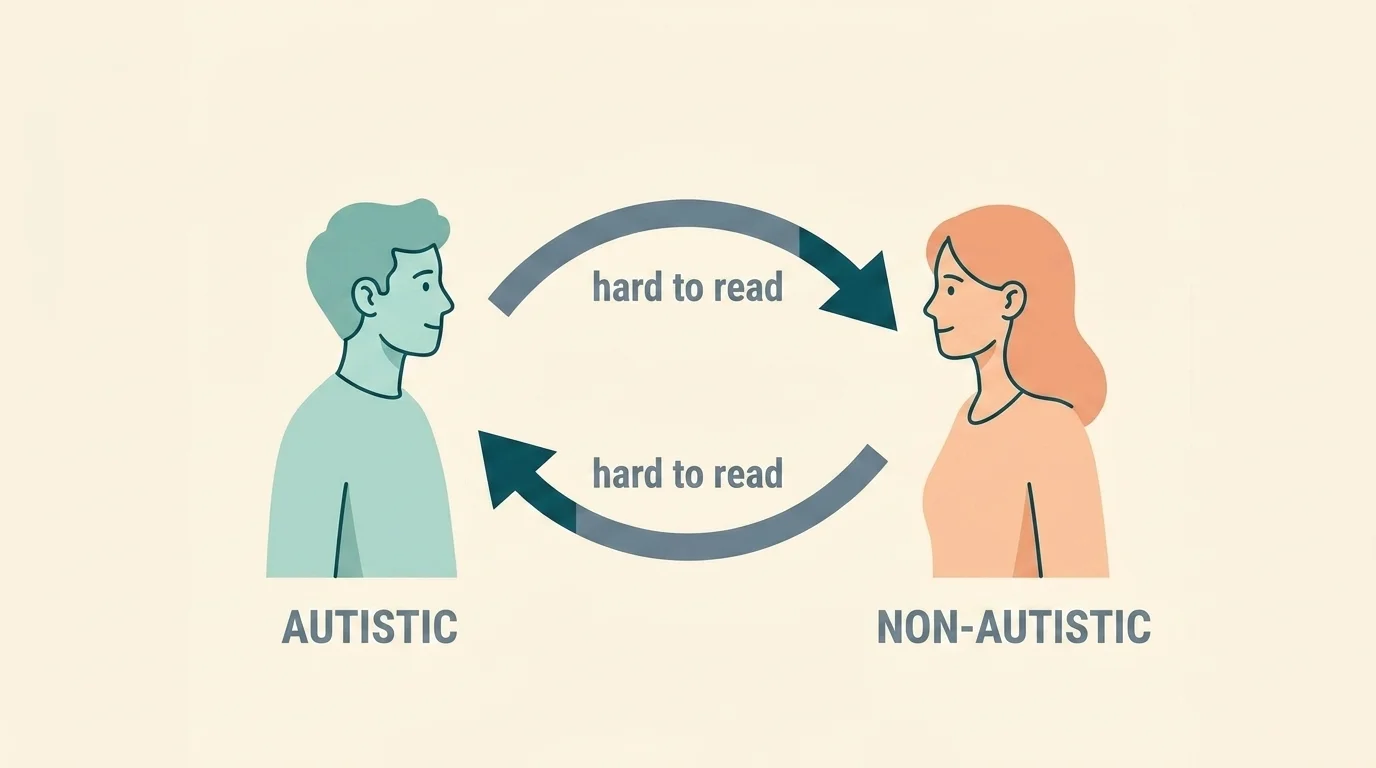
The double empathy problem holds that autistic and non-autistic people struggle to read each other — a mutual mismatch, not a one-sided autistic deficit.
The idea comes from the autistic researcher Damian Milton, who in 2012 described it as "a disjuncture in reciprocity between two differently disposed social actors" — two people whose neurotypes and life experiences differ enough that each finds the other hard to read. The difficulty is relational. It lives in the gap between two people, not inside one of them.
What moved this from a compelling argument to a testable one is data. In a 2020 diffusion-chain study — a structured version of the telephone game — Catherine Crompton and colleagues passed a detailed story down eight-person chains, 72 participants in all. Information degraded significantly faster in mixed chains of autistic and non-autistic people. Autistic-only chains, by contrast, did not differ significantly from non-autistic-only chains, and mixed chains also reported lower rapport. The bottleneck was not autistic communication; it was the mismatch.
A 2025 systematic review of 52 qualitative studies found that autistic adults' experiences of other autistic people were largely positive, and were associated with improved quality of life across a range of domains. Associated with — worth stating precisely, because it is a pattern reported across studies, not a demonstrated cause. Summarizing the experimental work for a general audience in 2021, Crompton and colleagues put it plainly: the quality of interactions between two autistic people "was just as strong as between two people who were not autistic". Note that the claim is parity, not superiority. Some of what looked like broken social machinery was a measurement taken only in mixed company.
One honest limit. Most double-empathy evidence so far comes from speaking autistic adults in Western samples; nonspeaking autistic people and those with intellectual disability are underrepresented, so the reframe is best established for the groups most studied and still being tested at the edges. (Emotion-processing differences such as alexithymia add another layer the simple "deficit" story misses entirely.)
Theory of Mind in Autistic Adults and "High-Functioning" Presentation
Most of the classic research used children. In adults the picture shifts, and it complicates the tests further.
Recall the finding from two sections back: most autistic adults pass explicit theory-of-mind tasks. What a test score cannot show is how the answer was reached. In a 2019 qualitative study of compensation in autism, participants described getting there by deliberate reasoning rather than automatic intuition — watching for patterns in behaviour and transferring them to new people, in a "constant overthinking of possibilities of what to say, how it will come across." As one put it, it "is always a make-do, perhaps like a foreign language. Even though one might have adopted it to a good extent, it's never native." A test that records only the final answer cannot see that effort — which means passing a task is not the same as moving through a day without friction.
Masking — the practiced suppression of autistic traits to fit neurotypical settings — pushes the same way. An adult who has spent years learning to perform expected social responses may score well on a lab task and still find ordinary interaction exhausting. Competence on the test and ease in life are different variables, and the test measures only one.
A word on "high-functioning." My own view is that the label is a blunt instrument: it tends to track how well someone masks or speaks rather than what they need, and it can quietly deny support to people who need it while flattening real variation. Describing specific support needs is more useful, and more accurate, than sorting people into functioning tiers.
Can Theory of Mind Be Developed or Supported?
The affirming answer first: the goal is mutual understanding, not fixing a person. Once you accept the double empathy reframe, "teaching theory of mind" stops being a one-way repair job.
On the evidence for explicit instruction — social stories, perspective-taking practice, structured role-play — my honest reading of the literature is that benefits are modest and context-bound. Skills practiced in one setting do not automatically generalize to messy real life, and gains on a task do not reliably become ease in the world. That does not make support pointless; it makes the framing matter. As one affirming Psychology Today explainer cautions, it is a mistake to underestimate the theory-of-mind abilities autistic people already have.
The more defensible aim is scaffolding communication on both sides. That means offering autistic children and adults concrete tools where they want them, and it equally means teaching non-autistic people — parents, teachers, clinicians, coworkers — to read autistic communication rather than expecting all the adaptation to run one way. Speech and language support is one such tool where communication access is the specific barrier, provided it is offered as support, not as a cure for being autistic.
The reframe is the whole point: if misunderstanding is a two-way street, so is the work of understanding.
The verdict: deficit, or difference?
So — deficit, or difference? The classic science is worth understanding; the Sally-Anne test and the mindblindness hypothesis genuinely shaped a field, and you cannot follow the current debate without them. But the honest 2025 picture of theory of mind and autism looks far more like a mismatch than a mindblindness: autistic minds are not broken empathy machines, and the misunderstanding runs both ways. That shift, from deficit to difference, is the part worth carrying forward — and worth passing to any educator or clinician still teaching the old frame. To keep exploring, browse our innovation coverage and the related work on alexithymia and autism.
Frequently Asked Questions
Do autistic people struggle with theory of mind? Some find false-belief tasks harder, but the picture is contested. Those tasks may make significant demands on abilities other than theory of mind — particularly language and executive function — and their questioning has been called inherently ambiguous. Misunderstanding also runs both ways, which is what the double empathy problem describes.
How does theory of mind explain autism? The classic 1985 model attributed autistic social difficulties to trouble reading others' mental states — the difficulty Baron-Cohen later named 'mindblindness.' Newer research argues those difficulties are better understood as reciprocal, neurotype-based communication differences than as a one-sided deficit, a reappraisal now hosted in the field's own flagship journals.
Do all autistic people lack theory of mind? No — 'lacking theory of mind' was never a universal description. A 2025 critical evaluation notes that most autistic adults, and many autistic children, pass tasks requiring theory of mind — evidence the authors say poses a significant problem for the classic deficit account, which is now heavily contested.
The difference between theory of mind and the double empathy problem is where the difficulty sits. Theory of mind describes attributing mental states to others and recognizing theirs differ from your own. The double empathy problem, coined by Damian Milton in 2012, places the breakdown between autistic and non-autistic people — a two-way mismatch between differing neurotypes, not a one-sided deficit.