Speech Therapy For Autistic


A father sat across from me not long ago — and because I am careful about this, I'll say plainly that the details are changed enough that he is, by now, several fathers folded into one — and told me he had asked his son's speech therapist to leave the picture-exchange folder at the clinic. He was frightened that if his boy learned to hand over a card for juice, he would never bother to say the word. I understood the fear completely. It is the same one that sends parents searching for speech therapy for autistic children at eleven o'clock at night: the quiet worry that a picture card or a talking tablet means giving up on speech. The evidence does not support that fear. This guide walks through what speech therapy for autistic people actually is, whether it works, the techniques a speech-language pathologist uses, and what you can try at home — all from one steady premise. Therapy here supports a person's communication in their own way. It does not fix them, and it does not set out to make them sound like someone they are not.
What Is Speech Therapy for Autistic People?
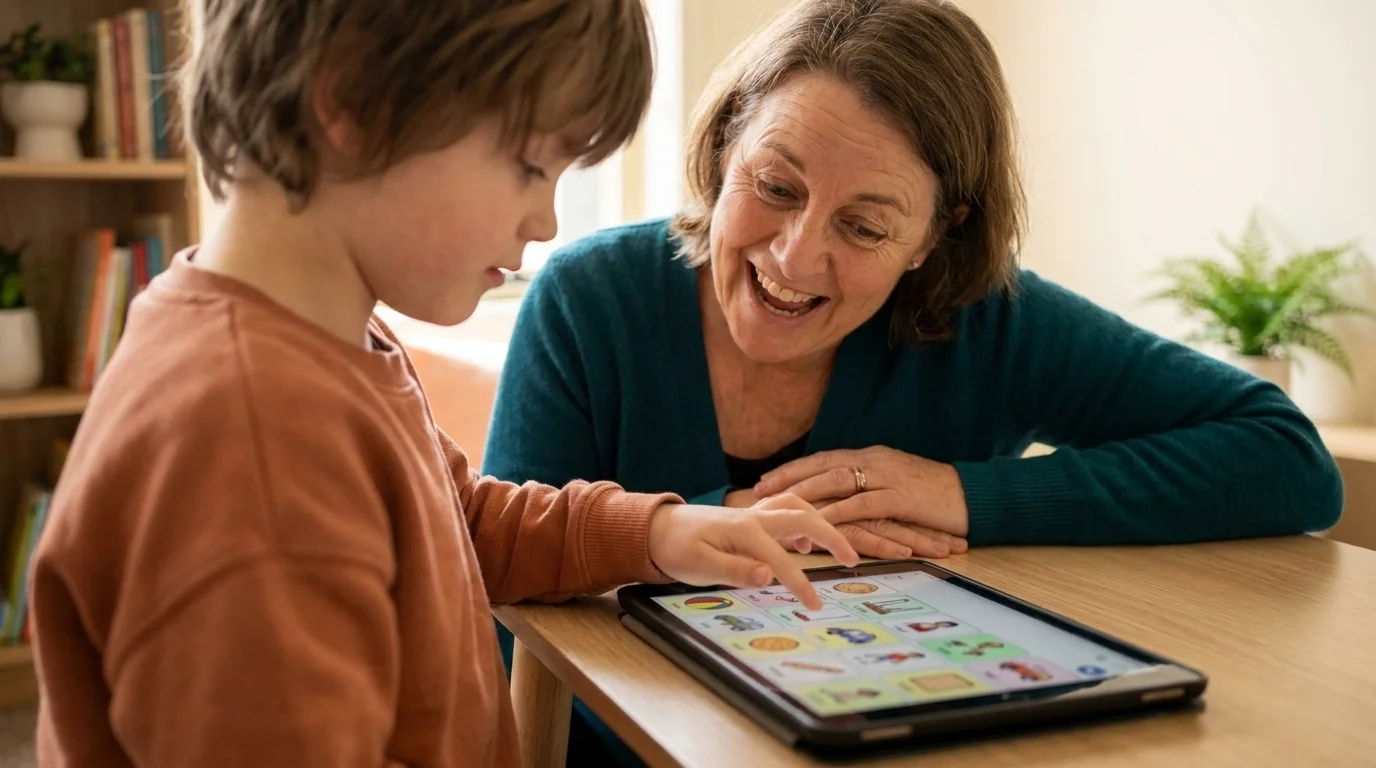
Speech therapy for autism is skilled support from a speech-language pathologist — an SLP — that helps a person understand and use communication in all its forms: spoken, nonverbal, social, and through pictures or devices, so they can express what they need, connect with others, and be understood in their own way.
That definition is doing quiet work, so let me unpack it. The clinician is a speech-language pathologist, a trained professional whose role the American Speech-Language-Hearing Association describes as providing "skilled services … based on their unique needs" (ASHA). The word that matters most is communication, which is much broader than speech. It includes expressive language (getting a message out), receptive language (taking one in), social or pragmatic communication (the back-and-forth of it), and nonverbal channels including AAC. Speech is one lane on a wide road.
This is also where the frame of the whole guide gets set. The goal of good speech therapy is communication, not conversion — not making an autistic person sound neurotypical. That is not a soft editorial preference; it is now the professional default. ASHA directs clinicians to honour a person's own language, noting that some people "choose identity-first language, such as autistic person, because they consider autism an intrinsic part of a person's identity" (ASHA). Autism Speaks frames the work the same way — supporting "verbal, nonverbal, and social communication." The point of naming a person's communication differences is to support them, never to erase them.
Will AAC or PECS Stop My Child From Talking?
No — and I would rather give you what the evidence actually shows than a reassuring pat. This is the fear I hear most often, and it deserves the real thing. Several systematic reviews have looked at exactly this question, and the finding that matters most to a frightened parent is a negative one: nobody has found that AAC costs a child their speech. A systematic review of AAC interventions for autistic children reported "no evidence of loss of speech skills" — and where speech did improve, it recorded only "modest gains" that "could not be attributable directly to AAC intervention," with effects it called "mostly negligible or small" (PMC review). A 2024 meta-analysis of aided AAC and naturalistic intervention goes one step further, and only one: "evidence suggests that providing AAC may actually bolster speech outcomes" (meta-analysis). Note the may. I am not going to upgrade it for you.
So the honest answer to your fear is not "a device will make your child talk more." It is this: no one has found that it makes them talk less, and there is some sign it may help. That is a smaller claim than the one you will read elsewhere, and it is the one the research will actually bear. What the reviews agree on firmly is the wider point — AAC aids are "effective tools for increasing communication in ASD children" (NeuroRegulation review). Handing a child a way to be understood does not close the door on speech. On the evidence we have, it does not touch that door at all — and it opens a different one the same afternoon.
There is a story people tell about why AAC might help rather than hinder, and it is worth hearing so long as you hold it loosely. A child with no reliable way to be understood lives with a great deal of frustration — that much any parent in the room can see. But the step from there to and that is what holds the words back is a proposal, not a finding. The Cochrane review of communication interventions for minimally verbal autistic children puts it carefully: it "has been proposed" that AAC may reduce the pressure to communicate verbally and, in doing so, "indirectly increase the chances of spontaneous vocal production" (Cochrane review). I would not sell you that as the mechanism, because nobody has shown it is. What holds is the pattern itself: communication, once it works at all, tends to want more of itself.
Pair this with a second finding that undoes the timeline many families are silently terrified of. Speech can keep emerging well into childhood and adolescence; the belief that a window slams shut at five is not supported by the research on minimally verbal autistic children, some of whom develop phrase speech years later than that. I'll be careful and name what is still genuinely debated — the exact proportions are not settled, and I would not stake a number on them here. But the direction is clear enough to lean on: this is not a race.
So the reframe worth carrying through the rest of this guide is simple. Therapy supports communication in any modality, on the person's own timeline. AAC is a bridge to communication, not a surrender of speech — and there are signs, hedged ones, that for some children it may be the bridge speech itself walks across.
Does Speech Therapy Work for Autism?
Yes — and it helps to be specific about what that means, because the whole results page asserts it and almost none of it shows the numbers. About thirty percent of autistic children do not develop speech sufficient for the demands of daily communication (PMC review). That is a large, real need, and it is precisely the need speech therapy is built to meet. Autism itself is identified far more commonly than it was a generation ago — roughly 1 in 31 American eight-year-olds in the CDC's most recent surveillance — so more families are asking this question than ever before.
Timing matters in both directions. Autism can be reliably diagnosed by around age two, yet the median diagnosis still lands closer to four, and only about half of children have had a developmental evaluation by age three — a gap that quietly spends some of the highest-yield years for support. So start when you first notice a communication difference. But — and this is the part the "window closes at five" story gets wrong — later gains are real too, as the last section covered.
Here is where I want to hold the line honestly. "Works" does not mean "cures." Progress is individual and rarely linear, and success is better communication and a better quality of life, not an autistic person made to sound neurotypical. A small caution from the consulting room: this guide can orient you, but it cannot assess your child. A speech-language pathologist can — and a communication delay is a reason to seek that assessment, not a verdict on who your child will become.
What a Speech-Language Pathologist Actually Does
If the last question was whether therapy works, this one is what it actually consists of — the part most guides skip. An SLP begins by getting to know how a person already communicates, mapping strengths as much as challenges, and then sets goals with the family or the adult rather than for them. ASHA's own framing is that these are "skilled services … based on their unique needs," often delivered alongside an interprofessional team.
A session does not look like a lesson. For a young child it is usually play- or interest-led — the work hidden inside something the child already wants to do. For an adult it looks more like a conversation, aimed at the situations that actually matter to them: a phone call, a difficult exchange at work, a friendship they want to keep. In both cases the goals point at real communication, not at drills.
The best SLPs are communication-first rather than compliance-first. They build on a person's interests and honour every channel someone uses — including scripting, gesture, and AAC — rather than treating anything non-standard as a problem to extinguish. If you want a sense of how autistic people communicate in ways that are different rather than deficient, that difference is exactly what a good clinician works with, not against.
Over time, goals are reviewed and adjusted. Progress is measured in functional communication — can the person ask, refuse, share, be understood — not in whether they have started to sound like everyone else in the room.
Speech Therapy Techniques and Exercises for Autism
There is no single correct method, and any honest account of the techniques has to say so up front. An SLP reaches for different tools depending on the person, and usually combines several. Here are the ones you are most likely to meet.
1. PECS (Picture Exchange Communication System)
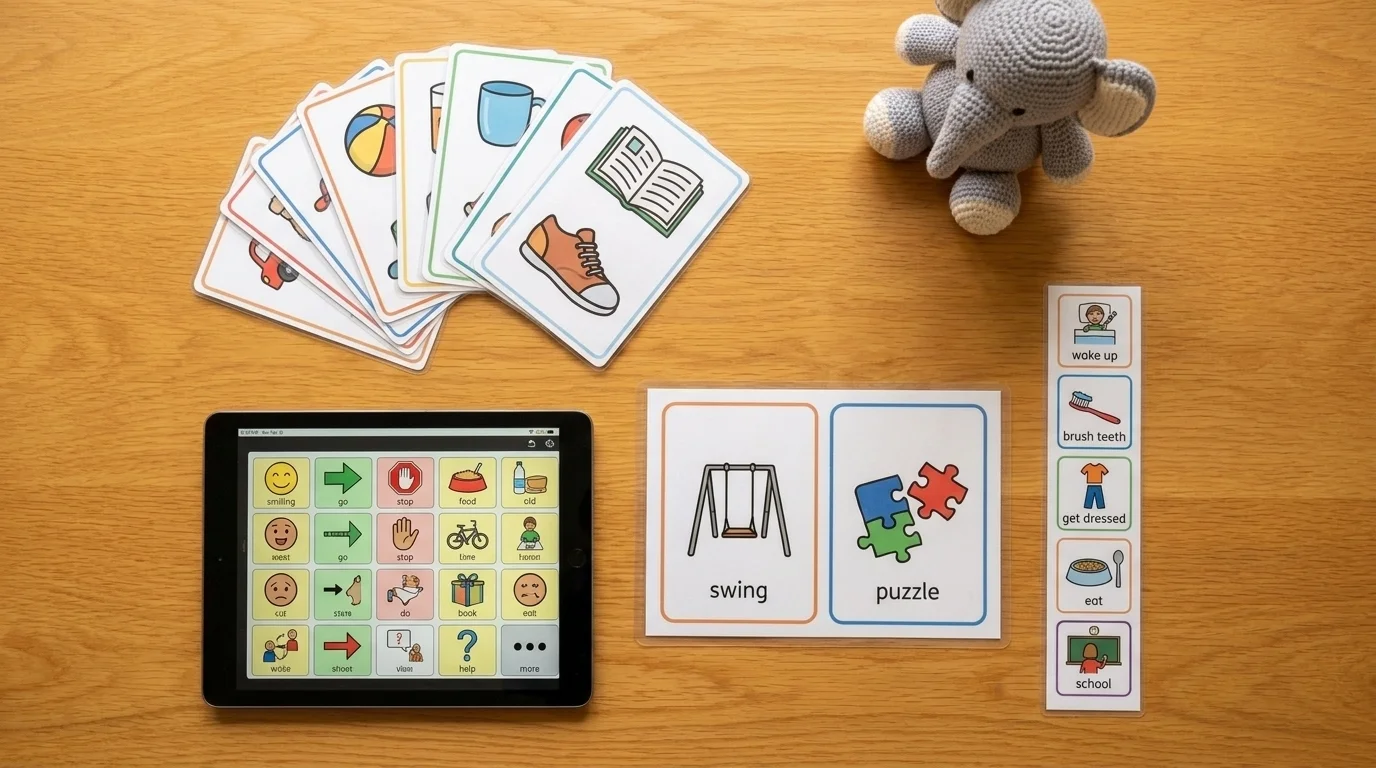
PECS teaches a child to hand over a picture to ask for something — a biscuit, a favourite toy, a turn outside. It is a way in, not a substitute for speech: the child learns that communication is a two-way exchange that gets them somewhere. Some children who begin with pictures go on to pair them with sounds and then words. An SLP builds it gradually, following what the child actually wants, because motivation does most of the teaching here.
2. AAC devices (speech-generating apps and tools)
Augmentative and alternative communication runs from a laminated board to a tablet app that speaks aloud when a symbol is pressed. As the earlier section covered, giving a child a reliable way to be understood has not been found to cost them spoken language, and may support it — for reasons that are still better described than explained. A good SLP matches the tool to the person, never the other way around, and a well-chosen device grows with them as their language does.
3. Modeling and expansion
Here the adult quietly shows the next step. A child says "car"; the adult says "red car" or "car go" — expanding the utterance by a word or two, close enough to imitate. There is no quiz and no pressure to repeat. Over many ordinary exchanges, the child hears language stretched just past where they are, inside something they care about. It is one of the least technical-looking techniques.
4. Visual supports
Picture schedules, choice boards, and cue cards give language something to hold onto. They make the invisible — what happens next, what the options are — visible and steady, which supports both understanding and expression. Visual supports are close cousins of the visual schedules used in classrooms, and the same tools can work just as well at the kitchen table. They lighten the load of holding it all in mind, which frees up room for communicating.
5. Naturalistic / play-based intervention (NDBIs)
Naturalistic developmental behavioural interventions teach communication inside play and everyday life rather than at a desk. If a child loves trains, the trains become the lesson: the adult follows their lead, builds in reasons to communicate, and treats each attempt as worth answering.
6. DIR/Floortime
DIR/Floortime asks the adult to get down on the floor, follow the child into whatever they are doing, and gently open a back-and-forth. The aim is not a correct answer but a shared moment — the turn-taking that underlies all communication. It is warmer and less structured than some other approaches, and clinicians often fold pieces of it into a wider plan rather than using it alone. Its instinct — meet the child where they are — runs through everything above.
Speech Therapy Across the Lifespan: Children, Adults, and Nonverbal Communicators
Speech therapy is not one thing done to one kind of person. What it looks like shifts across a life.
Autistic children
The largest group of searchers are parents of autistic children, and for good reason: early support tends to help most. But "early" is a reason to start, not a deadline to panic about. Goals are led by the child's interests, and progress is measured in real communication — asking, refusing, sharing, connecting — rather than in how typical the child sounds. Most of the techniques above were designed with children in mind.
Autistic adults
Speech therapy is not only for young children, and this is where most guides go quiet. Autistic adults work with SLPs on social communication, self-advocacy, communication at work and in relationships, and on AAC when speech is effortful or unreliable. The frame shifts toward autonomy: the adult sets the goals. Some autistic people move through the particular experience of being identified later in life, and communication support at any age is about being understood as themselves — not being remade into someone easier for others to parse.
Nonverbal and minimally-verbal communicators
Being nonspeaking is not the same as being non-communicating — a distinction that changes everything about how you support someone. Here the work is AAC-first and communication-first: presume competence, provide a reliable way to be understood, and honour every channel a person uses, including gesture, sign, and device. The AAC evidence from earlier matters most for this group. A dependable way to communicate has not been shown to close speech down, and may help it along; and where it does neither, it still gives a person their own voice — which was always the point.
At-Home Speech Therapy Activities for Parents
None of this replaces an SLP, and none of it is homework in the drilling sense. Think of it, instead, as widening the number of moments in a day when communication is welcome and low-stakes. A handful of moves do most of the work at home: narrate what you are doing as you do it; offer real choices ("apple or banana?") and wait for any kind of answer; follow your child's interests rather than redirecting them; lean on visuals; comment rather than quiz ("you found the red one!" instead of "what colour is it?"); and imitate your child's sounds and play.
One small thing changes a surprising amount: wait. Autistic children often need something like five to ten seconds to take in what you have said, find a response, and get it out. That pause can feel unbearably long, and most of us fill it by repeating ourselves or answering on their behalf. Try counting silently to ten before you do.
Five things to try this week
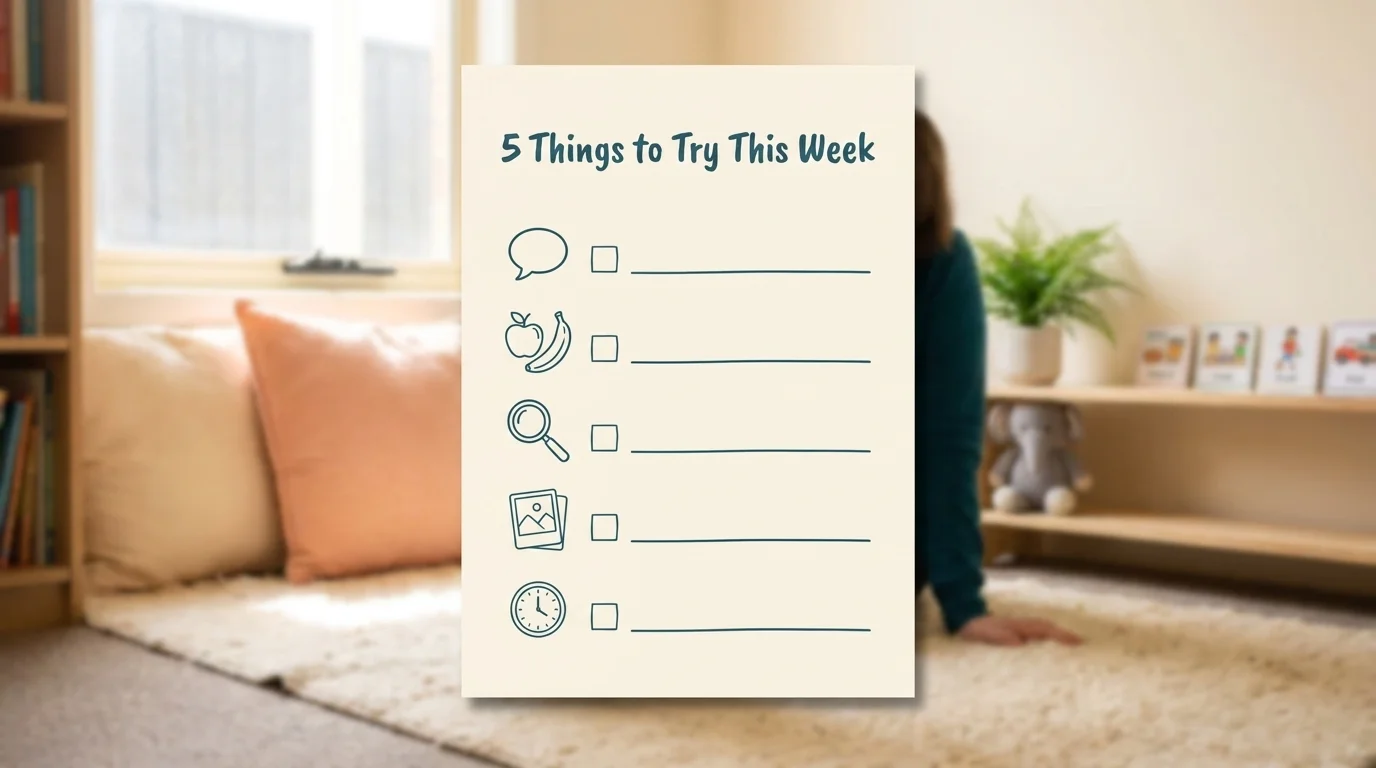
- Narrate one daily routine out loud from start to finish — making toast, running a bath.
- Offer two real choices and honour whatever the answer is, in whatever form it comes.
- Follow their lead for ten minutes of play without steering it anywhere.
- Add one visual — a photo choice board on the fridge, a simple picture schedule for the morning.
- Leave a full ten-second pause after you speak, and resist filling it.
A small caution from the consulting room: you are supplementing the therapist, not replacing one, and you are your child's parent before you are their practice partner. Follow their lead, and stop before it stops being fun for either of you.
How to Access and Choose a Speech Therapist
Most families start with a referral — a pediatrician or GP, an early-intervention program, a school-based service, or a private SLP directly. Be ready for the practical realities: insurance coverage varies, waitlists can be long, and session length and frequency differ a good deal from service to service — that last one is worth asking about plainly when you call, because nobody volunteers it. None of that should stop you from getting on a list early; because autism can be reliably diagnosed by age two, an evaluation the moment you notice a communication difference is time well spent.
Choosing well matters as much as choosing quickly. Look for a clinician who honours a person's identity-first preference where they have one, who treats all modalities of communication as legitimate, and who can tell you plainly how they will build on your child's interests rather than override them. It is entirely reasonable to ask a prospective SLP how they think about AAC, and to keep looking if the answer treats it as a last resort.
A word, finally, about two approaches you may come across — Facilitated Communication and the Rapid Prompting Method. I want to be careful here, because families rarely arrive at them casually. They arrive because they are desperate to hear the inner voice of a child who cannot yet speak for themselves, and that longing is entirely reasonable. But the evidence does not support these methods, and the professional body is unambiguous about both. On Facilitated Communication, ASHA's position is that it "is a discredited technique that should not be used," because "there is no scientific evidence of the validity of FC," alongside extensive evidence that the messages are authored by the facilitator rather than by the person with a disability (ASHA position statement). On the Rapid Prompting Method it is a shade more measured, and lands in the same place: RPM "is not recommended because of prompt dependency and the lack of scientific validity" (ASHA position statement). The honest, hopeful alternative is evidence-based AAC, which is designed to give a person their own voice — not to lend them someone else's.
The Reframe Worth Keeping
If you take one thing from all this, let it be the shift the newest evidence keeps pointing to: speech therapy for autistic people supports communication in any modality, on the person's own timeline. A picture folder and a spoken word are not rivals, and a tablet is not a white flag. Progress is individual and rarely a straight line, and it is not a race against a door that closes at five. Start a few of the at-home moves this week, and if communication support would help, seek out an affirming speech-language pathologist for an evaluation. For more in this vein, the therapy section gathers related neurodiversity-affirming guides. The father I mentioned kept the picture folder, in the end. His son, last I heard, is using more words, not fewer.
Frequently Asked Questions
Speech therapy for autism can start as early as a communication delay is noticed. Autism can be reliably diagnosed by around age two, and early intervention tends to yield the strongest outcomes — though meaningful gains are still possible well beyond early childhood, so it is rarely too late to begin.
Yes — autism can be associated with speech and language delays, and a delay at four years old is a common reason families seek help. It is a reason to ask for a speech-language evaluation, not a verdict on your child's future communication. A speech-language pathologist can assess what is going on and what support would help.
No, and that isn't the goal. Speech therapy will not make an autistic child neurotypical, and an affirming clinician would never aim for it. The purpose is to help an autistic person communicate more effectively in their own way — supporting expression, understanding, and connection. It supports communication; it does not try to erase autism.
How long speech therapy takes to help varies widely by the individual and their goals — progress is individual and rarely linear, and there is no fixed timetable. Because speech can keep emerging past early childhood, therapy is best understood as ongoing support rather than a course with a finish line.
Speech therapy and ABA are different services. Speech therapy is led by a speech-language pathologist and focuses on communication — how a person understands and expresses themselves, in speech or through AAC. The two are sometimes offered alongside each other at the same clinic, but they are not the same service, and this guide covers speech therapy only.