Ocd Pediatric Treatment


If you have just heard the letters O-C-D attached to your child and gone looking, at midnight, for what happens next — this is written for you. Pediatric OCD treatment is one of the genuine success stories of child mental health: it works, it works well, and there is a clear, evidence-backed first-line answer. The parents I see are almost never calm when they arrive, and I have long since stopped expecting them to be; someone has said those three letters out loud about their son or daughter, and everything since has felt like a slow fall. So let me say the reassuring thing first, because it is also the true thing — most children with OCD get meaningfully better with the right treatment. This guide walks you through what that treatment actually looks like: ERP and how it works, when medication is added, the part your family plays at home, the particular question of OCD in autistic children, and how to find the right help. I'll keep it warm, and I'll keep it sourced. None of it replaces your child's own clinician, who knows things about your child that no article can.
Pediatric OCD Treatment: ERP Is the Gold Standard
The gold-standard treatment for pediatric OCD is Exposure and Response Prevention — ERP, a form of cognitive behavioural therapy — with SSRI medication added when symptoms are moderate to severe.
ERP is worth understanding properly, because its logic is not obvious. Anxiety disorders in general are maintained through avoidance: when something frightens a child, they want to avoid it — and avoiding it eases the anxiety in the moment while actually building and maintaining it over time (Child Mind Institute). A ritual — washing, checking, asking for reassurance — is avoidance wearing a practical face, and the relief it brings is real, which is exactly the trap. ERP interrupts the bargain. A child approaches the thing that frightens them, gradually and with support, and then does not perform the ritual — and discovers, in their own body, that the anxiety crests and falls on its own. You cannot reason a child out of a fear the nervous system has learned, but you can let the nervous system learn something new by living through it.
The evidence for this is current and strong. A meta-analysis of 71 randomised trials, published in the American Academy of Pediatrics' journal Pediatrics, found ERP more effective than a waitlist, and probably more effective than a general behavioural comparison treatment — and, in a finding that matters enormously for families far from a specialist, found that ERP delivered remotely by telehealth is as effective as ERP delivered in person (AAP/Pediatrics 2025; AHRQ evidence report). Good therapy for OCD is no longer something only city families can reach.
What a first ERP session actually looks like
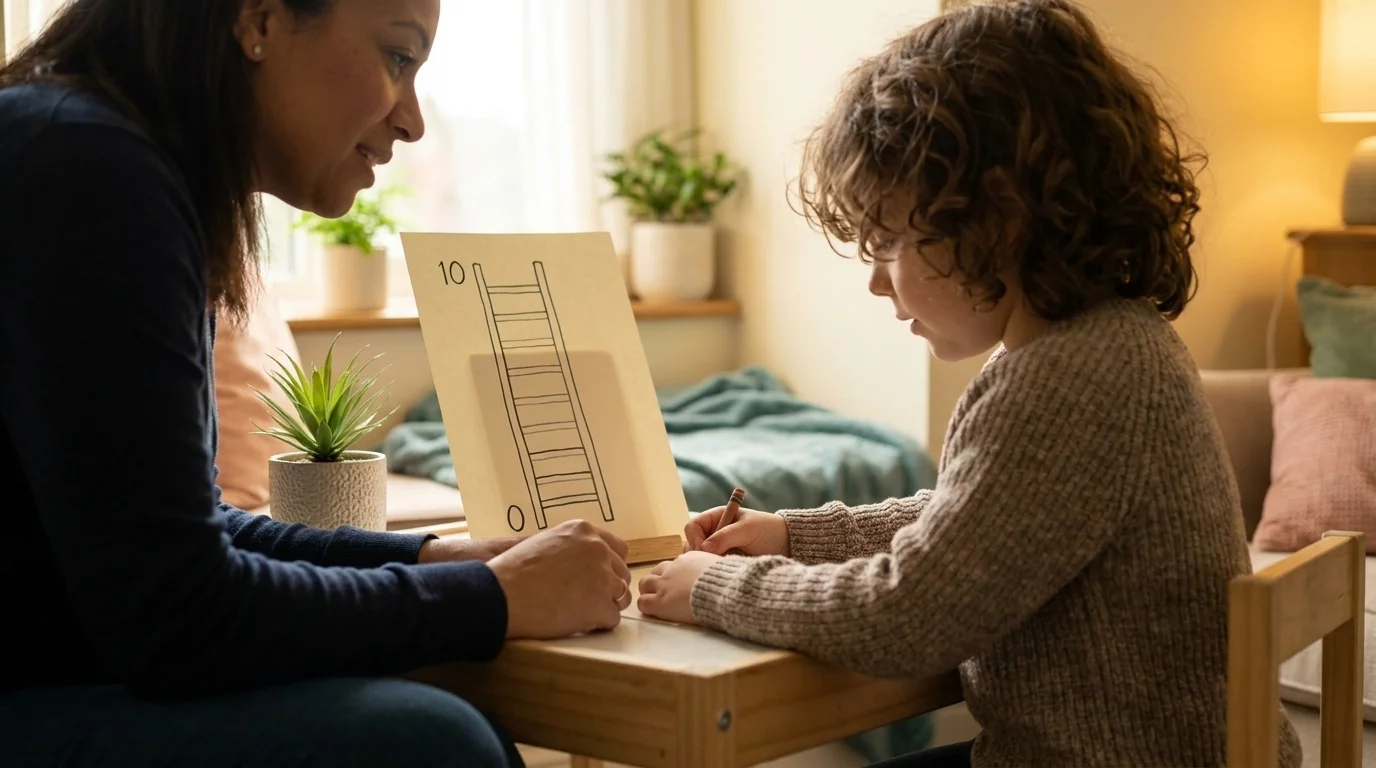
A good first session is, in my experience, mostly conversation. The therapist and the child — with you often in the room — build what is called a fear hierarchy: a ladder of feared situations rated, say, from 0 to 10. A child terrified of germs might place a stack of clean towels on the floor near the bottom of that ladder, with the bin somewhere near the top. You start at the bottom. The child does the small, low-rung thing, feels the anxiety rise, and — this is the whole point — waits, without washing, while it comes back down. Then, another day, you climb a rung. Nobody is thrown into the deep end: the work is gradual by design, and in good practice the child is the one who agrees to each next step.
Is It OCD or Autism? Telling Compulsions Apart — and How ERP Adapts
OCD compulsions are understood to work by avoiding a negative mood state like anxiety; some autistic repetitive behaviours look like the mirror image — moved toward, not away from. Clinicians work out the function before treating anything.
This is the section I most wanted to write, because it is the one the general guides leave out — and it is where a neurodiversity blog can actually be useful. If your child is autistic, you have almost certainly been asked, by someone, whether their repetitive behaviours are "OCD." Often they are not, and the distinction is not academic — it decides what you should, and should not, treat.
The dividing line is function, not appearance. In OCD, the presumption is that a compulsion works to avoid a negative mood state — anxiety, most often. The child does not want to do the ritual, feels dread if they cannot, and experiences it as intrusive. Some kinds of autistic repetitive behaviour appear to run the other way: unusual interests and preoccupations, in particular, seem to be associated with approach-motivation or positive mood states — the child is moving toward something they like, not away from something that frightens them (ERP-for-repetitive-behaviours review). I have kept that sentence carefully hedged because the researchers did: this is a presumption about some types of behaviour, not a law. Still, stimming that comforts a child is not a symptom to be extinguished, and I would gently ask any parent tempted to treat it what they imagine the child would lose.
The practical rule follows from the distinction: you target the distressing compulsion, and you leave the comforting behaviour alone. When a child is both autistic and has OCD — which does happen — ERP still works, but it is adapted. Sessions are kept highly structured, with frequent reviews, and the material is delivered through visual supports — checklists, reminders, daily schedules — because autistic people tend to be visual learners. The assessment itself rests on a thorough behavioural analysis drawing on the autistic person's own account alongside family and helpers (IOCDF). If you are trying to read how an autistic child's mind is working underneath a behaviour, that is precisely the read a clinician experienced in both conditions is trained to make. A small caution from the consulting room, and it is the IOCDF's caution too: much of the research here — the older work especially — does not seem to distinguish between the restricted interests and repetitive behaviours of autism and the obsessions and compulsions of OCD. So when it is genuinely unclear, seek out that experience. Assessing function is subtle work, and getting it wrong in either direction costs the child something.
Medication for Pediatric OCD: The Four FDA-Approved Medications
Four medications are FDA-approved for pediatric OCD — sertraline, fluoxetine, fluvoxamine, and clomipramine — and are usually added when symptoms are moderate to severe.
When ERP alone is not enough, or when symptoms are moderate to severe from the start, medication enters the picture — and here the facts are worth getting exactly right, because frightened parents are handed a great many vague ones. In the United States, four medications are approved by the Food and Drug Administration specifically for pediatric OCD: sertraline (Zoloft), fluoxetine (Prozac), fluvoxamine (Luvox), and clomipramine (Anafranil) (IOCDF). You may hear other medicines mentioned too — escitalopram among them. Two things are worth knowing before that conversation. It is not on the FDA-approved-for-pediatric-OCD list above. And the large evidence reviews do not crown a best SSRI: they analyse SSRIs as a single class, and on that basis find the class more effective than placebo (AHRQ evidence report). If anyone tells you one SSRI is definitively the strongest for children, that is not a claim the current evidence base makes.
Why does ERP still lead, if medication helps? Because on its own, an SSRI typically produces something like a 30 to 40 percent reduction in symptoms — real, but leaving many children with a meaningful share of their OCD still in place (2024 review). Medication tends to do its best work as ERP's partner, not its replacement.
Two reassurances spare families a lot of premature disappointment. OCD often needs higher doses than you might expect — sometimes closer to adult-sized — and a medication deserves a fair trial of ten to twelve weeks at the right dose before anyone concludes it isn't working. And when treatment is working, guidance is to continue it for at least a year after symptoms settle (IOCDF). I want to be plain about my own limits here: I am a psychologist, not a prescriber. Every dosing decision belongs to your child's doctor, and everything in this section is background for that conversation, not a substitute for it.
How to Help Your Child With OCD at Home
You help most by reducing family accommodation: gently stepping out of the rituals, validating the feeling underneath, and supporting your child to ride the anxiety out.
There is a phrase every OCD clinician uses that parents rarely hear until they are deep in it: family accommodation. It names all the small, loving things families do to lower a child's distress in the moment — answering the same reassurance-seeking question for the fortieth time, waiting while a ritual is completed, quietly rearranging the household around the fear. Every one of them is well-meant. And every one, gently, feeds the OCD, because each teaches the child that the fear was too big to survive without the ritual (Child Mind Institute).
Reducing accommodation does not mean withdrawing warmth. It means changing what you offer: not the reassurance the OCD is begging for, but your confidence that your child can get through the wave.
Say this, not that
- Instead of answering "Are you sure my hands are clean?" for the tenth time — try: "That sounds like the OCD asking again, and I love you too much to answer it for it. You can handle not knowing for a minute — I'll stay with you."
- Instead of "Don't worry, nothing bad will happen" — try: "I can see how anxious you feel right now. Let's ride this one out together; it always comes down."
- Instead of taking over the ritual to speed things along — try: "I'm not going to help with the checking, but I'm right here the whole time it feels hard."
The thread through all three is the same: validate the feeling, decline to feed the ritual, and stay beside your child while the anxiety does the only thing anxiety reliably does, which is pass.

You are, in effect, a co-therapist — but one who partners with the ERP clinician rather than improvising exposures alone. And here I want to borrow Winnicott's phrase and say plainly that you do not need to be a perfect co-therapist. You need to be a good-enough one: consistent enough across the week, roughly aligned across both parents where there are two, and quick to celebrate the effort of resisting a ritual rather than waiting for a symptom-free day to arrive. A neurodivergent child needs support at home that bends toward them, not a flawless performance — and good-enough, repeated, is what does the quiet work.
Is It OCD or a Normal Childhood Ritual? Causes, Triggers, and Sudden Onset
A great deal of childhood is ritualistic — the exact bedtime sequence, the foods that mustn't touch, the crack in the pavement that has to be jumped. So a fair first question is whether this is OCD at all. The dividing line I watch for is not the behaviour but its weight: how intense it is, how much distress it carries, how much it interferes. A normal ritual tends to be portable and mostly cheerful; OCD is rigid, frightening to the child, and begins eating into time, school, and family life. If you are orienting yourself with an online checklist or a "does my child have OCD" quiz, treat it as a prompt to ask a professional, never as a diagnosis.
As for causes, there is no tidy one. OCD is a complex problem that likely has a combination of causes, and the causes for one child may not be the causes for another. Twin studies suggest genetics play a stronger role than environmental factors — and, this is the part I most want you to hear, found that a shared environment, like a home, did not significantly affect whether OCD showed up. Brain imaging has turned up some differences between people with OCD and people without, but they are small, not consistently observed, and cannot yet tell us whether they cause OCD or are caused by it (IOCDF). It affects somewhere between 1 and 3 percent of children (2024 review). Nothing you did as a parent caused this — and that one deserves saying flatly, because so many parents privately believe otherwise. Reading the difference between an anxiety-driven behaviour and a self-regulating one is genuinely hard from the inside, which is a large part of what a clinician is for.
A note on sudden-onset OCD (PANDAS/PANS)
One uncommon pattern is worth naming, carefully, without alarming anyone. In most children OCD builds gradually. Occasionally it appears almost overnight — a dramatic, sudden onset, sometimes after an infection — which clinicians discuss under the labels PANDAS and PANS. If that describes what you saw, it is worth raising specifically with a clinician, because the picture is distinct and may be handled differently. But there is no confirmatory lab test, it is genuinely rare, and a sudden bad week is not the same thing (AAP 2025 PANS report; NIMH).
Treating OCD in Teenagers vs. Younger Children
Treatment is not one-size-across-ages, and the evidence lets us be specific.
For school-age children and teenagers, the landmark POTS trial still anchors the evidence, and its numbers are worth seeing plainly. Among 112 children aged 7 to 17, twelve weeks of treatment produced clinical remission in about 54 percent on CBT combined with sertraline, about 39 percent on CBT alone, about 21 percent on sertraline alone, and under 4 percent on placebo (POTS, JAMA 2004). Two details inside that table matter more than the headline. Combined treatment did not statistically outperform CBT alone on remission — which is why the trial's own conclusion is that children should begin with CBT plus an SSRI or CBT alone. Therapy by itself is a legitimate starting point, not a compromise. And sertraline alone, for all that it beat placebo on symptom severity, did not reach statistical significance on remission — one more reason medication belongs in this story as ERP's partner rather than its stand-in. In my experience teenagers can also do more of the cognitive work themselves and take on self-directed exposures between sessions.
For younger children — roughly ages five to eight — the approach leans family-based: parents are coached as co-therapists and lead much of the work at home. The POTS Jr trial showed this works even at that age, with around 72 percent of children responding to family-based ERP versus about 41 percent in a comparison group (POTS Jr).
One honest expectation to hold alongside the hope: most children improve, but up to a third of early-onset cases do not fully respond to first-line treatment, and finding the right combination can take iteration (research review). That is not failure — it is information the next step gets built on.
How to Find and Vet an ERP-Trained Therapist
Because ERP is specific, finding a therapist who genuinely does it — rather than general talk therapy with a hopeful name — matters more than almost any other choice you will make here. A few questions sort the field quickly. Do you use ERP specifically for OCD? How do you build a fear hierarchy? How are parents involved? A clinician who does this work will have clear, unhurried answers, and will not be offended that you asked.
Look for explicit ERP or CBT-for-OCD training. The International OCD Foundation keeps a directory that is a reasonable place to start — as a resource, not a recommendation of any one person.
And if there is no specialist within reach, the remote options are legitimate, not a consolation prize. The current evidence finds ERP delivered by telehealth as effective as ERP delivered in person (AAP/Pediatrics 2025), and internet-delivered CBT for adolescents has reported strong results — on the order of 71 percent responding and 76 percent in remission at six months in the reviewed studies (2024 review). Distance is a smaller barrier than it used to be.
What to Hold Onto
If you are still awake with all of this, hold onto its shape: pediatric OCD treatment is genuinely hopeful. ERP leads, medication and your steady presence at home support it, and autistic children are served by the very same tools, thoughtfully adapted. None of it asks you to be a perfect parent — only a good-enough one who keeps showing up. The single most useful next move is a conversation: with your child's pediatrician, or an ERP-trained clinician you can find through the IOCDF directory. You might start by easing one small accommodation this week. And to say it once more, plainly: this has been educational, not medical advice — your child's own clinician comes first. For more in this vein, horizonsmind's therapy writing is a good place to keep reading.
Frequently Asked Questions
Can OCD in children go away without treatment? The evidence behind this guide does not answer that, and I would rather say so than guess. What it does show is the hopeful part: with ERP first and medication where it is needed, most children improve. That is reason enough to seek help rather than wait.
What medications are FDA-approved for pediatric OCD? Four are: sertraline (Zoloft), fluoxetine (Prozac), fluvoxamine (Luvox), and clomipramine (Anafranil). They are typically added when a child's symptoms are moderate to severe rather than used first, since ERP therapy leads. Any decision about medication and dosing belongs to your child's prescribing doctor.
How long does pediatric OCD treatment take? It varies, and there is no single number — but two timelines are worth knowing. If medication is part of the plan, it deserves ten to twelve weeks at the right dose before anyone judges it. And once symptoms settle, guidance is to continue treatment for at least a year.
What is sudden-onset OCD (PANDAS/PANS)? It is a rare presentation in which OCD symptoms appear abruptly, sometimes after an infection, rather than building gradually. Because the picture is distinct, it is worth raising specifically with a clinician — though there is no confirmatory lab test, and a single bad week is not the same thing.
Can very young children (ages 5-8) be treated for OCD? Yes. Family-based CBT with ERP is effective even at this age, with parents coached as co-therapists to lead much of the work at home. The POTS Jr trial showed young children respond well to this developmentally adapted, parent-led approach.