Alexithymia And Autism


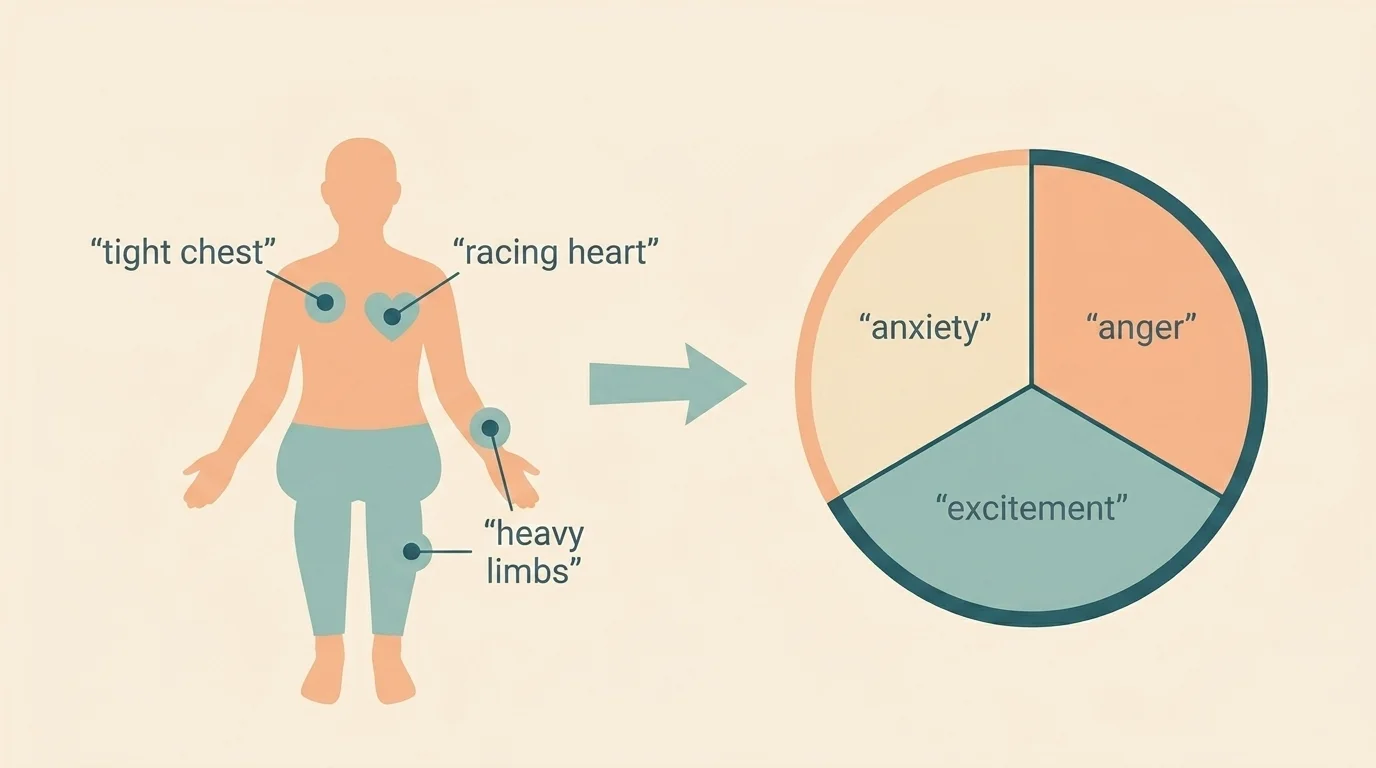
You feel a tight chest, a low buzzing dread, a fog you cannot see through — and if someone asks whether that is anxiety, anger, or plain exhaustion, you honestly cannot say. That gap between feeling something and being able to name it is what alexithymia and autism, taken together, come down to in a single sentence, and it affects roughly half of all autistic people.
Here is the part the deficit narrative gets wrong, and it is worth saying before anything else: this is not the absence of emotion. A January 2026 study from the University of Birmingham found that autistic people do not lack emotional expression — they form it differently, "almost like speaking different languages." The rest of this guide is what follows from that reframe: what alexithymia actually is, why it rides along with autism so often, the empathy myth it feeds, how it is really measured, and a concrete, body-first toolkit for working with it — the practical part almost no page on this topic bothers to publish.
What Is Alexithymia — and Why Is It So Common in Autism?
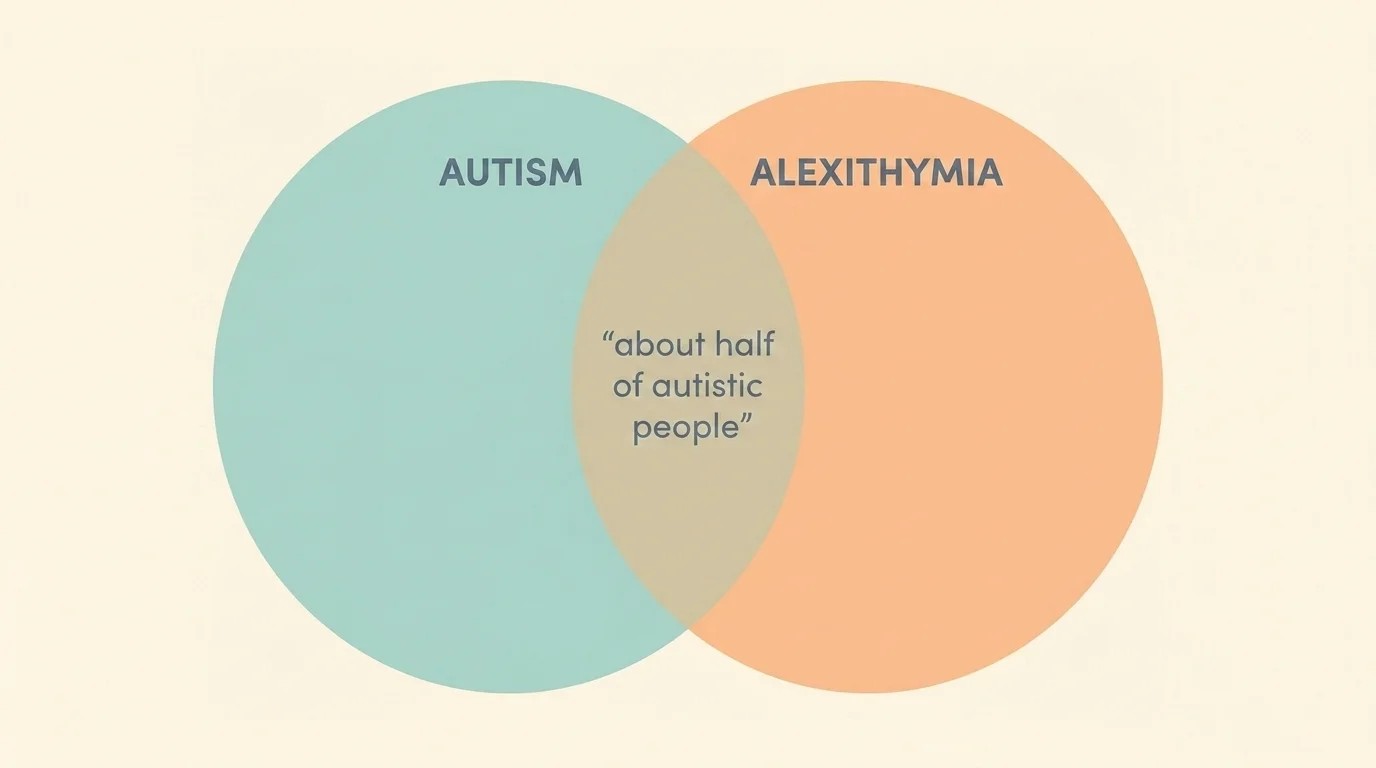
Alexithymia is difficulty identifying and describing your own emotions. It isn't autism, but about half of autistic people have it.
That capsule hides two facts worth separating. First, alexithymia is a trait, not a diagnosis — it sits on a spectrum, and you will not find it in the DSM-5. It describes a way of processing emotion, not a disorder you either have or don't. Second, the co-occurrence with autism is real and large. The cleanest number comes from Kinnaird and colleagues' 2019 meta-analysis of 15 studies: pooled prevalence of alexithymia was 49.93% in autistic people versus 4.89% in the general population. Some individual samples run higher — up to roughly 85% showing at least slight alexithymia — but the fifty-versus-five figure is the one with the strongest evidence behind it, and it is the one to remember.
"About half" also means about half not. Being autistic does not guarantee alexithymia, and plenty of alexithymic people are not autistic at all. They are distinct things that keep company. For the wider context, the development category collects the related pieces.
Alexithymia vs. autism: how they differ
The short version: autism is a broad neurotype — a whole pattern of social communication, sensory experience, and focused interests. Alexithymia is one specific thing: difficulty putting a name to what you feel. One is the territory; the other is a single feature of the map that happens to show up disproportionately inside it. Keeping the two separate is the entire reason the rest of this article holds together.
Alexithymia and Autism: A Different Emotional Language, Not Missing Emotions
This is the part the older guides on the topic simply do not have, because the science is newer than they are.
In January 2026, researchers at the University of Birmingham analysed about 5,000 facial expressions from 51 adults — 25 autistic, 26 not — capturing more than 265 million data points. Their finding, published in the journal Autism Research on 19 January 2026, was not that autistic people express less emotion. It was that they form expressions differently — less smoothly, on a different timeline — and that the higher a person's alexithymia, the more ambiguous their anger and happiness expressions were. As Professor Jennifer Cook put it, autistic and non-autistic people may express emotion in ways that are "different but equally meaningful — almost like speaking different languages."
Hold onto that metaphor, because it fixes the whole picture. The emotion is there, and it is felt fully. What runs differently is the translation — the step that converts a body signal into a named feeling.
What interoception has to do with it
Interoception is the sense of your own internal state: heartbeat, breath, a full stomach, the muscle-tightening that runs ahead of a feeling. The evidence points to this as the site of the gap. In a 2016 study, Shah and colleagues concluded that alexithymia, not autism, is associated with impaired interoception — the body sends the signal, but the wiring that reads it and hands back a label ("that tightness is anxiety") runs on a different frequency. This is why difficulties often pinned on autism itself — trouble with emotion recognition, for one — track alexithymia more closely than they track autism. The naming stumbles; the feeling does not.
The Empathy Myth: Can Someone With Alexithymia Feel Love?
Yes. People with alexithymia feel love; the difficulty is recognising and naming feelings, not lacking them.
This is the myth worth dismantling with actual evidence, because it does real damage. For years, "low empathy" was filed under autism as a defining trait. The more careful reading is that traits long blamed on autism — blunted emotion recognition, difficulty reading a partner's mood — are frequently predicted by co-occurring alexithymia rather than by autism itself. A 2025 fMRI study revisiting this "alexithymia hypothesis" found that alexithymia, not autistic traits, modulated social-brain activity during facial-affect recognition. Report that study honestly, though, and it splits in two. On the brain measure, alexithymia did the work. On the behavioural measure it did not: autistic participants recognised faces less accurately regardless of alexithymia status — a result the authors say does not support the alexithymia hypothesis at the behavioural level, and a split between behaviour and brain response they call an unexpected dissociation. By their own account the wider behavioural evidence for the hypothesis is substantial; this particular study just did not reproduce it. That is what a live question looks like, and you are entitled to see it rather than the tidied version. The distinction still matters, because it moves the target from "this person cannot care" to "this person cares and cannot narrate it."
In a relationship, that looks like a partner who is fully present and deeply attached but goes quiet when asked "what are you feeling?" — not evasion, but a genuine blank where the label should be. The workarounds are unglamorous: agreed check-in scripts, permission to answer "I don't know yet," and describing the body ("my chest is tight") when the emotion word will not come. It helps to separate affective empathy — feeling with someone — from cognitive empathy — correctly reading what they feel. Which of the two alexithymia weighs on is not something I can settle from the evidence here; what that evidence does say is that the difficulty tracks alexithymia rather than autism.
Signs and Symptoms: What Alexithymia Actually Feels Like
The signs are consistent enough to list, though they are easy to miss from the outside because they are mostly internal. Common ones: confusing an emotion with a physical sensation; answering "how do you feel?" with a genuine, non-evasive "I don't know"; struggling to tell hunger from anxiety, or tiredness from sadness; a flat or blank response where a feeling was expected; and realising hours or days later what you were actually feeling at the time. This is a spectrum — it can be a passing state or a stable trait, and it splits into a cognitive strand and an affective strand. In the Bermond–Vorst model, the cognitive strand covers identifying, analysing and putting words to feelings; the affective strand covers how strongly emotion-inducing events arouse you, and how readily you fantasise.
What alexithymia feels like from the inside
The autistic adults who describe this online are strikingly consistent, and their accounts are more useful than any clinical checklist. The recurring version goes something like this: the body reacts first and loudest — a clenched jaw, a stomach drop, a wired restlessness — and the word for it arrives late, if it arrives at all. Some describe scanning a mental menu of emotion words and finding none that fit. Others notice they are upset only because they have started crying, having felt nothing they could name beforehand.
Concrete examples
A few short ones. You skip lunch, get increasingly irritable and short with people, and only later realise you were not angry — you were hungry. A friend's dog dies; you know it is sad, you say the right thing, and the feeling itself does not land until the drive home. Someone asks how the interview went and you can report every fact about it and nothing about how it made you feel. None of these is coldness. Each is the label lagging the signal.
What Causes Alexithymia?
There's no single cause. Alexithymia is linked to differences in interoception, and to genetics shared with autism and sensory processing.
Take those in turn. The proximate mechanism is the interoception gap from earlier — if the internal signal is hard to read, the emotion built on top of it is hard to name. That is the "how." The "why some people and not others" is partly genetic, and here the newest evidence is genuinely interesting. A 2025 study in Translational Psychiatry, a Nature journal, examined the shared genetics of autism and sensory processing and found that the genetic correlation between them was no longer statistically significant after controlling for alexithymia. Read carefully, that suggests alexithymia may account for part of the genetic overlap people had been attributing to autism directly. It is a genetics-and-correlation finding, not proof that alexithymia "causes" anything — the honest version is that these traits share more machinery than we assumed.
How Is Alexithymia Assessed? The TAS-20
The most common measure is the 20-item Toronto Alexithymia Scale (TAS-20); a score of 61 or above indicates alexithymia, 52 to 60 indicates possible alexithymia, and 51 or below indicates none.
Here is what it actually is, because "take the test" gets thrown around loosely. The TAS-20 is a self-report questionnaire — twenty statements you rate on a scale. It is, as a meta-analysis of the scale's structure puts it, the most popular instrument for assessing alexithymia — the 49.93% prevalence figure from earlier ran on it, using the ≥61 cutoff. That cutoff is one of three bands set by the scale's developers in 1994: 51 and below means no alexithymia, 52 to 60 means possible alexithymia, and 61 and above means alexithymia.
What it is not is a diagnosis. A screener sorts people into "worth a closer look" and "probably not"; it does not hand down a verdict, and no single questionnaire should. Free online versions exist and are fine as a starting point — a way to put a name and a number to something you had only felt vaguely — but treat the result as the beginning of a conversation, not the end of one. I write about what the research says; that is not a substitute for the conversation itself. If the score is high and it is affecting your relationships, your work, or your sense of yourself, that is the point to bring it to a clinician who understands neurodivergence, not to self-manage from a webpage.
Coping and Treatment: A Body-First Toolkit
Alexithymia can improve. Body-first strategies — naming physical sensations, interoception training, emotion wheels, and affirming therapy — build emotional vocabulary over time.
Start with the honest framing: the goal is not a cure, it is fluency. And there is real evidence the needle moves — in one longitudinal study of personality-disorder patients, alexithymia improved significantly with treatment and 19% reached full remission. Read that cohort carefully: it is not an autism sample, and the study does not tell us whether the same holds for autistic people, or which treatment did the work. What it establishes is narrower than it first looks, and still worth having — alexithymia is not necessarily fixed. "Fixed forever" was never the right frame anyway. Here is the toolkit clinicians increasingly reach for.
Name the body sensation first
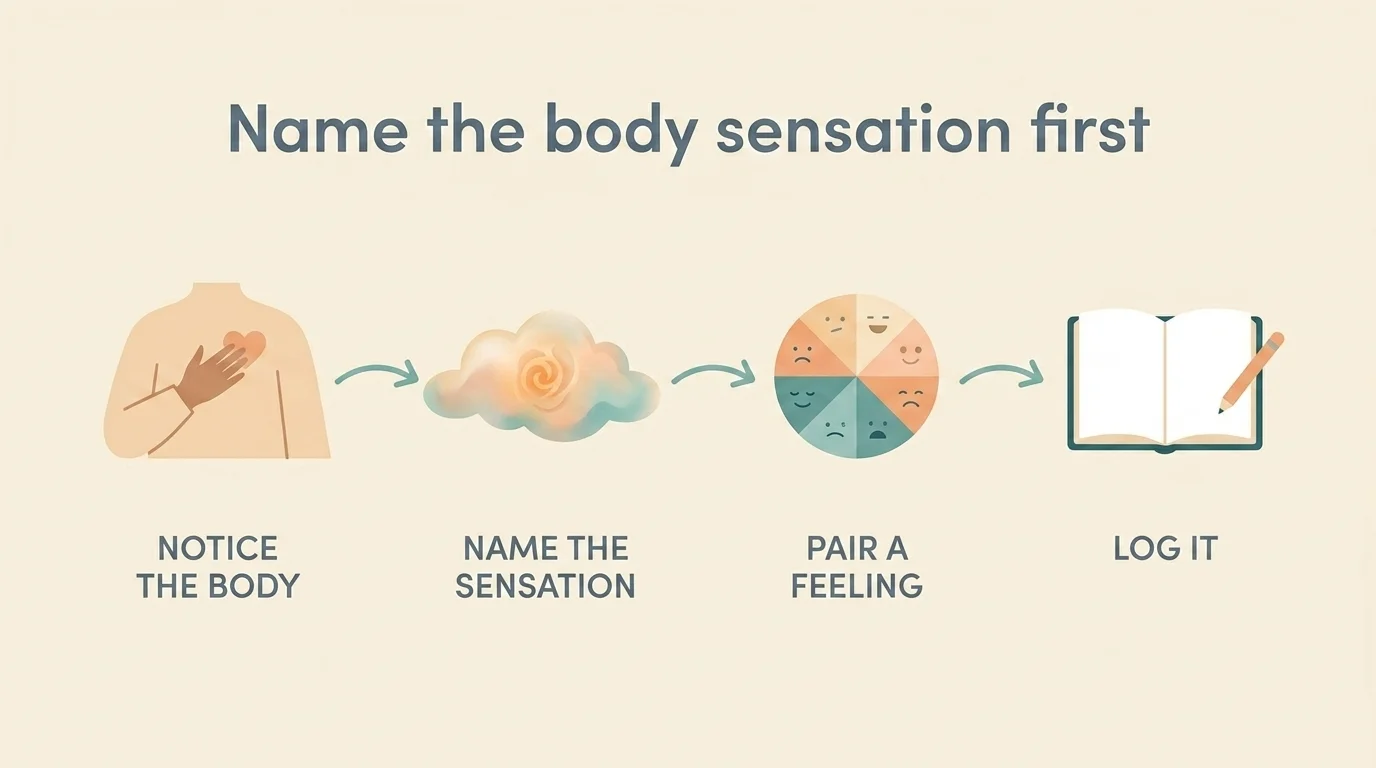
This is the whole method in one move, and it inverts the usual advice. Instead of asking "what am I feeling?" — the exact question the wiring struggles with — ask "what is my body doing?" Tight chest. Heavy limbs. Buzzing hands. Clenched jaw. Name the sensation, which is concrete and available, then work outward to the emotion it usually signals. You are building the missing half of the translation, one reliable pairing at a time.
Interoception training
Because the gap sits in interoception, that is the sense to train. Simple, repeatable exercises: pause and count your own heartbeat, follow your breath, notice hunger and thirst before they become urgent. A 2026 argument in the International Journal of Developmental Disabilities makes the case that autism support has under-prioritised interoception relative to social-skills training — that the body-signal layer should come first, not last.
Emotion wheels and mood tracking
When the word will not come, a scaffold helps. An emotion wheel gives you a menu to point at instead of generating a label from nothing; a simple daily mood log builds the pattern library over time. These are training wheels, not a permanent crutch — the aim is to need them less as the pairings become familiar.
Neurodiversity-affirming therapy and accommodations
Therapy that treats this as a difference to work with, not a defect to correct, is the kind worth finding. There is preliminary evidence that cognitive behavioural therapy adapted for emotion regulation helps autistic adults, and plain accommodations carry weight too: at work, feedback in writing rather than "how do you feel about this?"; in relationships, the check-in scripts from earlier. Our other development and coping guides go deeper on the day-to-day of this.
Alexithymia in Autistic Women and AuDHD
Two overlaps get asked about and answered almost nowhere. Both are places where the honest answer is about what the evidence does not say.
Alexithymia, women, and late diagnosis
This is the question I most wanted to answer with a number, and I cannot. The intuitive story is masking: that a lifetime of performing the socially-expected emotional response — saying the right thing, arranging the right face — hides alexithymia in autistic women and late-diagnosed adults, so nobody clocks the gap, including the person themselves. It is a plausible story and I have no evidence for it. Nothing I have cited in this article tests it, and the two guides that rank for this question mention gender only in passing or not at all. So take the masking explanation as a hypothesis worth raising with a clinician who knows neurodivergence, not as a finding. If being identified later in women is part of your picture, that conversation is where this belongs.
The AuDHD overlap
Then there is AuDHD — autism and ADHD together — and this is the point where I run out of evidence and say so. I could not find clean coverage of how alexithymia sits inside that combination anywhere, let alone a study I would be willing to quote a number from. That absence is worth knowing in itself: anything you read that confidently describes how the three interact is running ahead of the research, mine included. If ADHD in adults is part of your picture, factor it into the clinician conversation rather than assuming the findings above transfer to it unchanged.
The Route from Body to Words Can Be Trained
So, the reframe, plainly. Alexithymia is not a broken heart or an empty one. It is a different route from the body to the word for what the body is doing — and unlike a lot of things about how a brain is wired, that route can be trained. If you recognised yourself in the opening paragraph, that recognition is already the first step. Try the "name the body sensation first" move this week. Take the TAS-20 as a starting point, not a verdict. And when you want to go further on alexithymia and autism, the rest of our development guides are here.
Frequently Asked Questions
Can alexithymia go away? Not always, but it isn't necessarily fixed. In one longitudinal study of personality-disorder patients — not an autism sample — alexithymia improved with treatment and 19% reached full remission. Read that cohort carefully: it doesn't tell us which treatment did the work, or whether the same holds for autistic people.
What is the most common misdiagnosis of autism? I can't rank them honestly — nothing cited in this article measures that, and I won't guess. What the evidence does support is narrower: alexithymia is common in autistic people, so 'I don't know what I feel' is a missing label, not a missing feeling. Say that to whoever is assessing you.
Does alexithymia get worse with age? I don't have an answer I'd stand behind. Nothing in the research behind this article tracks alexithymia across the lifespan, so anything confident about ageing — in either direction — is running ahead of the evidence. What that evidence does support is only this: alexithymia is not necessarily fixed.
Do people with alexithymia cry easily? It varies, and I have no figure for it. The pattern autistic adults describe is the one this article keeps returning to: some notice they are upset only because they have started crying, having felt nothing they could name beforehand — the body reacting before the label arrives.
Is alexithymia a mental illness or diagnosis? No. Alexithymia is a trait that sits on a spectrum, not a formal diagnosis, and it does not appear in the DSM-5. It describes how a person processes and labels emotion, and it turns up in autistic and non-autistic people alike rather than being a disorder of its own.