Autistic in Adult Women


She is at the party, or the team meeting, or the school gate, doing a great deal of work no one in the room can see: reading faces, timing her contributions, gauging how long to hold eye contact. She will go home emptied out and not quite know why. To be autistic in adult women is very often to be fluent, exhaustingly, in a language you were never actually taught. It is not rare — it was unseen, which is a different thing, and it is changing fast. What follows is what the signs actually look like, why a generation of women went unrecognised, what the daily performance costs, and how, if this reads like your own life, you might go about being seen.
The hidden generation is being found right now
Autism in adult women was long hidden by a diagnostic model built around boys — and the newest data shows that gap closing, with adult women now being identified in record numbers.
Two studies published since late 2024 tell the story with unusual clarity:
- A February 2026 study in the BMJ (Fyfe and colleagues), which followed 2.76 million people born in Sweden between 1985 and 2020, found the male-to-female autism diagnosis ratio fall from roughly 4:1 in childhood to just 1.2:1 by age 20 in the most recent cohort — and projected it to reach parity around 2024. Across the study window autism diagnoses rose roughly tenfold, and the age at diagnosis for females now peaks at 15–19, against 10–14 for males (News-Medical summary).
- A JAMA Network Open study from October 2024 (Kaiser Permanente, 12.2 million US records) found the sharpest rise of any group among adults aged 26–34 (+450%), and that the adult increase was steeper for women (+315%) than for men (JAMA Network Open / PMC).
Read those two findings together — one a whole-population cohort, the other a decade of US clinical records — and the conclusion is hard to avoid: the gender gap in autism was never biology. It was an artefact of a model built to recognise boys, and the model is visibly correcting. Even now the wave is early. UCLA Health estimates that around 80% of autistic females are still undiagnosed at 18 (UCLA Health). The late-diagnosed autistic adults arriving at recognition today are the leading edge of a much larger cohort still standing in the dark.
What are the signs of autism in adult women?
Autism in adult women often looks like social exhaustion, sensory sensitivity, intense focused interests, and executive-function struggle — real traits, easily mistaken for anxiety, shyness, or simply being "sensitive." UCLA Health groups the presentation into five broad signals — plus a sixth heading for the conditions that commonly arrive alongside them — and they are a good place to start, provided you read them for depth rather than as a tick-box (UCLA Health):
- Social communication. Not an absence of social skill but a performed one: rehearsing conversations in advance, scripting small talk, mirroring other people's expressions and phrasing. The fluency is real, and it is expensive — the work happens where no one can see it.
- Sensory sensitivity. Light, sound, particular textures and fabrics, the seam of a sock, the hum of a fridge, certain foods refused for reasons that read to others as fussiness. What looks like preference is often genuine overwhelm managed quietly.
- Self-regulation and executive function. Shutdowns and meltdowns that can arrive behind a closed door, after the performance is over; a disproportionate struggle to begin tasks, sequence a day, or switch between them. The executive-function load is one of the least visible and most tiring parts of the picture.
- Intense interests. Deep and sustained, and easily mistaken for an ordinary enthusiasm: the interest anchors a life rather than decorating it.
- Repetitive behaviours. Stimming that has been camouflaged into respectability — skin-picking, hair-twirling, a jiggling foot under the table — rather than anything a checklist was taught to look for.
Underneath all five runs a single, lifelong thread that women describe again and again: the sense of having always felt slightly foreign, of watching other people appear to know a set of rules that was never handed to them. A word on "high-functioning," which many readers will have typed to get here: it is worth knowing because clinicians and search engines still use it, but the autistic community contests it, because it flattens a fluctuating reality and reads as a verdict on a person. "So-called high-functioning," "low support needs," or "level 1" are the more honest terms — and, as we will see, an outwardly capable surface can hide a great deal.
A self-reflection checklist
This is a set of prompts to think with, not a test and not a diagnosis. If several ring true, they are a reason to look further, not a conclusion:
- Do social situations leave you unusually depleted, even ones you enjoyed?
- Do you rehearse conversations beforehand, or replay them for hours afterwards?
- Have you built a life around one or two deep interests that anchor you?
- Are there sounds, lights, textures, or foods you find genuinely hard to tolerate?
- Do routines and advance notice matter to you more than they seem to for others?
- Have you often felt "different," or been told you are "too much" or "too sensitive"?
- Were you praised as a quiet, capable child while feeling overwhelmed inside?
None of this is a verdict. A list of traits is not a diagnosis — recognising yourself here is a beginning, a reason to seek a proper assessment, not a substitute for one. What it can do is give a name to a pattern you may have carried, unexplained, for decades.
Why is autism so often missed in women?
Because the criteria and the tools were built around a male-centred picture of autism, and masking can make the traits harder still to see, autism in women is frequently mislabelled as anxiety — or missed entirely.
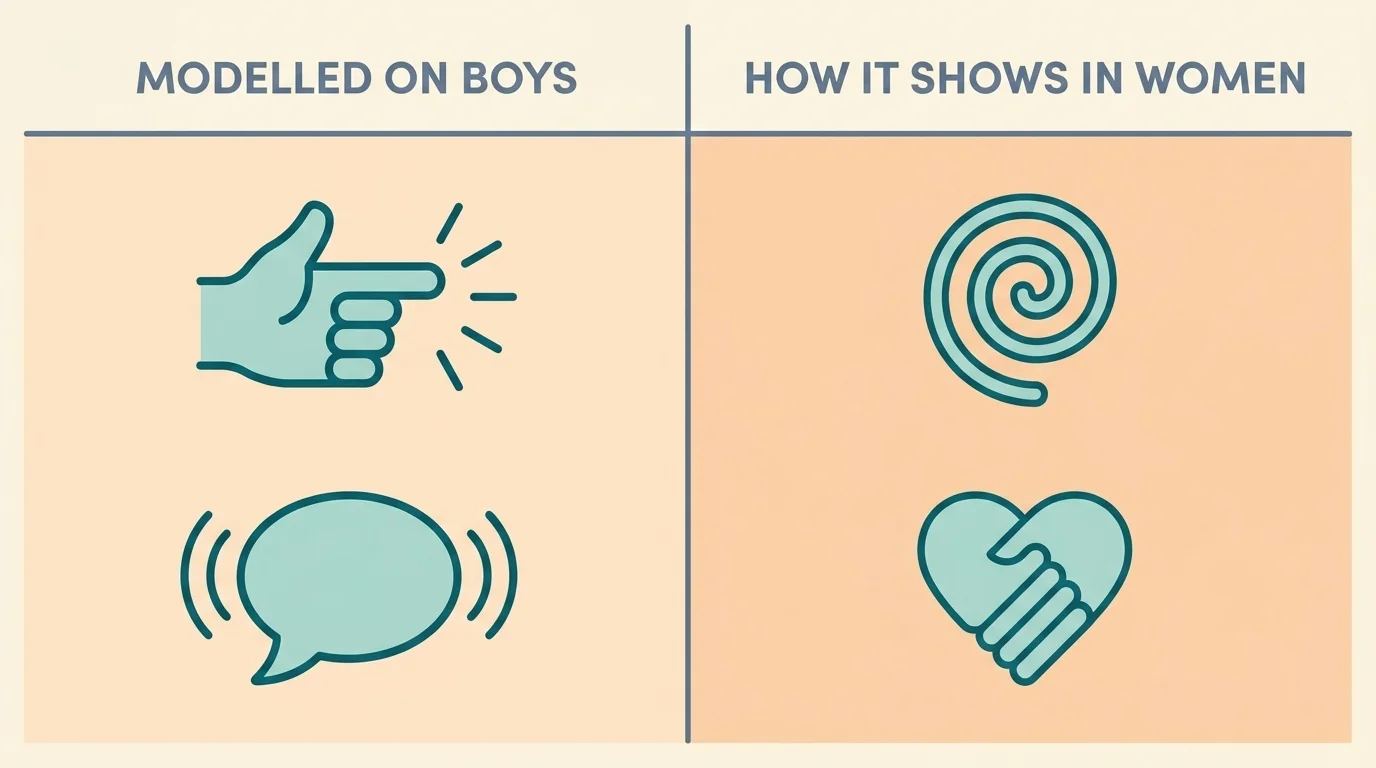
The clinical term is the female phenotype: the idea that autism, in many women, presents with more internalised traits and heavier camouflaging than the textbook picture, which was drawn largely from boys. When your instrument is calibrated to one presentation, it under-reads the other. A January 2026 narrative review in Frontiers in Psychiatry (Minutoli and colleagues) is careful about how far the evidence reaches, and the care is worth keeping: some studies, it reports, suggest the apparent gender disparity is "largely attributable to underdiagnosis and/or misdiagnosis in females, rather than a true lower incidence of the condition." Its own framing is structural — "current diagnostic criteria and assessment tools are largely based on a male-centered understanding of autism" — and it notes that the field's standard instruments, the ADOS-2 and the ADI-R, "may have reduced sensitivity" for identifying autism in women. Population-based predictive models, the review adds, suggest up to 39% more girls could be expected to be diagnosed than are currently identified (Frontiers in Psychiatry). This is the same underlying autism you can read about in how autistic traits differ across profiles — presented in a register the tools were never tuned to catch.
There is a second mechanism, subtler and more human. When a masking woman finally reaches a clinician, the trait that is visible is the exhaustion, so the label that gets reached for first is an internalising one — anxiety, or depression. The autism sits underneath, unread. Autistic advocates have named this pattern for years; as Dr Camilla Pang has observed, autistic women "are more likely to be described as 'anxious'" and the autism overlooked, and as Dr Kate Fox argues, the real difference between autistic men and women is less about biology than about "how society treats and socialises males and females" (National Autistic Society). The criteria did not fail because women are hard to see. They failed because no one was looking for this.
Masking and autistic burnout: the hidden cost
A building keeps a public elevation — the face it turns to the street, kept clean and correct — and behind it, rooms the public never enters. Masking, or camouflaging, is the maintenance of exactly such a facade: consciously and unconsciously suppressing autistic traits to pass as neurotypical. It means rehearsing conversations, copying other people's expressions and gestures, forcing eye contact that feels wrong, holding in a stim until you are alone. It is skilled, effortful work, and it is nearly invisible, which is precisely the problem.
The evidence that women do more of it is measurable rather than anecdotal. A 2025 study of 253 autistic adults in Brazil found that camouflage behaviours "were significantly more common among women than men" (Autism in Adulthood).
Then comes the inference everyone makes, including me, three paragraphs ago: that the mask is therefore what keeps the clinician from seeing. That inference is exactly what the study was built to test, and it does not survive the testing. The same paper reports "no consistent associations between masking measures and early autism identification," and finds that the camouflaging patterns "did not directly explain the delay in suspicion and diagnosis in this population." Its conclusion deserves quoting at length, because it cuts against the tidier story: while camouflaging "may exacerbate psychological distress and make autism more invisible for women, it is not the primary factor contributing to the delayed identification. Instead, gender stereotypes and the inadequacy of clinical assessment tools tailored to more typically feminine presentations of autism are likely major obstacles in the diagnostic process."
Sit with that, because it rearranges the furniture. The facade is not what keeps the surveyor out. The surveyor arrived with the wrong plans and a fixed idea of what the building was for — which is the argument of the section above, arriving from an unexpected direction and carrying more weight for it. Masking is not the lock on the door. It is the tax you pay while standing outside it.
And that tax is where the same study is unambiguous: camouflaging predicted higher levels of anxiety, stress and depression, especially in women. The facade holds. The cost of holding it accrues elsewhere.
That cost has a name: autistic burnout. A 2023 mixed-methods systematic review in Clinical Psychology Review synthesised 58 studies covering 4,808 autistic participants and sorted the consequences of camouflaging into four themes, one of them named precisely what it is — "overlooked, under-supported, and burnt out." Camouflaging, the review concludes, "emerges as primarily a socially motivated response linked to adverse psychosocial outcomes" (Clinical Psychology Review). Socially motivated: not a symptom arising from within, but a response to a room. Burnout is also hard to catch early if naming what you feel is itself difficult — the warning lights come on late, if at all. Unmasking, in that light, is not indulgence. It is structural repair.
What autism in women is commonly misdiagnosed as
Before many women receive an autism diagnosis, they collect others. The usual labels are anxiety, depression, ADHD, eating disorders, and borderline personality disorder — and the pattern is common enough to be predictable. Around 70% of autistic people carry at least one co-occurring psychiatric diagnosis, and women, in particular, tend to receive an earlier psychiatric label that quietly obscures the autism underneath (BMJ 2026, via News-Medical).
The mechanism is the same one running through this whole piece — masking plus a male-default template — reframing the same traits under different names:
- Anxiety and depression absorb the exhaustion of constant social performance and the low mood that follows burnout, treating the symptom while missing its source.
- ADHD genuinely co-occurs so often that the overlap has its own name, AuDHD; the two get tangled and are frequently separated only late, which is why the overlap between adult ADHD and autism is worth understanding in its own right.
- Eating disorders can grow out of sensory aversion rather than the body-image disturbance and fear of weight gain the textbook picture assumes. A scoping review of autistic women's eating found they reported "significantly more sensitivities regarding the sensory properties of food, such as smell, texture, and taste" than women with eating disorders, non-autistic women and autistic men alike, and that their eating behaviours "resemble those of individuals with avoidant restrictive food intake disorder (ARFID)" — where restriction is "not driven by body image disturbances or a fear of gaining weight." The same review is careful to add that "none of the studies have examined the presence of specific ARFID symptoms in autistic women," which is its own kind of finding (Problematic eating behaviours of autistic women).
- Borderline personality disorder is perhaps the most consequential misread, and a conceptual analysis of the overlap maps it trait by trait: emotional dysregulation that tracks sensory overload and burnout rather than interpersonal drama, relationship instability, and a sense of self destabilised by camouflaging and stigma — each of them legible as BPD (conceptual analysis). But the label lands very differently on a woman's records.
None of this means the other diagnoses are always wrong; many women are genuinely anxious, or do have ADHD. It means the autism is often the floor plan underneath, and until someone reads it, the renovations never quite hold.
Late diagnosis and identity: finding out at 30, 40, 50
Late diagnoses often begin with a trigger rather than a hunch. A child is assessed, and the mother recognises herself in the questionnaire. A burnout arrives that will not lift. What comes next is rarely simple.
Relief.
Relief is often first: the enormous, uncomplicated relief of a pattern finally having a name, of a life that felt like a series of private failures resolving into something coherent. But grief comes too, and it deserves to be said plainly — grief for the years spent not knowing, for the support never offered, for the earlier, easier version of a life that a timely diagnosis might have allowed. Late diagnosis is a reframe, not a downgrade; it re-reads a whole biography in a kinder light, but the re-reading takes time.
Virginia Woolf argued that a woman needed a room of her own and five hundred a year — the point was really about the architecture of who gets taken seriously, who is given the space to be understood. A diagnosis is a smaller, stranger room, but the principle rhymes: for a long time the door to it was not built for women at all. What is happening now — in the appointments, the subreddits, the group chats where late-diagnosed women trade recognition — is that a generation is finally being handed the key. The stakes of that key are not abstract. Research reported by the National Autistic Society (Cazalis and colleagues, 2022) found that around nine in ten autistic women reported having experienced sexual violence — a figure I include carefully, because it measures not some fragility in autistic women but how badly a world serves people it has never learned to recognise (National Autistic Society). Being seen is not a matter of self-understanding alone; for many women it is a matter of safety. And the language of being seen matters too: "level 1," or low support needs, is a more honest term than the old "high-functioning," because a person can need very little visible help and still be carrying an enormous amount that no one has thought to ask about. Read the culture of autistic identity and self-understanding and you find, over and over, this same insistence — that recognition is not a diminishment but a homecoming.
How to get an autism assessment as an adult in the US
If the picture so far reads like your life, here is the practical part — offered as a map, not a push.
Start where the system lets you in. UCLA Health's version is the plainest: "Consult your primary health provider, who can connect you with specialists and resources that can help" (UCLA Health). That is the front door. What follows is my own counsel rather than anyone's clinical guidance — I am an observer of how institutions behave, not a clinician: ask, directly, whether the specialist you are sent on to has assessed adults, and women, before. That experience matters more than any single credential, because it is exactly what the standard tools were not built for.
Know what an assessment actually is. It is not a single test but a process; clinicians, as UCLA Health describes it, "rely on the information they gather from a person's developmental history, symptom assessments and behavior to reach a diagnosis." It helps enormously to arrive prepared — notes, examples, the patterns you have noticed in yourself over the years. The online self-tests you may have found — the AQ, the RAADS-R — are screening questionnaires, not diagnoses. The National Autistic Society is explicit that a diagnosis "should not be based on any autism-specific diagnostic instrument alone" but should draw on a range of sources together with clinical judgement (National Autistic Society). A score can be a reason to seek an assessment. It cannot stand in for one.
It is worth knowing what the door opens onto, in a country where that question is rarely abstract. A diagnosis, UCLA Health notes, "may provide access to therapy and support programs, and help you get health insurance coverage to pay for those services," and may leave you "eligible for resources under the Americans with Disabilities Act (ADA)" (UCLA Health).
And a gentler note to close the practical section on: an assessment is a door, not a verdict. Many women find that self-identification, held honestly while they wait — waiting lists are real — is valid and steadying in its own right. Recognition, however it arrives, is the beginning of getting the right communication and support after diagnosis, not the end of anything.
Being seen
Go back to the woman at the party, doing her invisible work. Nothing about her has to change for the account of her to change completely. Recognition is not a label to fear but a key: to self-understanding, to support that finally fits, to a community of people who have been standing in the same unlit room. And the data is unambiguous that she is not alone — being autistic in adult women is not a rare condition suddenly appearing, but a common one finally being seen, because the model was wrong, not because women changed. If this reads like your life, take the self-reflection checklist above to a clinician who knows adult and female-presentation autism — and, when you are ready, read on with us about the executive function that masking quietly taxes and about how the labels differ across the spectrum. The room was always occupied. Someone has finally turned on the light.
Frequently Asked Questions
The female phenotype theory of autism holds that autism often presents differently in women — with more internalised traits and heavier camouflaging — so criteria built around boys tend to miss them. A 2026 review reports that current diagnostic criteria and assessment tools rest on a male-centred understanding of autism, and that up to 39% more girls could be diagnosed.
Autism is not thought to be fundamentally different in women compared with men. What differs is visibility: research finds autistic women camouflage more and internalise their traits, so the presentation is subtler. As Dr Kate Fox argues, the real difference lies less in biology than in how society treats and socialises males and females.
Careers well suited for autistic women resist a fixed list. What is well evidenced is the traits, not the jobs — focused interests, sensory sensitivity, the exhaustion of social performance, executive-function load. Those point toward work shaped around a woman's own interests, sensory needs, and tolerance for unpredictable social demand, rather than any occupation in particular.
Autism is largely genetic: a 2016 meta-analysis of twin studies estimated its heritability at 64–91%, concluding autism is due to strong genetic effects. The claimed vaccine link does not survive the data — a Danish cohort of 657,461 children found MMR vaccination does not increase autism risk.
'Level 1,' or low-support-needs autism, describes autism that requires the least formal day-to-day support — it does not mean the experience is mild. For women especially, heavy masking can hide significant internal load behind an outwardly capable surface, so a 'level 1' label can badly understate how much effort ordinary situations actually take.