Adhd Treatment For Adults


Adult ADHD is common, and it responds well to treatment — two things the research literature took an oddly long time to say plainly. The more useful truth is that ADHD treatment for adults in 2026 is as much a question of access as it is of options. The CDC now counts roughly 15.5 million U.S. adults — about 6.0% — with a current diagnosis, and more than half were first diagnosed as adults. Yet 36.5% of them receive no treatment at all, and among those who take a stimulant, 71.5% have struggled to fill the prescription during an ongoing shortage. So this guide does two jobs at once: it lays out the full, accurate menu — medication, CBT, coaching, self-management — and it shows how to build a plan that keeps working when the medication supply does not. One caveat before we start. I read papers for a living, not prescriptions; this is educational, not medical advice.
ADHD Treatment for Adults: Highly Effective, Access Is the Real Challenge
First, the reassuring part: adult ADHD is highly treatable, and the best results usually come from combining medication with therapy, tailored to the parts of life the condition impairs most.
Now the numbers, because they reframe everything that follows. In its first dedicated adult estimate, the CDC's NCHS Data Brief 543 put current adult ADHD at 6.0% — about 15.5 million people — with 55.9% first diagnosed in adulthood. This is not a childhood condition that occasionally lingers; it is a mainstream adult one.
Here is the part the press release left out. The same body of CDC data shows that 36.5% of adults with ADHD received no treatment in the prior year, and that among the roughly one in three who took a stimulant, 71.5% had trouble filling the prescription because it was unavailable. The bottleneck, in other words, is often not knowing what works — it is getting it, reliably, month after month.
That single fact should reorganize how you think about a plan. If the first-line treatment is also the one most likely to be interrupted, then CBT, coaching, and evidence-based self-management are not the consolation prize. They are the resilient backbone — the parts of the plan that keep working when the pharmacy shelf is empty. It is a framing no clinical page I found draws, and it is the through-line of this guide. (It is also, for what it is worth, why an accessible clinical-psychologist explainer arguing adult ADHD is "challenging but highly treatable" resonates: hope and realism are not in tension here.)
A word on stakes, stated carefully: untreated adult ADHD is associated with harder outcomes in work, relationships, and finances. A 2023 narrative review in the Journal of Attention Disorders puts it bluntly — among untreated adults, the functional impairments associated with ADHD are "widespread and cumulative", spanning job stability, romantic relationships, and income. Associated with — not proven to single-handedly cause them, and not guaranteed to reverse on treatment. The association is reason enough to take a plan seriously.
The Diagnosis-to-Treatment Pathway: From "I Think I Have ADHD" to a Plan
Most guides jump straight to the drug list. The journey there is where people actually get stuck, so it is worth walking.
The first step is an assessment, and what one actually involves is worth asking about when you book. The sources behind this guide are detailed on treatments and quiet on intake, and I would rather say so than hand you a script I cannot vouch for. If you are not sure where to begin, finding a provider who assesses adults is the first concrete step.
From there, a good plan is built around impairment, not diagnosis alone. CHADD frames it well: adults benefit by identifying the areas of life most impaired by their ADHD and then targeting treatment at those. A plan for someone whose job is on the line looks different from one built around a stalled degree or a strained marriage.
If medication is part of it, the process has a name that surprises people: titration — dose laddering that begins low and systematically increases, with results compared at each follow-up visit to land on the dose with the best combination of high treatment response and low side effects. Medication selection for ADHD remains an imperfect process, largely based on trial and error; and pharmacogenomic testing, for all its popularity, is not yet predictive enough to help pick the drug for you (CHADD). The right dose is found by iteration, not guessed on day one.
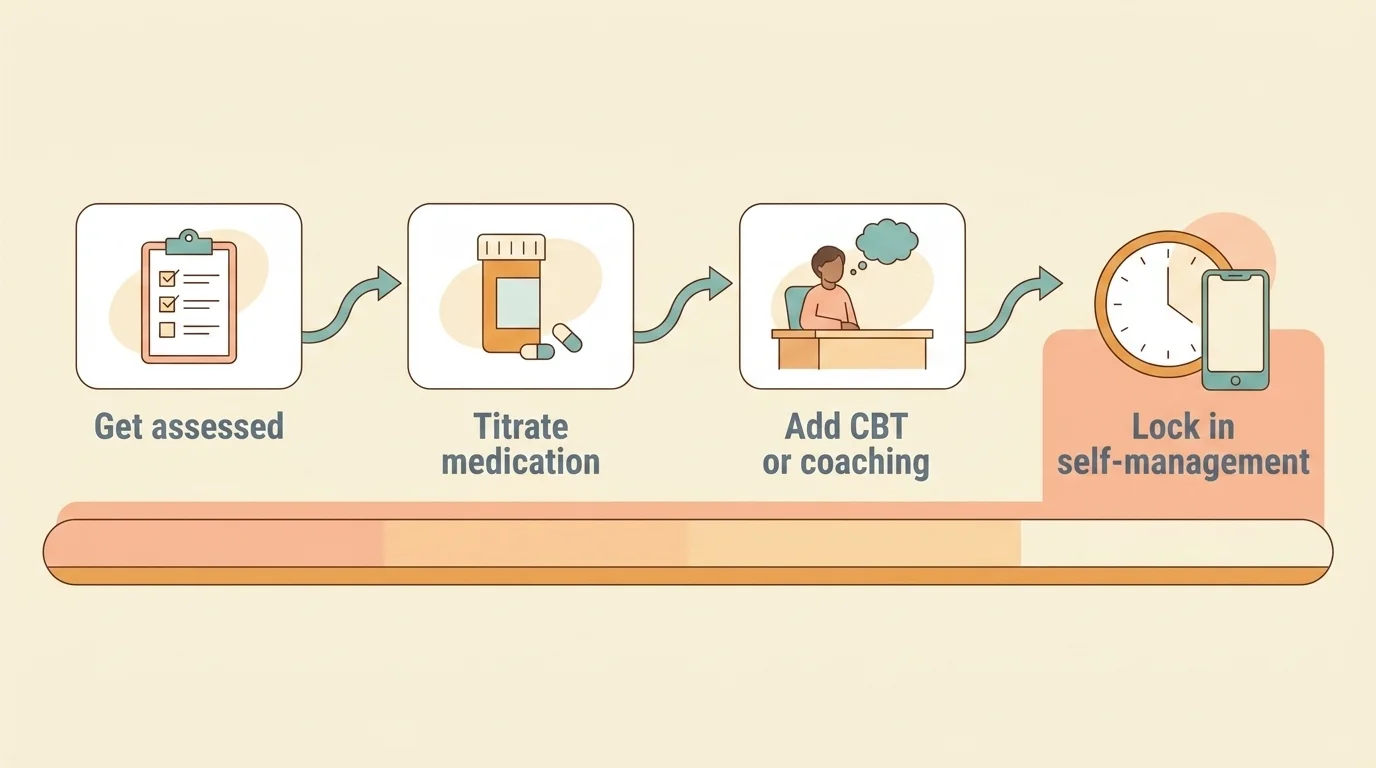
Therapy and coaching can be layered on afterward, once medication — if any — is stable. Treatment is a sequence, not a single prescription, and the whole thing is a months-long process. That is normal, not a sign it is going badly.
ADHD Medication for Adults: Stimulants, Non-Stimulants, and the Shortage
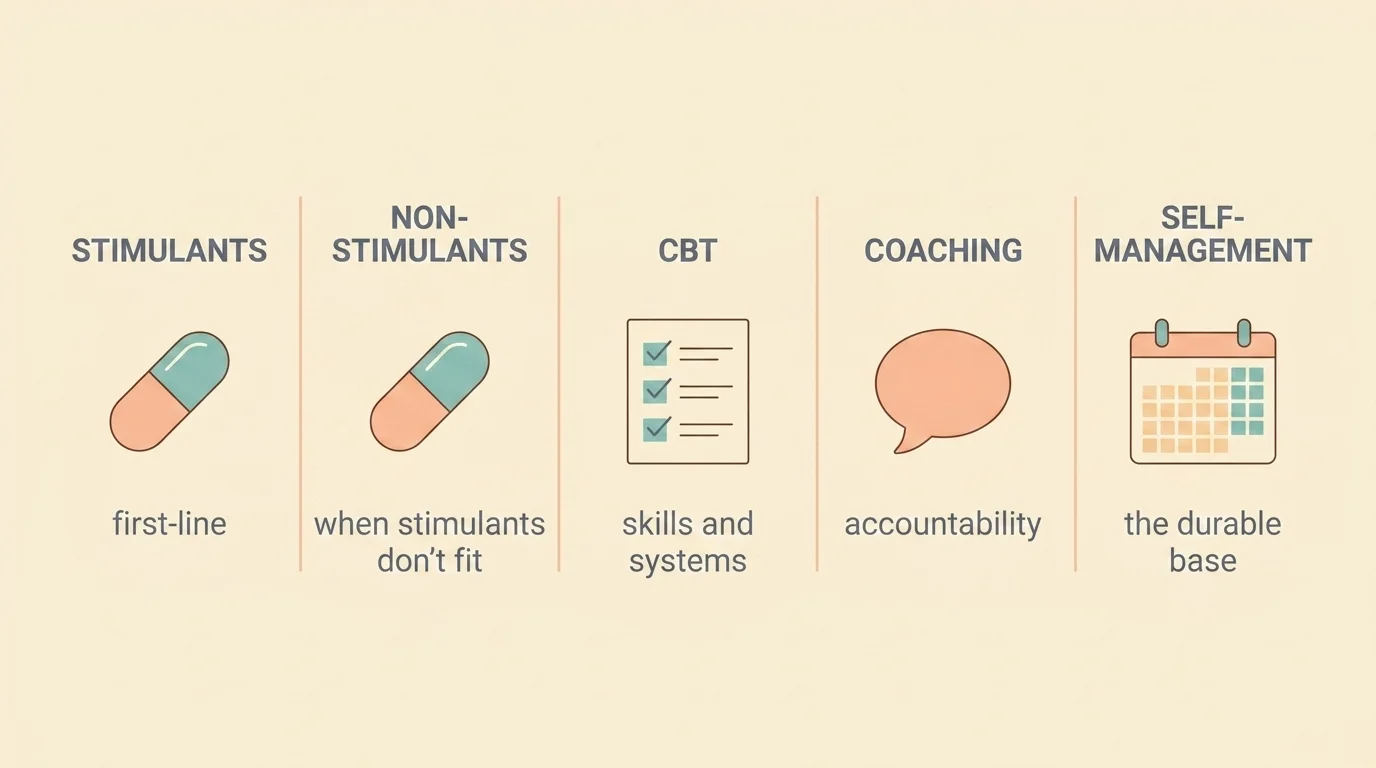
Here is the menu in one sentence: stimulants are first-line; non-stimulants are the alternative when stimulants do not fit. Now the detail — this is the section where getting the facts exactly right matters most.
Stimulants (first-line)
Two stimulant families dominate: methylphenidate (Concerta and others) and the amphetamines (including lisdexamfetamine, sold as Vyvanse). Yale Medicine psychiatrist Dr. Eunice Yuen puts it plainly: "Stimulant medications, such as Adderall and Concerta, are the first-line treatment." The peer-reviewed literature is close but not identical: a 2023 review of adult ADHD treatments identified methylphenidate and atomoxetine as the first-line medications — which puts atomoxetine, a non-stimulant, inside the first-line set rather than in the tier below it. That gap is worth holding onto: "first-line" is a label different sources apply slightly differently, not a settled ranking.
Non-stimulants
When stimulants do not fit — a substance-use history is the case the sources spell out — the non-stimulant options come in. Atomoxetine is generally first-line among them, and often preferred when there is a substance-use history. Viloxazine (Qelbree) gained FDA approval for adults in 2022, the first new non-stimulant class approval for adults in years. Guanfacine and bupropion are also used, both off-label for adults.
The stimulant shortage — what to do when you can't fill a script
The U.S. stimulant shortage has been live since October 2022. It is easing, not over. Effective 2 October 2025, the DEA raised the aggregate production quota for d-amphetamine (for sale) from 21,200,000 to 26,450,000 grams — just under 25%, and the first increase since 2021 — while also lifting the methylphenidate quota (DEA final order, Federal Register).
Here is the part the coverage left out. Read the order itself and the DEA is not claiming to have solved the problem at your pharmacy counter: it states that the existing quotas were already "adequate to address both the domestic and foreign medical demand," and that the increase was needed to accommodate an unexpected rise in manufacturers' requests for product development activities. And the new quotas won't necessarily fix the ongoing shortages — many drugs, Adderall, Ritalin, Concerta and Vyvanse among them, are still in short supply. A higher ceiling on what may legally be manufactured is not the same thing as a filled prescription.
The practical moves: talk to your prescriber early about alternative formulations or medications rather than lapsing, and keep the non-medication backbone strong so a gap in supply is a setback, not a collapse. This is exactly why the plan matters more than any single prescription.
CBT for Adult ADHD: Retraining Time, Task, and Self-Talk
In one line: CBT for adult ADHD is a structured, skills-based therapy that builds external systems to carry what memory keeps dropping, sharpens time and organisational skills, and reaches the emotional weather around the condition — and the evidence for it is genuinely good.
Start with what it targets, because ADHD-specific CBT is not the same as generic talk therapy. It helps people anticipate and create external resources to back up existing memory losses — the executive-function scaffolds that do the remembering for you, like calendars, timers and reminder systems — and works on improving time management and organisational skills, decreasing impulsivity, and regulating anger (2023 review).
Now the effect sizes, stated as the studies actually found them. Meta-analyses report that CBT is superior to a waitlist with a moderate-to-large effect, and superior to active control conditions with a small-to-moderate effect. That second comparison is the honest one — measured against another active treatment rather than against doing nothing, the benefit is real but more modest. And the gains extend beyond the core symptoms: the same 2023 meta-analysis found CBT reduced emotional symptoms too, with decreases in depression and anxiety predicted by the reduction in core ADHD symptoms, and observed increases in self-esteem and quality of life. For anyone carrying years of "I'm lazy, I'm unreliable," that last one is not a footnote.
Here is why CBT belongs at the center of a resilient plan rather than at its margin. Yale's Dr. Yuen notes that "the best results usually come from combining therapy and medication" — but the skills CBT builds do not depend on a pharmacy having stock this month. That is a claim about availability, not about effect size, and availability is the variable the CDC data says is failing. A drug you cannot get this month is worse than a habit you already own.
ADHD Coaching for Adults: What It Is and Who It Helps
Put simply: ADHD coaching is practical, goal-focused support for building systems and habits — a complement to therapy and medical care, not a replacement for either.
The cleanest way to hold the distinction: therapy treats the condition itself — the underlying patterns, the comorbidities, the emotional residue. Coaching is narrower and more external — accountability, structure, and the unglamorous work of turning intentions into repeatable systems. A therapist asks why the mornings fall apart; a coach helps you build a morning that holds.
What coaching costs, and whether any of it is covered, is worth checking before you commit — and be clear about what you want from it. Some people get more from a coach's weekly accountability than from any app; others find it redundant once CBT skills are in place.
One caveat worth stating plainly: the title on its own will not tell you what you are getting. Ask a prospective coach what training and credentialing sit behind it, ask how they work, and treat coaching as one supported layer in the plan — alongside CBT and self-management — rather than the whole structure.
Managing Adult ADHD Without Medication: Evidence-Based Self-Management
The honest headline: non-medication strategies — exercise, sleep, mindfulness, and deliberate environmental design — can help, and they work best as a complement to clinical care, not a replacement for it. Given the access reality, they are also the most reliable part of the plan.
Movement, sleep, and mindfulness
Three levers come up again and again. Regular exercise is recommended in the adult ADHD self-management literature as a symptom-reducer. Sleep is a big one: a delayed sleep phase — a body clock that runs late — is commonly reported in ADHD, and sleep hygiene earns its place in the plan. Mindfulness rounds out the trio, recommended in the same literature.
A note on two numbers you will see everywhere. Self-help writing routinely claims that around 80% of adults with ADHD have sleep problems, and that exercise improves inattention by roughly 30%. I went looking for the primary studies behind those figures and could not cleanly trace either; they circulate in secondary summaries without a clear original. So take them as suggestive, not settled — the direction (sleep and exercise matter) is well supported; the precise percentages are not something I would stake a claim on.
Environmental and structural design
This is the least glamorous category, and the one I would start with. The principle is to externalize memory and reduce friction: put the thing you need in the path you already walk, not in a drawer you have to remember to open. Calendar and reminder systems, body-doubling (working alongside another person for accountability), single-tasking by default, and the same executive-function scaffolds CBT teaches all live here. These are the "how to calm down and stay on track" tactics people search for — and the backbone that holds when medication access is unreliable.
The guardrail: none of this is a cure, and none of it replaces diagnosis or medical care. It is the durable base a real plan is built on.
ADHD Treatment for Adult Women and Late Diagnosis
In brief: the treatment menu for adult women is the same evidence-based one, and the thing most worth planning around is not a different drug list but a late diagnosis and the years that came before it.
Start with the limit of what I can actually tell you. The CDC figure I have been citing — 55.9% of adults with ADHD first diagnosed in adulthood — establishes that late diagnosis is the norm; on its own, it is not a statement about women specifically. There are well-known accounts of why women in particular get missed, and I have deliberately not repeated them here: they are not in the sources behind this guide, and a treatment guide is the wrong place for me to relay a mechanism I have not checked myself. We cover ADHD symptoms in adult women in more depth separately; here the focus is treatment.
Clinically, the core options do not change: stimulants and non-stimulants, CBT, coaching, self-management. What shifts is the surrounding context. Co-occurring anxiety and depression come up often enough that the CBT trials track them as outcomes in their own right — and they deserve that same attention inside a plan.
And there is an emotional layer a treatment menu does not capture. A late diagnosis often arrives with a strange mix of grief and relief — grief for the years spent assuming a character flaw, relief at a mechanism that was there all along. That reframing, from "I failed" to "I was unsupported," is not a side effect of treatment. For many people it is part of it.
Building Your Resilient ADHD Treatment Plan
Everything above assembles into one plan, and the assembly has a logic. The multimodal principle — combining therapy and medication usually beats either alone — is the starting point, matched to the areas most impaired rather than applied by default.
A workable sequence looks like this. Get assessed. If medication is appropriate, start and titrate it patiently. Add CBT or coaching once things are stable. And lock in self-management — sleep, movement, environmental design — as the durable base underneath all of it. The order matters less than the principle: build the parts that do not depend on a pharmacy to last, and build them to last.
Then design for resilience deliberately, because the access data demands it. Keep the non-medication backbone strong enough that a supply gap slows you down without stopping you. Ask your prescriber, in advance, what the plan is if your usual formulation is unavailable — the worst time to improvise is the day the pharmacy says no. Progress that only exists while the prescription is filled is fragile progress.
Finally, on finding care: vetting a provider who treats adults — checking training, asking how they approach adult ADHD, confirming they will partner on shared decisions — is worth the effort up front. You are hiring for a months-long relationship, not a single appointment.
The plan that holds up is not the one with the single most powerful lever. It is the one with the most redundancy — several things working at once, so that no one failure takes the whole system down.
The takeaway
Adult ADHD is highly treatable, and the strongest plans are resilient ones: medication when it helps and is available, with CBT, coaching, and self-management as a backbone that keeps you moving regardless. If you take one thing from this guide, let it be that framing — good ADHD treatment for adults is not a single prescription but a system with redundancy built in. The next step is concrete: talk to a qualified clinician about getting assessed, and start one self-management habit today. And the frame this piece opened with still holds at the close — this is educational, not medical advice, and decisions about medication belong with you and a prescriber. For more neurodiversity-affirming reading, explore our development coverage.
Frequently Asked Questions
The best way to treat adult ADHD is multimodal: medication — usually a stimulant — combined with therapy such as CBT, tailored to the areas of life most impaired. Yale Medicine notes the best results usually come from combining therapy and medication, and CHADD emphasizes matching treatment to your specific impairments rather than a one-size-fits-all plan.
The most effective medication for adult ADHD has no single settled answer. Stimulants — methylphenidate and amphetamine-based drugs like lisdexamfetamine — are first-line; non-stimulants such as atomoxetine and viloxazine (Qelbree) are alternatives when stimulants are unsuitable, for example with a substance-use history. The right drug and dose are found through titration with a prescriber, not picked in advance.
You can manage ADHD without medication using CBT, ADHD coaching, regular exercise, better sleep, mindfulness, and environmental design that externalizes memory and reduces friction. These work best as a complement to clinical care rather than a replacement — but because medication access can be unreliable, they also form the most dependable backbone of a real-world plan.
If adult ADHD goes untreated, the impairments associated with it tend to be widespread and cumulative — spanning job stability, romantic relationships, and income. That is an association drawn from observational data, not proof that ADHD alone causes those outcomes — but it is reason enough to take assessment and a treatment plan seriously.
The 1/3/5 rule for ADHD is a popular, non-clinical planning method — not a validated medical treatment. The idea is to tackle one big task, three medium tasks, and five small ones each day to cut overwhelm and decision fatigue. Some people find it a useful structure; treat it as a productivity habit, not therapy.
The '7 triggers' is a popular, non-clinical framework, not an official list — phrasings vary, and no source behind this guide defines one. The factors this guide's sources do address are sleep, which is commonly disrupted in ADHD, and gaps in medication supply. Treat it as a self-awareness prompt; persistent difficulty is worth raising with a clinician.