Asperger vs Autistic


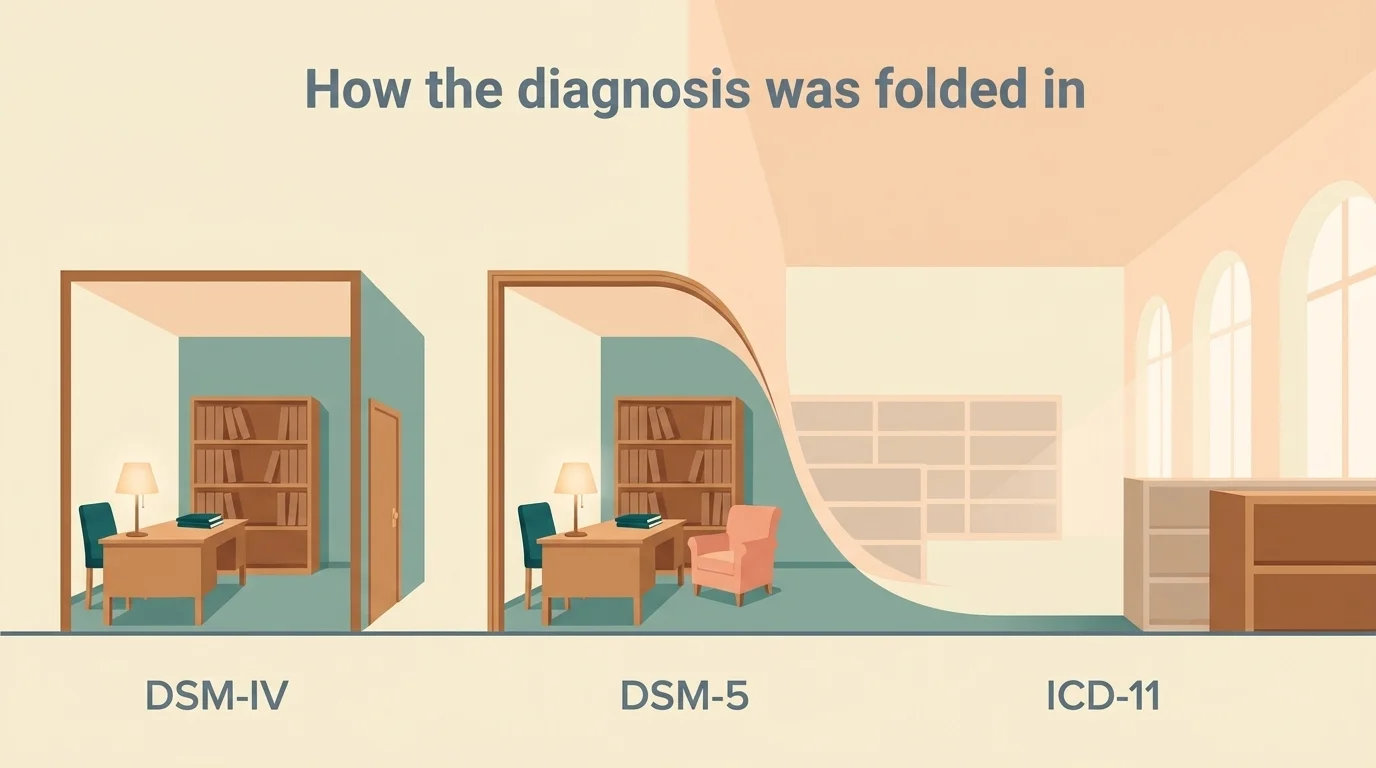
A diagnostic manual is a kind of building — the plain civic sort, a records office, where a society keeps the names it has agreed to call things. For nineteen years one room in that building had a name on the door: Asperger's syndrome. In 2013 the people who maintain the building took the name down, knocked through a wall, and folded the room into a larger hall already in use: autism spectrum disorder.
That is the short, true answer to asperger vs autistic — or, as it is also typed, aspergers vs autism, the difference between autism and asperger's. Today there is no medical difference. But many of the people who had been living in the smaller room did not move out. The short answer and the whole answer are not the same thing, and the gap between them — why the name was taken down, and why so many keep it anyway — is where this piece lives.
Asperger's vs. Autistic: The Short Answer
Medically there is no difference today — in 2013 the DSM-5 folded Asperger's into autism spectrum disorder, and what was once called Asperger's is now diagnosed as Level 1 autism. Autism Speaks puts it without hedging: there is "no clinical difference between the two profiles in modern diagnostic criteria" (autismspeaks.org). If you came for a verdict, that is the verdict.
Hold it lightly, though, because the sentence hides a whole argument. A page written by a clinic can stop there, and most do. What it leaves out is everything that made the change worth making and everything that made it sting: why the name came down, and why the people who carried it did not simply hand it back. That is the throughline here — the settled clinical answer, then the contested name, then the claimed identity — and I want to give all three the same seriousness, because all three are real.
One thing to fix at the top, so nothing below is misread as a ranking. What we are describing is a set of differences and a set of support needs, not a hierarchy of better and worse. "Level 1" is not a grade. No one in this story is a milder version of anyone else.
From DSM-IV to ICD-11: How Asperger's Was Retired
Every category has a paper trail, and this one is short enough to hold in the hand.
In 1994, the fourth edition of the Diagnostic and Statistical Manual — the DSM-IV — introduced Asperger's syndrome as a diagnosis in its own right: a room newly partitioned off for people who had the social profile of autism but had reached childhood speech on time. For close to two decades it was a working address. Then, in 2013, the DSM-5 took the partition down. The American Psychiatric Association concluded that Asperger's, autistic disorder, and several neighbouring labels were better read as points on one continuum, and merged them. Cleveland Clinic's summary is plain: as of that revision, "we now consider them one condition — autism spectrum disorder" (health.clevelandclinic.org).
The part most pages omit is the second demolition. The World Health Organization's ICD-11 — the world's other diagnostic manual — came into effect on 1 January 2022 (WHO), and it declined to rebuild the room. The ICD-11 brought its criteria into line with the DSM-5, which is to say that it now includes "Asperger's Syndrome, Childhood Disintegrative Disorder and certain other generalised developmental disorders, within the category of 'Autism'" (Autism Europe). So the tidy way to say it, and the accurate one, is that as of 2026 both of the major diagnostic systems have retired the term. It is no longer a live diagnosis anywhere; no new ones are being written.
Keep the timeline in view, because the interesting question was never when the room came down but why — and we will get there.
The Historical Distinctions — Reframed
Before the merge, clinicians did draw lines between the two, and it is worth seeing them clearly — partly because they are still, I suspect, the lines most people carry in their heads, and partly because their unreliability is the whole reason the merge happened.
Here are the four distinctions once used to separate a former "Asperger's profile" from what was then called classic autism — kept, deliberately, in the words of the sources that actually draw the comparison (Cleveland Clinic) and of the DSM-IV criteria themselves (Kennedy Krieger Institute):
| What clinicians once compared | Former "Asperger's" profile | "Classic autism" profile |
|---|---|---|
| Early language | "Appropriate language skills for their age" — the diagnosis required "no clinically significant general delay in language" | "Delayed language skills" |
| Cognitive ability | "Average or above average intelligence"; the criteria required "no clinically significant delay in cognitive development" | Never actually specified — see the note below |
| Social interaction | "Difficulty with social interactions" — the profile's main feature | "Difficulties interacting with others," alongside repetitive behaviours and inflexible routines |
| Support needs | "Most (but not all) children with Asperger's-like symptoms need level-one support" | Children with autism-style symptoms "often need higher-level care" |
A note on that second row, because its emptiness is the most honest thing in the table. The cognitive line was only ever drawn from one side: the Asperger's criteria excluded significant cognitive delay by definition, so the profile could not contain it. Nothing symmetrical was ever said back — the clinical comparison does not characterise "classic autism" by intelligence at all, and the widespread belief that it does is a reader's inference, not a finding. What can be said, of the spectrum as a whole rather than of either column, is that the range is wide: among autistic eight-year-olds with cognitive data in the CDC's most recent surveillance, 39.6 percent were classified as having an intellectual disability, 24.2 percent scored in the borderline range, and 36.1 percent average or higher (CDC).
Read the table the way it was meant, and you can see the appeal: it looks orderly. Read it the way clinicians eventually did, and you can see the problem. These were descriptive tendencies, not a boundary anyone could hold. A child could sit on both sides of it at once, or cross it as they grew, or land in a different column depending on who was doing the assessment. What the table files under "severity" is really the amount of support a person needs in a given setting — which changes with the setting. A grid that will not stay still is not a grid. It is a spectrum wearing a grid's clothes.
What Is Level 1 Autism — and Why the Field Moved to Support Levels
Level 1 autism is the support-level term that replaced Asperger's — it describes autistic people who need the least day-to-day support to go about their lives.
When the DSM-5 collapsed the old labels, it did not leave a single undifferentiated word in their place. It introduced three levels, and their names are worth reading closely, because each one is a description of support rather than of a person: level 1, "requiring support"; level 2, "requiring substantial support"; level 3, "requiring very substantial support" (Autism Speaks). Level 1 sits where "Asperger's" used to sit — Autism Speaks says so directly, that Asperger syndrome "is medically classified as Level 1 Autism Spectrum Disorder (ASD)" (Autism Speaks).
The change of vocabulary is not cosmetic. The old shorthand — "high-functioning," "low-functioning" — flattens a fluctuating reality into a fixed label, and it reads, unavoidably, as a verdict on a person's worth. Someone called "high-functioning" can still be unable to make a phone call on a bad day; someone filed the other way may hold capacities the label never let anyone see. When we describe where a person sits on the wider autism spectrum, support-level language earns its keep for exactly this reason: it names what a person needs, on a given day, in a given room — not how much of a person they are. A support need is a fact about circumstances. It is not a measure of a life.
Why Isn't Asperger's Used Anymore? Two Reasons, Not One
Two reasons, not one: clinicians could not reliably tell Asperger's apart from autism, and the name itself became contested over the history of the man it was named for.
Most pages give the first reason, if they give any. Fewer give the second, and it is the more uncomfortable of the two.
The diagnostic reason
The everyday reason is the one the table above already exposed. The Asperger's/autism boundary could not be applied consistently. Two competent clinicians, looking at the same child, could reasonably reach different labels, because the criteria meant to separate the conditions described overlapping realities. When a distinction cannot be drawn the same way twice, it is not doing the work a diagnosis is supposed to do. Cleveland Clinic, one of the few clinical sources to give a real why, frames the move as a single, more consistent spectrum being cleaner than a border no one could police (health.clevelandclinic.org).
The historical reason
The other reason is a name. Asperger's syndrome was named for Hans Asperger, a paediatrician in Vienna in the 1930s and 40s. His record there has been contested. In 2018 the historian Edith Sheffer, in Asperger's Children, and the medical historian Herwig Czech, independently, presented archival evidence that Asperger participated in the Nazi-era system of child "euthanasia" — referring some children to the Am Spiegelgrund clinic in Vienna, where children were killed (Scientific American). I want to be careful here: this is documented, and it is also still argued over by historians — a 2024 re-examination of his role reopened rather than settled the question (PubMed). Treat it as a live scholarly debate, not a closed verdict. But you do not need the debate resolved to understand why some autistic people no longer wish to carry the name. A diagnosis can be retired for being imprecise. A name gets retired for what it means.
Why Many People Still Call Themselves "Aspie"
Still.
Retire a diagnosis and you have changed a line in a manual. Retire a word that people have built a self around, and you have done something the manual keeps no page for. For the generation diagnosed between 1994 and 2013, "Asperger's" — and its warmer chosen diminutive, "Aspie" — was never only a clinical code. It was, for many, the first word that made a life legible: the explanation for why school had felt like a foreign country, the entry ticket to a room full of people who recognised each other on sight. When the label was folded away, some experienced it not as an administrative tidy-up but as a small bereavement. The academic literature has named the risk plainly, and in the language of medicine's own worst outcome: removing the Asperger's label, "valued by patients for its distinctiveness from autism," is an act that "brings with it the potential to inflict iatrogenic harm" — harm caused by the treatment — and that "has the potential to threaten the identity of those affected" (Psychiatria Danubina). Note the hedge in that: potential. It is an argument, and a serious one, not a measured effect.
Susan Sontag once warned against turning illness into metaphor, into a story about the sufferer's character. Here the current runs the other way: a community taking a medical word and keeping it as a name for themselves — in forums, group chats, and bios, the ordinary furniture of a living culture — long after the clinic has let it go. And here is the synthesis this piece has been walking toward, the one no clinic page attempts: the retirement of the diagnosis was right, and the attachment to the name is legitimate. Both. The medicine needed one consistent spectrum; the person needed a word for themselves, found one, and is under no obligation to give it back because a committee moved a wall.
There is a quieter shift folded inside this one, worth naming. The affirming default has moved from person-first phrasing — "a person with autism" — to identity-first — "an autistic person" — on the view that autism is not an accessory someone carries but part of how they are built to meet the world. "Aspie" was identity-first before the phrase existed.
Asperger's, Autism, and Late Diagnosis in Adults and Women
Clinically there is no difference in adults either — but many autistic adults, and women especially, mask their traits for years and are diagnosed late (National Autistic Society), some only recognising themselves when a child of theirs is assessed first (autism.org.uk).
In adults and late diagnosis
Roughly 5.4 million adults in the United States — about 2.2 percent — are on the autism spectrum, on figures derived from the CDC (cdc.gov). Many of the people who still say "Aspie" belong here: diagnosed before 2013, or never diagnosed at all, and only now recognising themselves in a description no one offered them as children. Late diagnosis is not a lesser diagnosis. For many it is simply the first time the map has matched the territory.
In women and masking
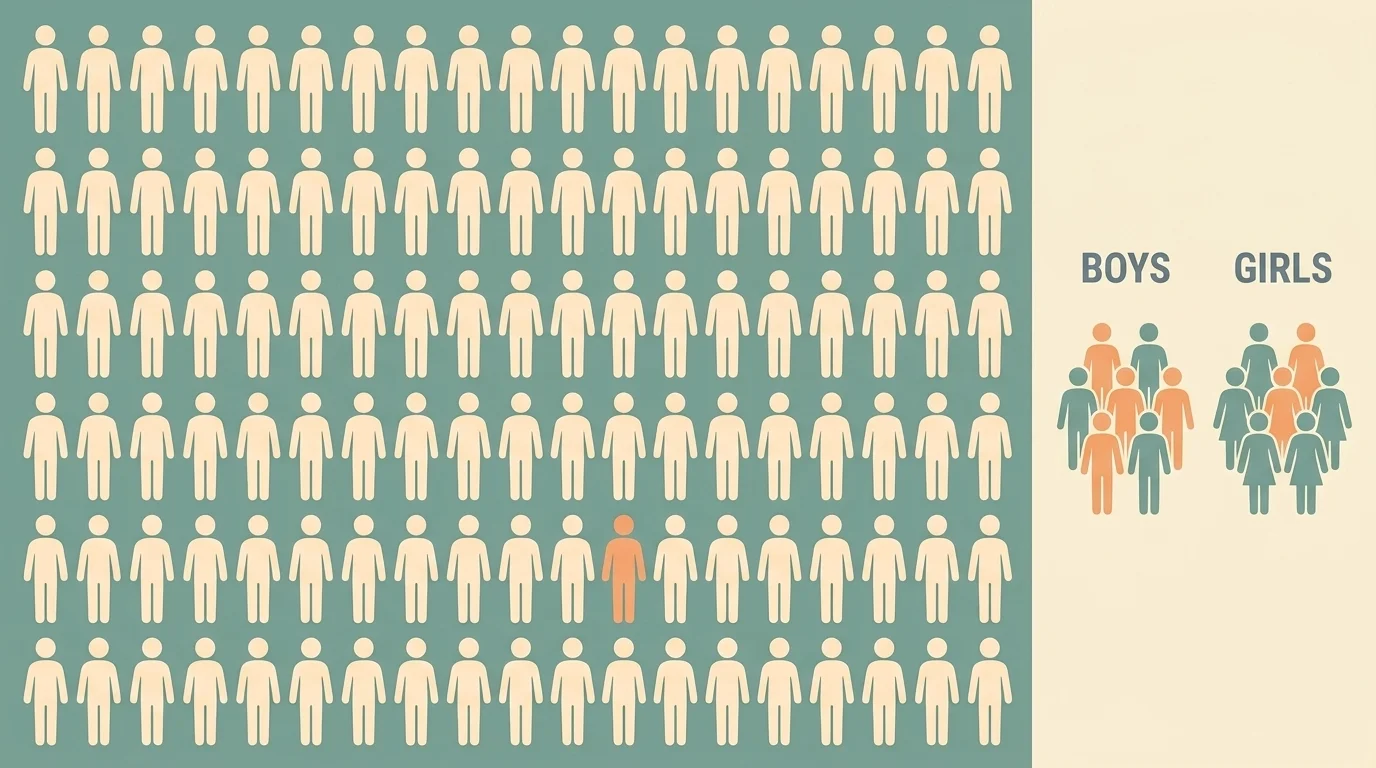
The pattern is sharpest in women and girls. The CDC's 2025 figures put autism identification at about 1 in 31 children aged eight, and at roughly 1 in 20 boys against about 1 in 70 girls — a gap of more than three to one (cdc.gov). The leading explanation for that gap is masking — and I want to be exact about its standing, because it is an explanation, not a measurement. The National Autistic Society puts the hedge exactly where it belongs: autistic girls "might seem to have fewer social difficulties than autistic men and boys, but this could be because they are more likely to 'mask' their autistic traits (though the stress of doing so can result in anxiety and overwhelm)" (National Autistic Society). Girls more often watch, copy, and cover, so their autistic traits get read as shyness, anxiety, or simply being "sensitive." How much of the gap that accounts for, nobody has established — the surveillance counts the difference; it does not explain it. What is not in doubt is the result: a generation of women reaching a diagnosis in adulthood. We follow them closely in our piece on being autistic in adult women, and on the executive-function load that a lifetime of masking can quietly run up.
Traits and Signs: "Which One Am I?"
A lot of people arrive at this comparison not to settle a taxonomy but to ask a quieter question about themselves. The traits once gathered under "Asperger's" are recognisable enough: deep, focused interests; a different relationship to small talk and the unwritten social rules; sensitivity to light, sound, or texture; a preference for routine and a real cost when it breaks. Read as differences rather than defects, they describe a way of meeting the world, not a fault in it.
But a list of traits is not a diagnosis, and this is the one place I want to be unambiguous: recognising yourself in a description is a beginning, not a conclusion. Only a qualified clinician can assess and confirm autism, and self-recognition — valuable as it is — is a reason to seek that assessment, not a substitute for it. Resist, too, the pull of the "which is worse" framing the search box will offer you; the honest question is never worse or better but what support would help here. One nearby tangle is worth naming and then leaving alone: autism and ADHD can overlap — the combination now often called AuDHD — which is why traits can point in more than one direction at once. That is its own subject, and we treat it separately in our guide to autism and ADHD in adults.
The Part Worth Sitting With
Go back to the building. The wall came down in 2013; the second wall, in the world's other manual, came down in 2022; and by every clinical measure the work is finished and correct. There is one spectrum, described by support, and asperger vs autistic is a question the medicine answered years ago. That part is closed.
The other part is not, and I do not think it is meant to be. A name is not only a code — it is a place people have lived, and some of them have kept the address on the door. The medicine settling the question and the identity outliving the diagnosis are not in contradiction; they are two different kinds of true, and holding both at once is, I think, the whole of the grown-up answer. If you came asking which one you are, that is worth sitting with — and worth taking to someone qualified to help you look. When you are ready to read further, our culture desk keeps going where this leaves off, including, for the reader who arrived quietly asking about herself, our piece on being autistic in adult women.
Frequently Asked Questions
Asperger's is now called autism spectrum disorder — specifically Level 1 autism, the support level that indicates the lowest day-to-day support needs. Since the DSM-5 in 2013, clinicians no longer diagnose Asperger's as a separate condition; the traits once grouped under that name are understood as one part of the broader autism spectrum.
Level 1 autism is roughly the same as what people mean by 'high-functioning autism,' and both overlap with former 'Asperger's' — all three point to lower support needs. Clinicians now prefer support-level language, because 'functioning' labels flatten a fluctuating reality and can read as a judgement on a person's worth rather than a description of the help they need.
You can no longer be newly diagnosed with Asperger's today. Since the DSM-5 in 2013 and the WHO's ICD-11 in 2022, clinicians diagnose autism spectrum disorder instead — both major diagnostic systems have retired the term, so no new Asperger's diagnoses are being written. People diagnosed before 2013 still hold that diagnosis, and many still use the name.
Asperger's is not really a 'mild' form of autism so much as autism with lower support needs — the more accurate and affirming reframe. 'Mild' undersells the real challenges involved, and support needs fluctuate with context: someone who copes easily in one setting may struggle in another. The better question is not how mild it is, but what support actually helps.