Autistic Learning Difficulties


Type "autistic learning difficulties" into a search bar and you get a small avalanche of pages that seem to disagree about the most basic thing: whether autism is a learning disability at all. Some say yes, some say no, and a fair number quietly say both on the same page. The confusion is not your fault. The phrase is doing at least three jobs at once, and most of the sites answering it are using the same words to mean different things.
Here is the boring version of this article, up front: autism is not a learning disability, it co-occurs with one more often than average, and it changes how a person learns whether or not a separate learning disability is in the picture. The rest of this piece is what that one sentence leaves out — how often the two actually overlap (with a current number and a source, not a recycled one), the specific ways autism shapes learning, and the accommodations that treat a difference as something to build around rather than a defect to correct.
Is autism a learning disability?
No. Autism is a neurodevelopmental condition, not a learning disability — but the two co-occur more often than average, and autism genuinely shapes how a person learns.
That is the whole answer in one breath, and each part is worth slowing down on. Autism is defined by differences in social communication and by restricted, repetitive behaviours and focused interests. It is a difference in wiring, not a measure of intelligence. As the UK autism charity Autistica puts it plainly, "Autism is not a learning disability. However, learning disabilities can co-occur at higher rates in autistic people compared to non-autistic people."
So why does the phrase keep coming up, and why does it keep making sense to the people typing it? Because autism creates real, describable differences in how someone takes in and works with information — differences that show up most visibly in a classroom. Those are genuine learning difficulties in the plain-English sense, even though autism itself is not the diagnosis called "learning disability."
There is a trap in that last sentence, and it is the reason half the search results contradict each other: the word "disability" means one thing in London and another in Chicago. Sort that out first, before any statistic, or every number you read afterward will be quietly wrong.
Learning disability, learning difficulty, or specific learning disorder? Sorting the terminology
Three terms, three meanings, and almost every page online swaps between them without telling you. Here is the disambiguation, US and UK side by side.
| Term | What it actually means | Who uses it this way |
|---|---|---|
| Learning disability (UK) = intellectual disability (US) | Reduced intellectual ability plus difficulty with everyday activities, starting in childhood and lasting for life — defined by what a person needs support with, not by an IQ cut-off | Autistica, Mencap, the NHS; the US calls the same thing "intellectual disability" |
| Specific learning disability / disorder (US) | A persistent difficulty with one academic skill — dyslexia (reading), dyscalculia (maths), dysgraphia (writing) — despite typical overall intelligence | US DSM-5 and IDEA; the UK folds these under the broad umbrella "learning difficulties" |
| Autism | A neurodevelopmental difference in social communication and restricted/repetitive behaviour — not a measure of intelligence | Everyone, in theory |
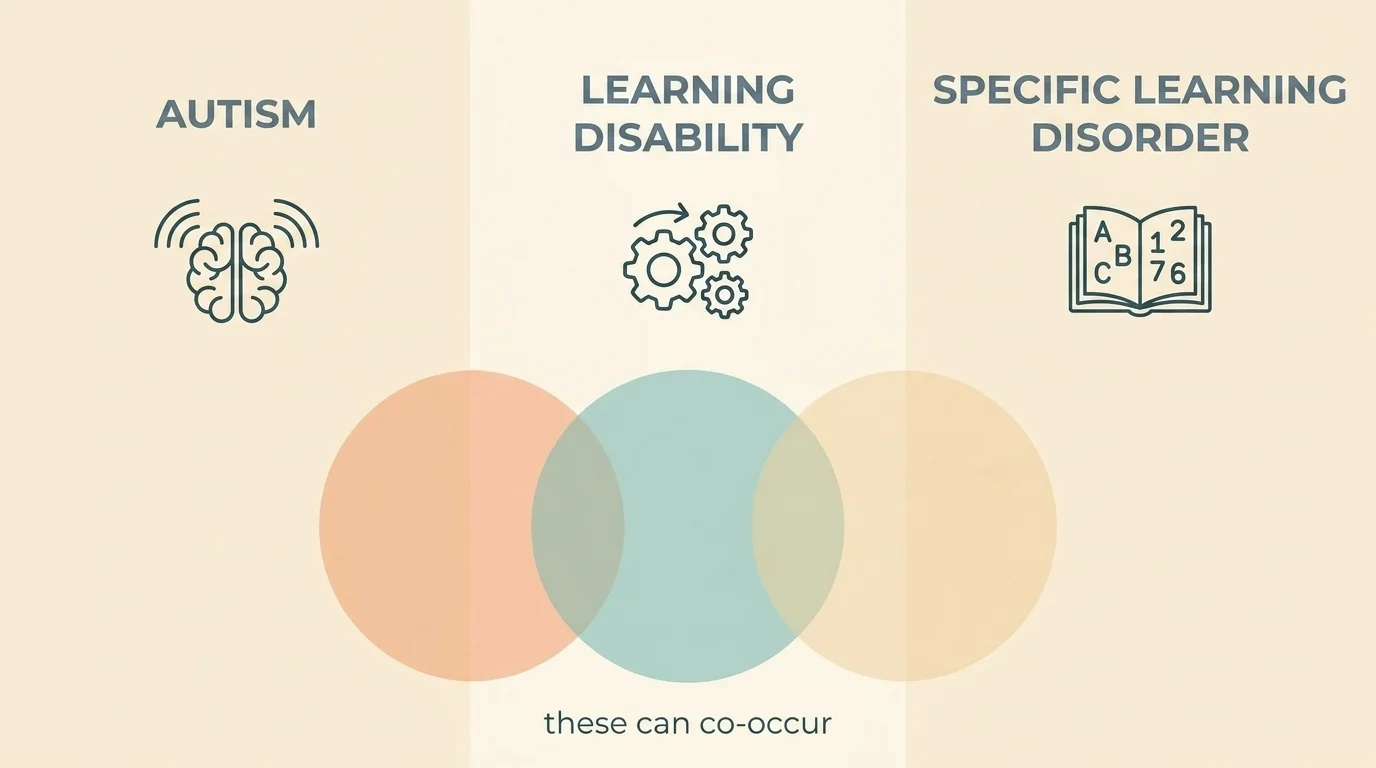
One caveat on that first row, because I had it wrong myself until I went and checked. You will read almost everywhere — and I had written it here — that a learning disability means an IQ under 70. The three bodies that actually own the UK term do not say that. Mencap defines it as "a reduced intellectual ability, usually identified soon after birth or in the early years," lasting "a person's whole life"; the NHS says a person with a learning disability "might have some difficulty" with "understanding complicated information," "learning some skills," and "looking after themselves or living alone"; Autistica names no threshold either. Not one of the three prints an IQ figure. The number is real, but it lives at the measuring end of this field rather than the defining end: the CDC surveillance that produces the headline statistic in the next section classifies intellectual disability as "IQ ≤70," because a study that has to count people has to draw a line somewhere. Definitions describe. Thresholds count. A page that swaps one for the other is making the same error as everyone else here, only in a lab coat.
Autism is neither of the first two. It can co-occur with either, or with neither. Keep this table next to you, because the single most common mistake in this whole topic is a sentence like "X% of autistic people have a learning disability" that never says which disability it means. In the UK reading, that sentence is about intellectual disability. In the US reading, it might be about dyslexia. Those are wildly different claims, and there is no reason to expect the same percentage to fit both. When you cannot tell which one a page means — and you often cannot — treat the number as decoration, not data. For how these labels sit alongside the autism spectrum and related terms, our life-skills guides go slower.
How often do autism and learning difficulties actually co-occur?
Here is a number that deserves to be more current than the one you usually see. The most recent CDC surveillance — the ADDM Network's 2022 data, released in April 2025 — found that 39.6% had a co-occurring intellectual disability. That is the figure to use. It quietly retires the "1 in 3" you will find on nearly every competing page, which traces back to older UK data.
Now the asterisk, which nearly every page carrying this number drops — including, I notice, the ones that copied it from the press release. That 39.6% is not "of autistic children." It is of the autistic eight-year-olds who had cognitive-ability data on file: 5,292 of them, or 61.4% of the 8,613 the network identified. The other 38.6% were never tested, or their results never made it into the record. Whether they resemble the counted group is not something the data can tell you, and the CDC does not pretend otherwise. Having spent this article insisting that a number is only as good as the population it describes, I am not about to exempt my own headline statistic from the rule.
So anchor it properly. Autism affects about 1 in 31 (3.2%) of eight-year-olds in that same surveillance year, up from 1 in 36 in 2020. Of the autistic eight-year-olds with cognitive data, roughly two in five met the criteria for an intellectual disability. The other three in five did not — 24.2% in the borderline range, 36.1% average or above — a fact the loose "learning difficulties" framing tends to blur.
The same CDC data carries something almost no one else reports: the co-occurrence is not evenly distributed. Intellectual disability was present in 52.8% of Black, 50.0% of American Indian/Alaska Native, 43.9% of Asian/Pacific Islander, 38.8% of Hispanic, 32.7% of White and 31.2% of multiracial autistic children. I will not pretend to explain a spread from 31% to 53% in a sentence — it plausibly reflects differences in who gets diagnosed, when, and with what — but it is too large to round away, and worth knowing before you accept any single national average as your own child's odds.
For completeness, the older UK figure: Autistica, citing NHS data and Rydzewska et al. (2018), reports about 1 in 3 autistic people have a learning disability in the UK sense — meaning intellectual disability. Same phenomenon, older and vaguer count.
How autism affects the way you learn
Autism affects learning through differences in information processing, executive function, sensory experience and language — not through lower ability. Keep that last clause in view, because none of what follows is a claim about how much a person can learn.
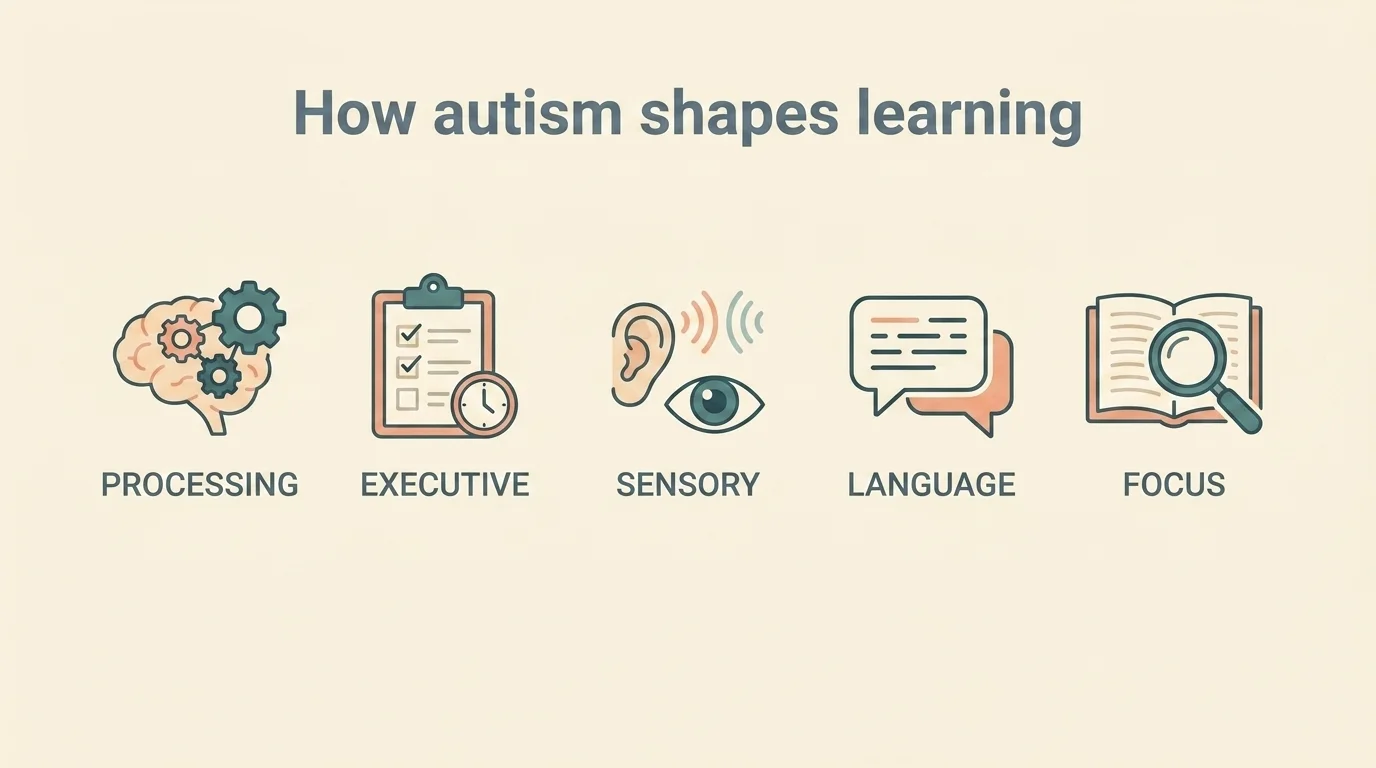
Information processing. Autistic learners take in and assemble information differently — a difference in route, not in ability. Abstract or verbal instruction is where that difference tends to show up.
Executive function. Planning, starting a task, holding several steps in working memory, switching between activities — these are the logistics of learning, and they are frequently harder, independent of intelligence. A learner can know exactly what to write and still be unable to begin. We go deeper on this in our guide to executive function.
Sensory processing. A flickering light, a scratchy chair, the hum of thirty other children — for many autistic learners these are not background. They are a tax levied on attention before any learning happens. Treating sensory load as a discipline problem gets the causation exactly backwards.
Language and generalisation. Literal interpretation is common: idioms, sarcasm and vague instructions ("show your working, use your judgement") land differently. And a skill demonstrated cleanly in one room does not automatically transfer to the next — generalisation has to be taught, not assumed.
Focus and retention. Focus and retention belong on this list — but the confident version you will read elsewhere (deep focus on the favourite subject, nothing left over for the imposed one) is not something I can put a source and a year against. Worth watching in a specific learner. Not worth stating as a rule about autistic people.
The specific autistic learning difficulties: reading, maths and writing
The mechanisms above show up as concrete difficulties in specific subjects. The word "specific" is load-bearing: these can sit right next to typical intelligence, which is exactly what the US term specific learning disorder is built to capture.
Reading & comprehension (including hyperlexia)
Some autistic children decode text early and fluently — a pattern called hyperlexia — while comprehension lags well behind. The reading looks advanced, so the gap gets missed: a child who reads a paragraph aloud perfectly may not be able to say what it meant. Support: separate decoding from comprehension in your head, pre-teach vocabulary, and scaffold meaning explicitly with questions and visuals rather than assuming it arrives free with fluency.
Maths (dyscalculia overlap)
An autistic learner can be strong with rules and patterns and still struggle with abstract number sense, or with word problems where the maths is buried under language. Dyscalculia — a specific difficulty with number — can co-occur. Support: concrete manipulatives before abstract notation, and chunk multi-step problems so the working-memory load does not sink the arithmetic.
Writing (dysgraphia, organising ideas)
Writing stacks demands: the motor act of forming letters sits on top of sequencing ideas into an order. Dysgraphia — the specific learning disorder named for writing — can co-occur. A learner can have plenty to say and no route from thought to page. Support: graphic organisers to externalise the structure, plus scribing or assistive technology so the motor cost does not erase the ideas. Structured visual supports and structured tools help across all three subjects.
None of these is a ceiling on ability. Each is a specific difficulty with a specific accommodation — which is a far more useful thing to know than a diagnosis in the abstract.
Supporting autistic learners at home and in the classroom
What makes the classroom harder
A mainstream classroom is, from a sensory and executive standpoint, close to a worst-case environment: unpredictable noise, frequent transitions, instructions delivered verbally and fast, and group work that runs on unwritten social rules. None of this is about capacity. It is a setting built for the median nervous system, handed to a learner who does not have one.
Visual, structured & chunked supports
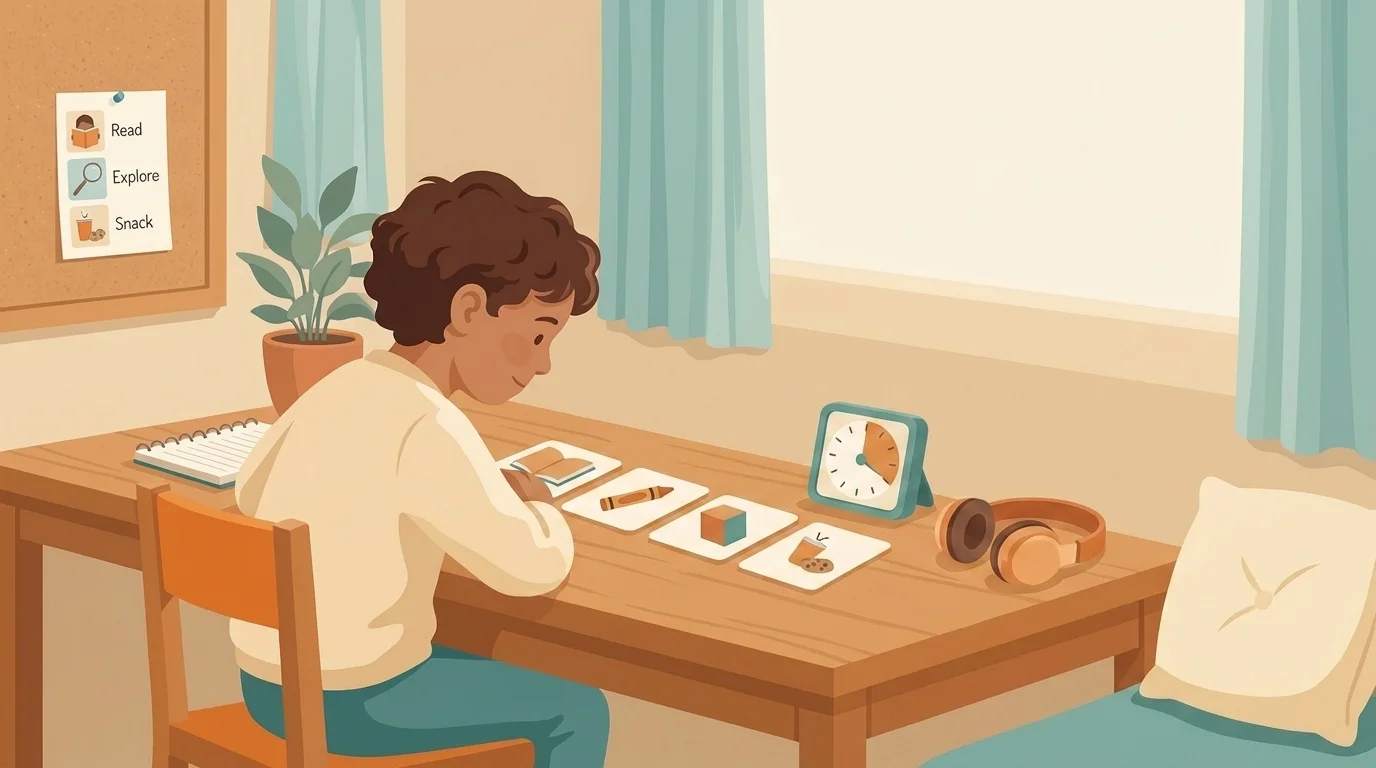
The reliable moves are dull, and they work. Make the day visible with a schedule. Break tasks into chunks with a clear finish line. Keep routines predictable so working memory is not spent on "what happens next." Practitioners who work with autistic students reach for the same toolkit again and again — visual schedules, captions, flexible seating, executive-function coaching.
None of this is folk wisdom. It has a name and an address: Structured TEACCHing, out of the University of North Carolina's TEACCH Autism Program, is built on exactly these four things — "physical organization, individualized schedules, work/activity systems, materials structure and visual supports" — described as "an antecedent-based approach … using visual supports to provide meaning, promote independence, and capitalize on the individual's strengths and interests." Antecedent-based is the load-bearing word: you change the conditions before the difficulty happens, rather than responding after it does. Universal Design for Learning, from CAST, makes the wider version of the argument — that "learner variability is predictable," so environments should be designed up front to "elevate strengths and eliminate barriers" instead of retrofitted child by child. The core idea under both is small: show the structure instead of narrating it.
Sensory accommodations
Cheap and high-yield: noise-reducing headphones, a low-stimulation corner to reset in, flexible seating, permission to fidget. These are not rewards or indulgences; they lower the sensory tax so attention is free for the actual work. Pair them with communication and speech supports where language is part of the picture.
The US support framework — IEP vs 504
In the US, two legal instruments deliver these accommodations. An IEP sits under IDEA, which defines special education as "specially designed instruction, at no cost to the parents, to meet the unique needs of a child with a disability" — and the regulations require the IEP itself to carry "a statement of measurable annual goals, including academic and functional goals". A 504 plan sits under Section 504 of the Rehabilitation Act, where an appropriate education can consist of "education in regular classrooms, education in regular classes with supplementary services, and/or special education and related services". The rough rule of thumb: an IEP changes what is taught and how, a 504 changes the conditions around it. But the same Department of Education guidance notes that implementing an IEP is one way to meet the Section 504 requirements — so the boundary is blurrier than most pages admit. Which one fits is a decision for the school team, not a search engine.
One honest limit before you act on any of this. I write about how systems and numbers actually behave; I am not a clinician, and this article is not an assessment. If you suspect a specific learning difficulty sitting alongside autism, the people who can actually identify it are a school psychologist, an educational psychologist, or a developmental clinician. Bring them the observations — the reading that outruns comprehension, the writing that stalls — and let them make the call. And build on the interests first: a bored learner is not a learner you are helping, and "engaging" is not a soft word here. It is the difference between a task that gets done and one that does not.
When learning difficulties get missed: verbal and "high-functioning" autistic learners
The learners most likely to fall through are often the ones who talk easily. Fluent speech reads as "fine," so difficulties with comprehension, organisation or sensory load get filed as laziness or attitude, and the support arrives late or not at all. Masking — the effort of looking okay — makes this worse.
"High-functioning" is a label worth retiring. It describes how visible a person's struggle is to you, not how much support they need. The more useful question is not how well someone functions but where, specifically, they need help. Diagnosis also skews toward boys, and girls in particular tend to be identified later — its own version of this same problem, which is why how autism can present differently is worth reading on its own.
Put plainly: a kid who can explain the water cycle out loud may still not be able to write the paragraph, and both things are true at once.
The environment fits the learner, not the other way around
So, the arc, resolved. Autism is not a learning disability. It co-occurs with an intellectual disability in about 40% of the autistic eight-year-olds the CDC was actually able to measure — the honest version of the headline — and it reshapes how a person learns regardless — which is what people are reaching for when they search "autistic learning difficulties." Every difficulty in this piece has a named, unglamorous accommodation, and the accommodations work. The goal was never a learner remade to fit the room; it is a room built to fit the learner. If you take one thing from here, take a single accommodation from the section above and try it this week — then browse the rest of our life skills guides when you are ready for the next one.
Frequently Asked Questions
The learning difficulties associated with autism cluster into a few areas: executive-function and sensory-processing challenges, difficulty with abstract or verbal information, trouble generalising a skill from one setting to another, and specific academic difficulties such as reading comprehension, dyscalculia (maths) and dysgraphia (writing). Autism itself is not a learning disability, but it genuinely shapes how learning happens.
Yes — you can absolutely have a learning disability without autism. The two are separate conditions that can occur independently, together, or not at all. A learning disability, in either the UK intellectual-disability sense or the US specific-learning-disorder sense, does not require an autism diagnosis — and in the UK sense, most people who have one are not autistic.
Autism affects learning in the classroom mainly through the environment rather than ability: sensory load from noise and light, frequent transitions, verbal instructions delivered fast, and group work built on unwritten social rules. Difficulty processing abstract instruction and generalising skills adds to it. Visual schedules, task chunking, predictable routines and sensory accommodations reliably lower those barriers.
No — autism is not an intellectual disability; they are distinct conditions. In UK usage 'learning disability' means intellectual disability, which adds to the confusion, but autism is a separate neurodevelopmental difference. They do co-occur, though: CDC data from 2022 found 39.6% of the autistic eight-year-olds with cognitive-ability data had an intellectual disability, so most did not.